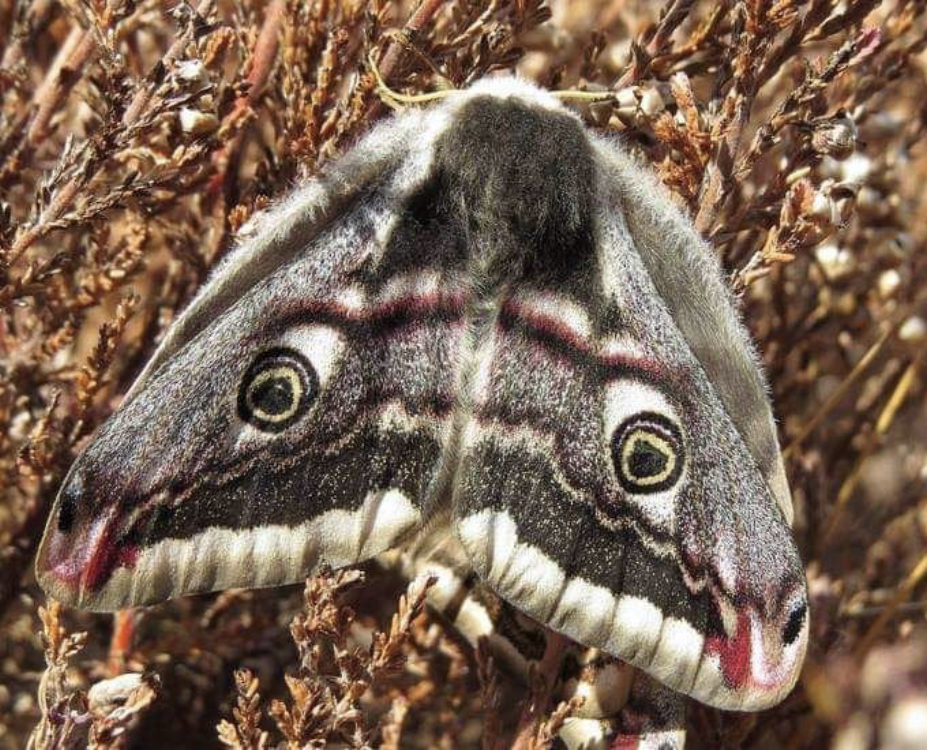
The Emperor moth, Saturnia pavonia is one of the most spectacular insects you could hope to see in the British isles and the only member of the Saturniidae family to be found here. The large ‘eyes’ on its wings give this moth its scientific name; ‘pavon’, which is Latin for Peacock, and it is indeed rather striking to find it looking back at you from the heather!
This moth is a day flyer and usually on the wing from April to June, as a species they are fairly widespread around the British isles and favour moors and heathland with plenty of young and old heather, they can also be found on established sand dune systems.

Striking eyespots
The Emperor is quite a large moth, with the female having a wingspan of 3 to 4 cm and the smaller male; 2.5 to 3 cm, what the male lacks in size, however, he more than makes up for with the dramatic and colourful spectacle of his wing markings.
On his upper forewings he has a pattern of brown, grey and orange markings, with striking black and yellow eyespots, reminiscent of the eyes of a bird of prey. His upper hind-wings also carry similarly striking roundrels set against an orange background.
The female moth also has prominent eye spots on her wings but lacks the male’s more colourful markings, instead hers are set against a background of grey, light brown, and white.

Irresistible pheromones
For the short period of the year that adult Emperor moths are on the wing they do not feed at all, as with the adult stage of a lot of insects their only purpose in life is to reproduce. While other flying insects such as butterflies will locate their mates by sight, most species of moth, even day flying ones like the Emperor, use their acute sense of smell to locate their partners.
The newly emerged female Emperor moth release pheremones that are irresistible to male emperor moths and then all they have to do is wait for potential suitors to follow this scent trail and come to them. The male, on the other hand has to fly frantically around the countryside , cutting across the wind to try and pick up the slightest hint of the female’s pheromones.
They can detect these pheromones from up to a kilometre away and just a few molecules detected by their feathery antennae can be enough to set them on a more determined course towards their prospective mate. The male has to hurry, however, as the competition for females is very fierce, so the first male to arrive has by far the best chance of mating.
Once mated, the female will take flight and find her caterpillar’s preferred food plants to lay her eggs upon, the variety of plant species that Emperor moths use is quite broad and includes Bramble, Birch, Hawthorn and Heather.

Caterpillars and Cocoons
When Emperor moth caterpillars have just hatched they are black and hairy and tend to gather together in close gangs at first, this is for mutual protection as at this stage they are vulnerable to being eaten by predators such as birds, indeed they are one of the favourite foods of the Cuckoo, which will stuff itself on then given half a chance!
As they grow up the caterpillars will gradually spread out from this protective huddle and eventually disperse across the moor completely, finding their own food plants to fatten up on, then the caterpillars turn bright green with black bands, and will grow orange or yellow projections from their skin, and each of these bumps will produce a small tuft of short black bristles.

Once they are large enough the caterpillars that survive spin themselves a silk cocoon, in which they pupate. This cocoon has an interesting one way exit system, with a ring of stiff outward-sloping bristles that makes it easy for the emerging moth to push its way out, while at the same time preventing unwanted intruders from entering.
The pupae will overwinter inside this protective, and insulating silk sleeping bag until spring, when, it’s metamorphosis complete, it emerges as an adult moth to begin the whole cycle over again.
A B-H
 Northwest Nature and History
6 thoughts on “The Emperor of the moors, Saturnia pavonia”