
The Lapwing, Vanellus vanellus, also known by various onomatopoeic names, most commonly ‘Peewit’ or ‘tew-it’ and, rarely, as the Green Plover, is resident to the British isles and in winter huge flocks (a group is called a ‘deceit’) can be seen on our coastal estuaries, mudflats and nearby farmland.
Enchanting and enigmatic
Lapwings are enormously enigmatic and enchanting wading birds, with a broad black band across their breast, bright white plumage on their underneath and a beautifully iridescent green and purple back they are very striking too. They have a unique and rather splendid crest, which is shorter on the female, and a distinct and unmistakeable manner of flight.

Flocks of Lapwing can be easily identified from quite far off by the ‘flickering’ effect the black and white underneaths of their wings create and they tend to flap their wings, which have quite a rounded tip to them, in a uniquely ponderous and rather languid manner.
This flickering, flapping flight gave the species it’s scientific name; Vanellus, which is Latin for ‘little fan’ and it is thought by some natural historians that ‘Lapwing’ derives from the Old English word ‘hleapewince’, which means ‘leap with a flicker’, the ancient Britons and other cultures held a belief, which still survives, that the arrival of the Lapwing invokes fertility, the rains and the health of the flocks.
Gregarious gatherings
The adult Lapwing is around 25 to 30 cm tall from foot to crest with a wingspan of 65 to 75cm, and the male and female are quite similar in appearance, although the male has a longer crest. Like lots of waders they are very gregarious and will gather together in vast flocks, along with other species such as Golden Plover, on estuaries, mud-flats and nearby farmland where they will hunt, in that peculiar stop-start motion which is particular to Plovers, for anything that moves, such as sand-fleas and other small crustaceans, beetles, worms and flies.

Spectacular spiralling swoops
Their winter flocks tend to have broken up by about February and by March they will have started heading inland to their breeding grounds, which will predominantly be open areas of closely grazed pasture land, spring-tilled farmland and moorland.
Here the male will engage in his display flights, which are a truly amazing and fixating spectacle to observe, he will fly in wide arcs and circles around his chosen courting ground before suddenly ascending high above the ground, after he has climbed high enough to proclaim himself to all observers he will then swoop, tumbling and turning towards the sward.
This can be frankly terrifying to watch as he plummets, spiralling, towards the earth, seemingly out of control like a Sopwith shot down by the Red Baron, but in reality the whole dance is perfectly choreographed and at the very last second he will pull up, mere inches from the ground, his wingtips brushing those of the grass, leaving you as breathless as he no doubt intends the observing female Lapwings to be!
Security in the sward
They choose areas of sward, ploughed fields and turf with low vegetation because, as with other ground-nesting species, they are vulnerable to predation from all directions and need to have a wide field of view. Tall grass and crops are anathema to the Lapwing, as is proximity to treecover and they prefer somewhere easily defendable to construct their meagre excuse for a nest.
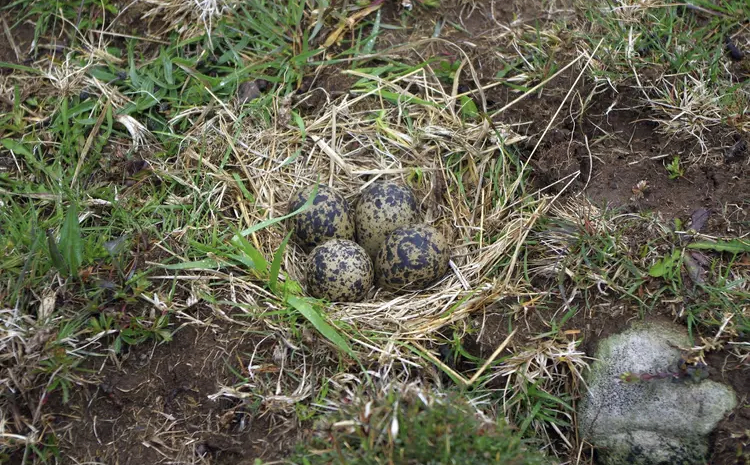
A Lapwing nest consists of nothing much more than a shallow scrape in the ground and here, from around about the end of March to the the beginning of July, the female will lay a clutch of 3 to 4 camouflaged eggs, these take about 26 days to incubate, the female being a very dedicated mother, and the chicks will emerge very well developed compared to those of other species, due to them being born on such exposed ground.

The laying period is when Lapwing are at their most vulnerable from predators and mankind in particular, as a loose dog can wolf down a whole clutch of eggs without its owner even noticing and the driver of a farm vehicle will be equally oblivious, even if the nest isn’t destroyed any keen eyed predators will now know of it’s whereabouts.
The young, however, are as well camouflaged as their eggs and are very mobile, able to hunt almost immediately and knowing to lie as still as a stone should their parents alert them to any danger. Both parents will aggressively defend against any intruder, no matter how big or fierce and, if needs be, will resort to feigning injury to draw attention away from their children, dragging one wing along the ground as if it is broken.
Sometime in July, when the young have completely fledged, Lapwing young and old, the young being identified by their shorter crests, will begin to move and congregate around their food-rich coastal grounds, with waves of migrant Lapwing joining them in winter from places as far away as Scandinavia and Northern Europe, here they will feed and move along with the tide, adding their call to the cacophony of the coast.
The Lapwing Act
Before the introduction of the Lapwing Act in 1928 Lapwing could be found for sale in markets throughout the country and their eggs were considered a delicacy and widely collected, but since this became illegal their fortunes are now tied to the agricultural land upon which they depend.
Decline reflecting changes in farming
Numbers have steeply declined over the decades, with sharper drops reflecting changes in agricultural practices, in the 40s and 50s the conversion of many thousands of hectares of pastureland to arable land through improvement methods such as draining instantly wiped out a lot of habitat, and the widespread adoption of pesticides as a cure-all simultaneously eradicated the Lapwing’s food sources.
Populations levelled off by the 60s but in the 80s further intensification and mass industrialisation of farming led to another dip in their numbers. Abandonment of the ancient practice of crop rotation and the introduction of better fertilisers meant that fields were left fallow (ploughed and unsown) for shorter and shorter periods, if at all, and crops would grow taller and earlier in the year, simply meaning that by the breeding season there would be fewer safe places for Lapwings to nest.
More recently a decline in numbers of many waders including Lapwing has been measured, and it is predicted that they will become effectively extinct in southern England and Wales, as they are now mostly found north of an imagined line passing through Birmingham and below this line it is estimated there are now only around 250-300 pairs.

Disturbance and dogs
More recent threats to Lapwing are from an increase in outdoor recreational activities, with dog walking proving to be particularly disturbing to them, the current fashion for rewilding and tree-planting is also a worry for conservationists who monitor other endangered ground nesting species too like the Curlew and Hen Harrier.
Lapwing are currently classified in the UK as Red under the Birds of Conservation Concern 4: the Red List for Birds (2015) and are a Priority Species under the UK Biodiversity Framework, on the IUCN (International Union for the Conservation of Nature) ‘Red List’ of Threatened Species they are listed as Near Threatened.
A B-H
 Northwest Nature and History
4 thoughts on “The Lapwing”