
The Cuckooflower
The Cuckooflower, or ‘Lady’s Smock’, has the scientific name; Cardamine pratensis, loosely translating as ‘peppery tasting herb of the meadows’ with Cardamine deriving from the Greek ‘kardamon’, meaning ‘pepper grass’, and the source of many plant names, especially ones used in cooking, and pratensis meaning ‘of the meadow’.
It is a very pretty, delicate looking perennial with large white, pink or lilac flowers and is usually found in damp meadows, ditches, riverbanks, and roadside verges. Its flowers, which rest on slender stems, will bloom throughout spring from March til June, with the peak time for seeing it flowering being in May, which coincides with the arrival of the first Cuckoos, hence its most widely used common name.
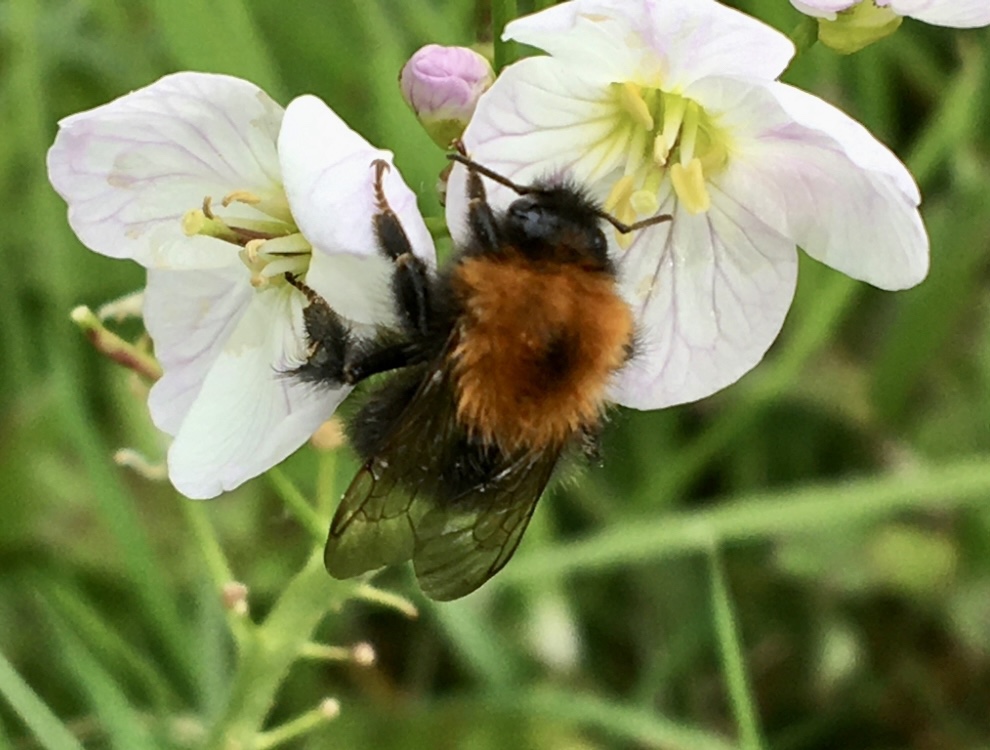
Although the plant appears to be extremely delicate, it is in fact quite tough and well able to withstand strong winds without its stems breaking, they also close at night or when it becomes overcast. Occasionally the flowers will appear bright white, which is something Shakespeare noted in his comedy, Love’s Labour’s Lost when he wrote; “lady smocks all silver and white, do paint the meadows with delight”. They are very popular with pollinating insects such as Bumblebees and a patch of them can be absolutely alive with bees and butterflies on a dry, sunny spring day.
It is a larval foodplant of the Orange-tip butterfly, which will soon be seen dancing along hedges and grasses in search of the four petalled flower. When a suitable plant is found, the female will lay a single, spindle-shaped egg on the underside of the flower buds, these eggs will turn a deep orange after a few days before the caterpillars emerge to feed on the developing seed pods.
Folklore
The Cuckooflower is associated with a lot of folklore and names. ‘Lady’s smock’ probably refers to the pale, pinkish and slightly cupped nature of the petals, which resembles the outer garment which ladies used to wear to protect their clothing while working. They are also called ‘milkmaids’, for broadly the same reason.
A lot of superstition surrounds the flower too, in Cumbria folklore tells of how a thunderstorm will break out if anyone picks it, and in some parts of the country picking it is meant to incur the punishment of a snake bite from an Adder, in other parts it is bad luck to bring the flower indoors.

Uses
Although considered bad luck in many parts of the country it is a very useful plant and has a lot of medicinal uses, such as curing stomach disorders and skin complaints, it has also been used as an antiscorbutic, which means something that prevents scurvy, as its leaves contain high amounts of vitamin C.
In cooking the younger edible leaves of the Cuckooflower have a peppery taste, which makes them a good substitute for cress in sandwiches and salads, it’s flowers are also edible too but they are so small it’s hardly worth picking them so it’s better to leave them for the bees and butterflies!
A B-H
 Northwest Nature and History
The easiest plant to reproduce from leaf cuttings. Basal leaves are best and can be rooted in damp compost or just in a bowl of water. Roots will form in a few days. We then propagate cuttings from the cuttings, easily producing dozens each year. A great plant to show children about making new plants.
LikeLiked by 1 person
Our garden is full of it, I try to cut around it when i mow the lawn, same with the Fox and cubs we’ve got growing everywhere
LikeLike