
The Early Purple Orchid, Orchis mascula, is, as its name implies, one of the earliest orchids to appear in the British countryside, flowering in April, all the way through to June. Its scientific name; mascula, derives from the shape of its tubers and roots which are, not to put too fine a point on it, masculine in shape.
Habitat
It is a perennial Orchid, so appears in the same locations every year and can first be seen emerging from the warmth of the soil around about February, where it’s long, heavily blotched, dark green leaves can be spotted lying flat against the ground in undisturbed places such as the damp edges of woods, the margins of meadows and old hedgerows. It prefers undisturbed, unimproved ground, such as at Dalehead Chapel in Gisburn Forest, where it grows in the graveyard.

The Early Purple can be a bit unpredictable about where it grows and, unusually for Orchids, which are known for being a very fussy order, they like both damp and dry habitats. They can be found growing right in the middle of some fields, especially if there are outcrops of Limestone, such as on the North Yorkshire moors, around Arnside and Silverdale and in a few places in Bowland and the Ribble valley. In these calcareous soils a white form of the Orchid may be found and they can form colonies which can be quite large.
Appearance
When the Early Purple emerges from the soil in spring, whether it be dry, damp, neutral or calcareous soil, it is very quick to try and develop and compete with its neighbouring plants for the spring sunshine. It will bud and flower as soon as it has developed leaves to gather enough energy and they can grow to be tall and elegant orchids standing proud above the lower vegetation by up to 2 foot high, and attracting lots of attention from pollinating bees, butterflies, hoverflies and other flying insects.
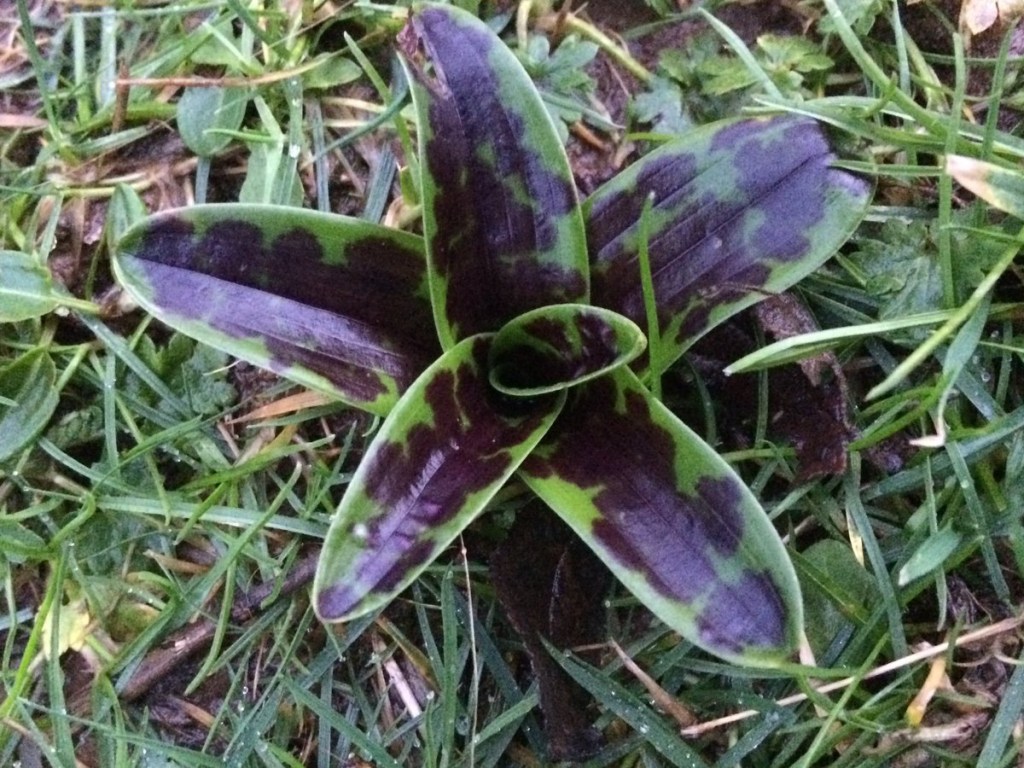
It’s leaves are unmistakeable, being quite large and glossy to look at, usually coloured dark green with darker blotches which can sometimes be purple themselves, there can be anything from 4 to 12 of these and they grow close to the ground. Further up the stem of the flower there might 2 or more smaller, and paler, leaves which end just where the stem starts to change colour from green to a dark brown or purple colour and from where the flower spike blooms.
The flowers are usually arranged in a loose spike around 4 inches tall and most commonly purple, although they can be pink or white, there can also be anything from 5 to 15 flowers in the spike. The individual flowers themselves are about 1 inch tall, with 3 lobes at the bottom and a bigger one at the top which forms a kind of hood, and when first bloomed have a very pleasant and unique scent which is quite similar to Lily-of-the-valley, this smell, however, starts to disappear when the flowers wilt and the plant no longer requires pollination and is replaced by an odour a bit more like that of un-neutered tomcats!

Uses
The Early Purple has several medicinal uses, including treatment of digestive problems, and is highly nutritious too. In the 17th century you could find ‘Salep houses’ throughout the towns and cities of the British isles and these sold a brew made from the roots of the Early Purple Orchid, called ‘Salep’, the dried roots were ground up into a yellow-white, starchy powder, with a sweet taste but unpleasant smell. Salep houses are still found in Turkey and parts of the Middle East and the drink is popular for being nutritious but also for having aphrodisiacal properties.
Ophelia’s robe
This Orchid is mentioned in Shakespeare’s Hamlet, in act 4, scene 7, when Gertrude, who is Hamlet’s mother and the Queen of Denmark sees the body of Ophelia and remarks upon the design of her robe; “Of crow-flowers, nettles, daisies, and long purples, that liberal shepherds give a grosser name, but our cold maids do dead men’s fingers call them…”.

‘Dead men’s fingers’ and ‘long purples’ are two of the many common names for the Early Purple, along with ‘adder’s meat’, ‘bloody butchers’, ‘red butchers’, ‘goosey ganders’, ‘kecklegs’, ‘kettle cases’ and ‘kite’s legs’ amongst many others. It is also believed by some that this orchid grew at the base of the cross and that the botched on the leaves symbolise drops of Christ’s blood, all in all it is a plant very steeped in folklore and has a very special place in the history of Britain’s countryside.
A B-H
 Northwest Nature and History
One thought on “The Early Purple Orchid”