
The Common Adder, Vipera berus, is locally common in the Northwest of England and can often be found in the summer sunbathing on paths in the woods or on the fells, it is one of only four species of snake in the British isles and the only species of snake that can be found within the arctic circle. It is also our only venomous snake.
Well-camouflaged
It is a very well-camouflaged snake, with a distinct dark zigzag that runs down the length of their bodies, as well as an inverted V shape on their neck. Male Adders are usually a pale grey while the larger females are a light brown and they can both grow up to two feet long, on rare occasions melanistic (black) adders can be found and leucistic (white) adders which are even less frequently seen, these oddly coloured snakes feature quite heavily in the folklore of the British isles.
The favoured habitats of Adders are rough grassland and heather moors with boggy areas nearby, they prefer to have a degree of cover but also exposed south facing slopes to sunbathe on. They also do not like being disturbed so will keep to areas of the moors and woods where fewer people visit, being very shy but also vulnerable to being stood on when they are torpid, cold and haven’t warmed up fully.
Although it is a venomous reptile, with hinged, hollow fangs capable of delivering venom deep into its victims flesh, the adder is recorded as having caused only fourteen fatalities since 1876 and none since 1975, the bites can have nasty effects though, including swelling, drowsiness, vomiting and diarrhoea, so you should always see a doctor straightaway. Also dogs should be kept on a lead all the time in areas where Adders might be found as its bite can be fatal to dogs.

Ectothermic
As it is ectothermic, ‘ecto’ meaning outside and ‘thermic’ meaning hot, needing to regulate its temperature to between 25 to 35°C, the Adder hibernates through most of the year, finding a deep, dry and draught-free spot under rocks, tree-roots or sometimes man-made things. I’ve disturbed two hibernating under a pile of corrugated tin sheets left by the side of a Pheasant pen and they have been found under paving slabs too. In spring, around May in the North of England, they will emerge and warm themselves up in the morning sun.
The male Adder is the first to rouse itself in the spring, as it needs to establish and defend its territory, also it will spend up to two months mainly sunbathing as it needs to get itself ready for the mating season. The males will spar with each other, rearing up in a kind of dance side-by-side and trying to force each other to the ground, once one male has forced the other to the ground they will wrestle each other until the loser gives in and escapes, the winner chasing after it until it has left its territory.
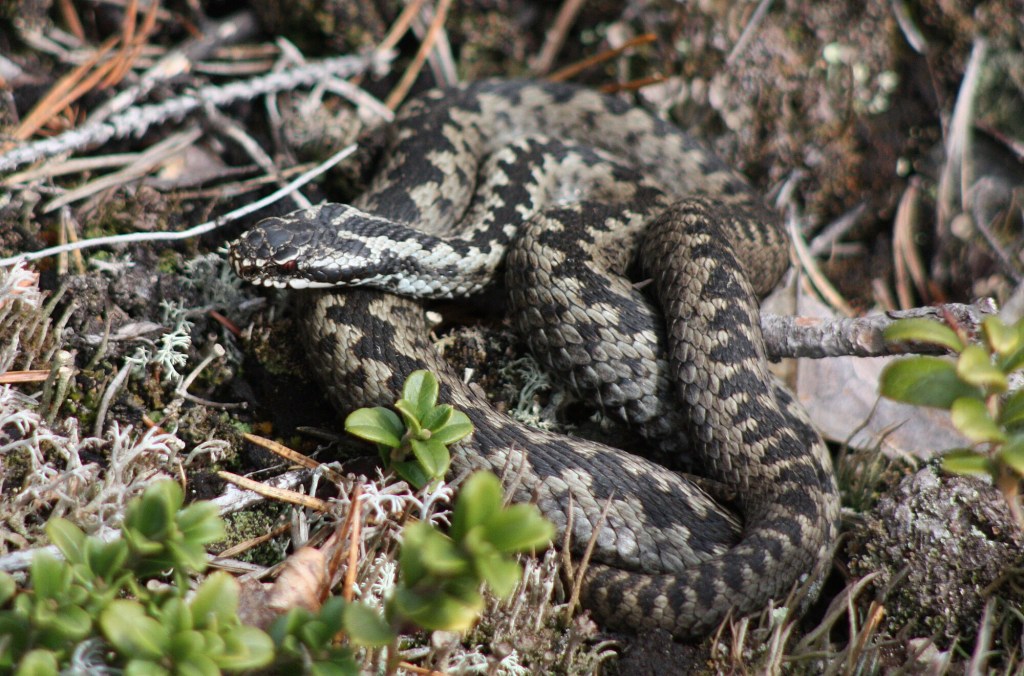
Efficient predators
After mating Adders will head down from the sunny slopes of the fells to the valley bottoms where they will hunt for most of the summer. Like all snakes Adders can sense vibrations through their skin and have a very keen sense of smell, flickering their tongue to capture molecules of scent and ‘taste’ the prescence of their prey. They will catch anything they can; frogs, newts, beetles, small rodents and the young of small birds. Efficient in every way like all reptiles the Adder will try to conserve its venom and will swallow smaller food like froglets, eggs and nestlings whole.
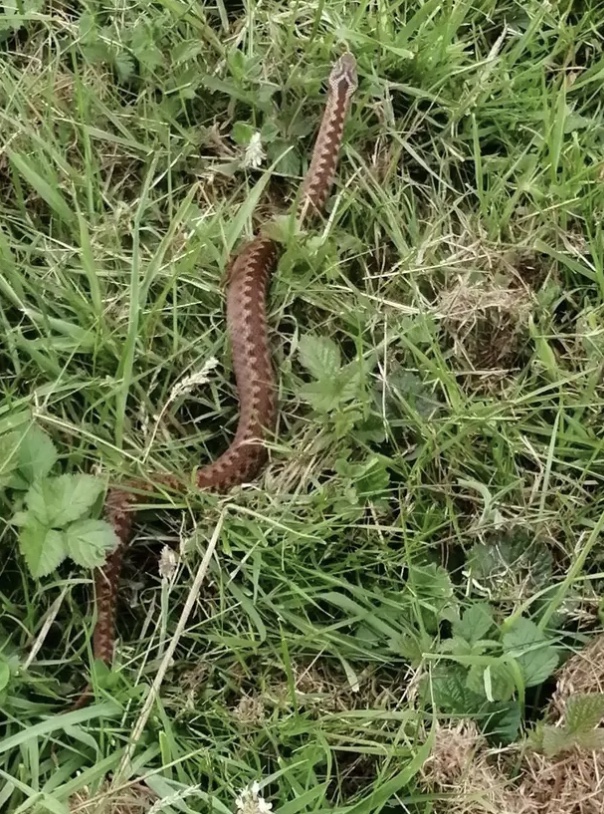
Ovoviviparous
After a long summer of hunting and building up energy reserves the female Adder, which like all Adders is ovoviviparous, the eggs hatching within the mother and the young born live, (the name ‘viper’ means ‘live born’) will give birth. Young Adders are called neonates and are born underground in August or September, they are completely independent and fully-formed, about 7 to 8cm long with microscopic fangs!, they will hibernate with the mother and father until spring when they first venture out in their own to hunt.
Adders take about 4 years to mature, and can grow to be quite old, some of the Adders you might see can be up to 40 years old, like all reptiles they will moult each year before breeding season and leave a perfect skin behind complete with the membranes over their eyes.
How you can assist the Adder
Please remember that we are of an infinitely greater threat to the Adder then it can ever be to us, there is no reason to fear this fascinating reptile and their habitat is being fragmented and lost at such a rate that they face a very uncertain future.
Even in those places you might imagine they would have some peace and quiet they are still at risk from disturbance, you can aid the adder by avoiding these areas or by helping your local wildlife trusts and other like-minded organisations create and preserve their habitat, here are a few you can contact;
Amphibian and Reptile Conservation Trust https://www.arc-trust.org/
Lancashire Wildlife Trust https://www.lancswt.org.uk/
The Woodland Trust https://www.woodlandtrust.org.uk/
A B-H
 Northwest Nature and History
5 thoughts on “The Common Adder”