
Bee Swarming
The period from May to July can be the hottest time of year and is often the hotspot for beekeepers being called out to deal with swarms of honeybees, which can occur almost anywhere in seemingly random places.
Very often the ‘swarm’ will turn out to be a Wasp nest, which can be removed by a pest controller (wasps are usually not aggressive though and very beneficial so give them some respect!) or Bumblebees, which usually nest underground and are harmless.
Very often the callout is made by somebody who is anxious about the insects posing a risk to their children or themselves if they are allergic to bee stings. You can find your local beekeeper by contacting the British Beekeepers Association.

What is swarming?
Swarming is the method by which honey bee colonies reproduce, it occurs when a group of bees seperate from their single, large honey bee colony and find somewhere else to settle and form a second colony.
For a bee colony to multiply, it must produce another Queen as a colony usually only has one queen bee present at any one time, this will take place when the colony is at its largest and the weather is hot and still enough for the swarm to depart from the hive en-masse and find another home.
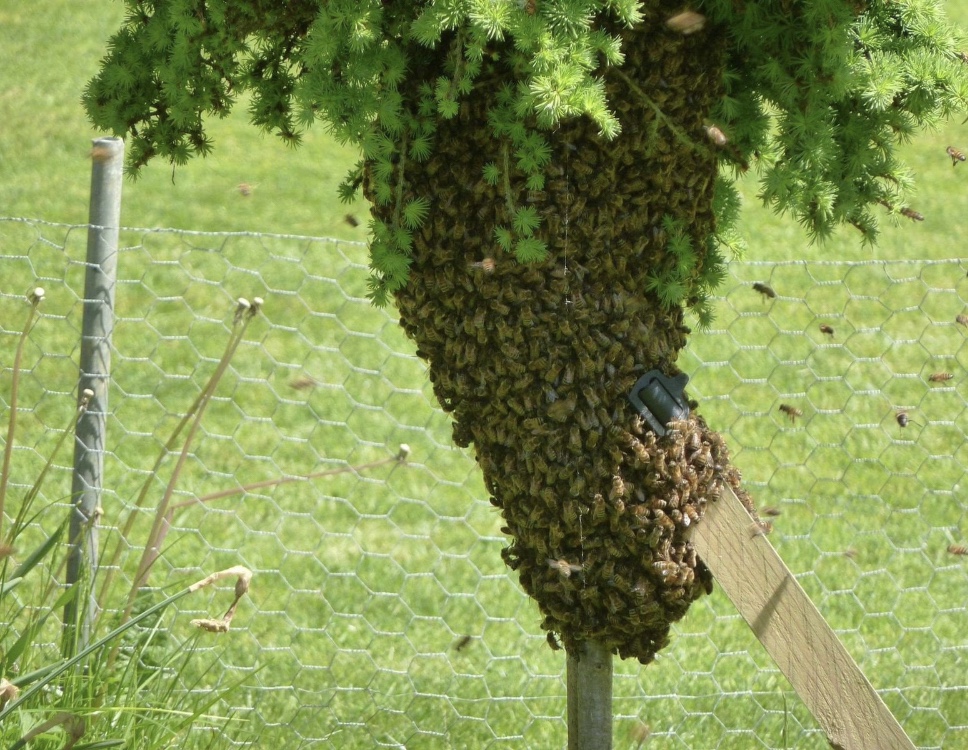
Seeking a new home
Honey bees start to prepare to swarm early on in the year, first scout bees, who are workers tasked with the job of searching the area around the colony for food, water and pollen start prospecting for, and memorising, possible sites for a new colony.
These scout bees can be seen in the spring investigating any likely nooks and crannies, including abandoned hives from years before, to see if they might make suitable accommodation.
For a new colony to even be considered a site has to tick several boxes; firstly it must be draught-proof, waterproof and otherwise sheltered from the elements. Also it must be big enough for the colony to occupy, and the scouts will take into account the future growth in numbers and the addition of collected stores into this equation.
Predation is a worry too so, like a pair of birds will choose a nest box with a narrow entrance hole that is far enough from the ground to avoid predators, so will the scouting bees.
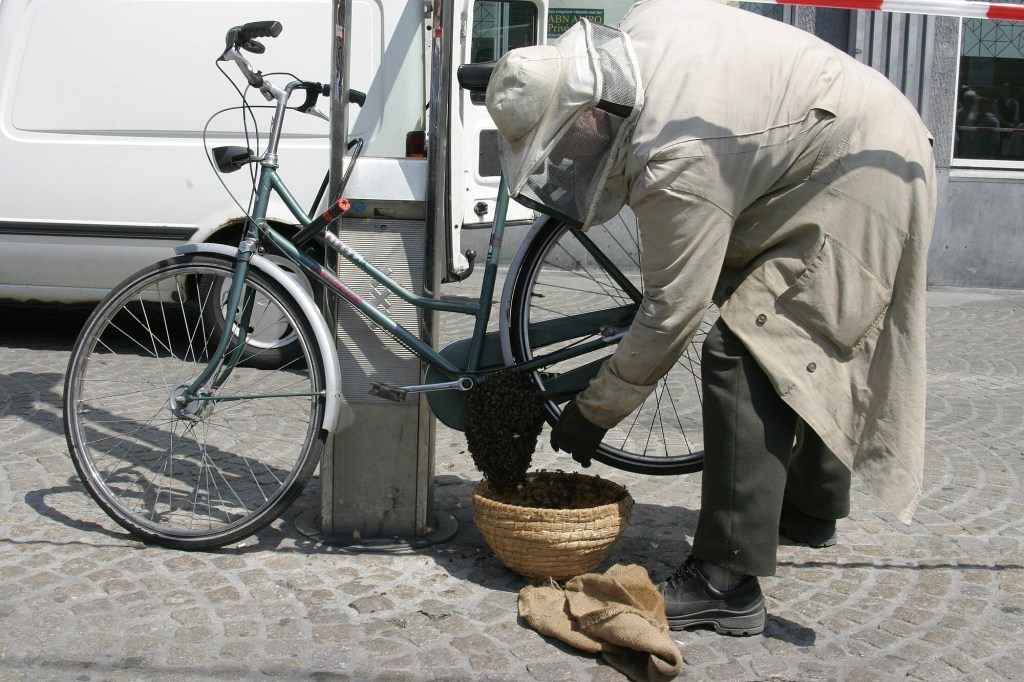
Catching a swarm
Beekeepers have long known that bees have very sensitive chemoreceptors, that is antennae, and prefer new homes that smell pleasant or familiar to them. So they might use similar psychological tricks to that which canny estate agents will use to entice people to buy new houses; by spraying air fresheners or walking around the property with freshly baked cakes or bread before a viewing, this makes you wonder if bees are on a par, intelligence-wise, with humans!
Swarms are quite often found in chimneys, where the smell of smoke is similar to the inside of their old hive after the beekeeper has smoked it out to calm them down before handling them.
Another place that swarms from man-made beehives will very often settle in are locations such as old houses, wall cavities, sheds and hollow trees which housed feral bee colonies at one time, even many years afterwards, as the pheromones of that colony will linger for a long time.
Beekeepers will check these places first if they find a colony has swarmed off, and if they can’t find the swarm they might use a ‘swarm trap’ or ‘bait box’ to catch them. In this the beekeeper will try a combination of odours with most having tried and tested formulas, one common fragrance which is widely used as an attractant is that of Lemon balm, which honeybees seem to like.
One thing that should be noted if a colony has tried to move into somewhere, is that due to the pheromones that remain another swarm is likely to occur there again, even within a few days of the first one.
So if you find a swarm it is worth allowing the beekeeper to place a baitbox nearby as they might move onto this instead. The beekeeper can take them away to his own beehives but if you want to you could attempt to catch the swarm and try your hand at being a beekeeper yourself as it is an enormously interesting and therapeutic hobby!

Talk to the bees
If you ever do decide to keep bees yourself it is essential that you talk to them every day, they are extremely intelligent, perceptive and sensitive creatures that observe, communicate and understand everything that goes on around them, your presence will be noticed and they will judge whether you are a threat or not by your behaviour.
If you become recognised by them as an innocuous being they will treat you likewise, if every time they encounter you they perceive you as quiet, calm and non-threatening they will react correspondingly. Like any other animal they will quickly learn to recognise your smell, appearance, movements and sounds, they will be wary if you suddenly seem like a stranger in any way; wearing the same clothes, walking the same route in the same gait, spraying the same deodorant, smoking the usual brand of cigarette, they will be wary of any change.
As they are extremely perceptive of pheromones, not only ones produced by insects but also those emitted by other animals, they will detect if you have recently been crying, ill, angry, happy or even if you’ve just had sex! It goes without saying that they respond better to the last two pheromone signatures more positively.
In the wild bee colonies will naturally be predated upon by animals such as Bears, Badgers, Foxes, Pine Martens, Woodpeckers etc and the CO2 breathed out by these labouring predators trying to gain access to the hive for the sweet, sweet honey and larva is something that evolution has taught them to be very cautious of. Bees are also susceptible to sub-sonic noises such as those produced by man-made machinery such as wind turbines motorways and power stations but will adapt and become tolerant if the sound frequency stays consistent.

This poem by Rudyard Kipling entitled ‘The Bee-Boys Song’ explains this in a manner way more succinctly than I ever could;
Bees, bees, Hark to your bees!
“Hide from your neighbours as much as you please”
“But all that has that happened, to us you must tell, or else we will give you no honey to sell”
A Maiden in her glory,
Upon her wedding-day
Must tell her Bees the story,
Or else they’ll fly away,
Fly away-die away
Dwindle down and leave you
But if you don’t deceive your bees
Your bees will not deceive you
Marriage, birth or buryin’
News across the seas
All you’re sad or merry in
You must tell the bees
Tell them coming in and out
Where the fanners fan
Cause the bees are just about
As curious as a man!
Don’t you wait where the trees are
When the Lightnings play
Nor don’t you hate where bees are
Or else they’ll pine away
Pine-away, dwine-away
Anything to leave you!
But if you never grieve your bees
Your bees will never grieve you.
A B-H
 Northwest Nature and History
One thought on “Honeybee Swarms”