
The Brown Hawker, Aeshna grandis is one of our largest dragonflies, it is also one of the commonest and most widely distributed, frequently seen throughout the British isles up to the limits of its range in the north of Scotland, the southwest and Ireland.

Appearance
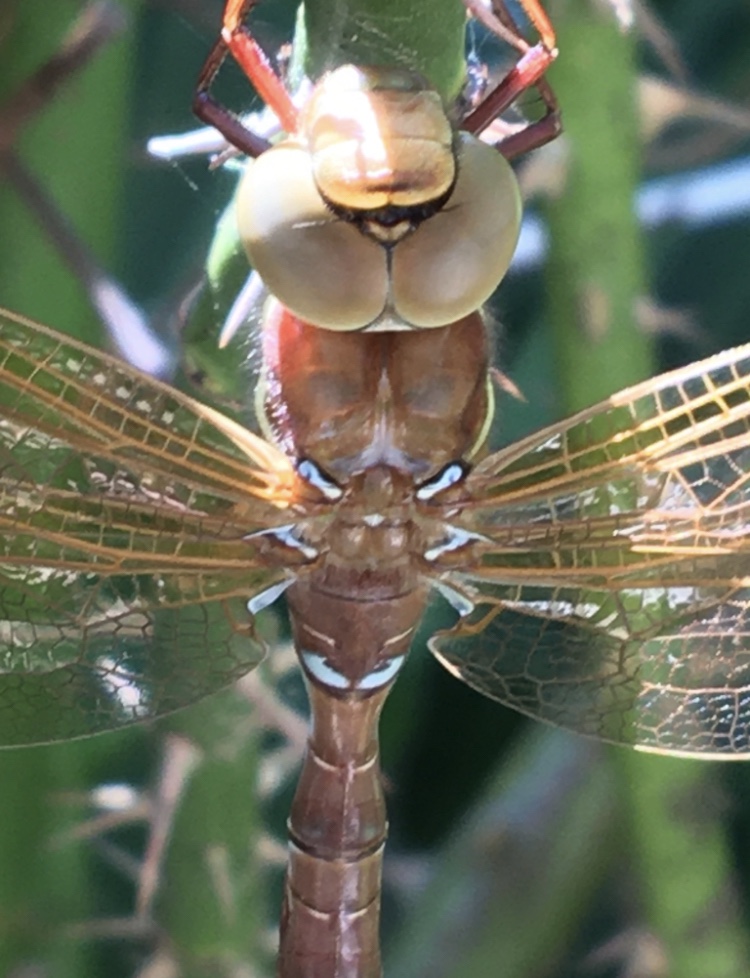
It is a very distinctive looking dragonfly with chocolate brown colouring, and quite large at up to 8cm long and with a wingspan of about 10cm.
Both the male and female are similar looking but the male can be distinguished from the female by the blue markings along his abdomen and the female by the yellow markings along hers, the adult male also has a prominent waist.
Both sexes have a blue spot on their eyes when mature and four light blue patches at the base of their wings.
Behaviour and territory
Brown Hawkers fly from around June to September and can be found along the edges of canals, marshes, reed-beds, ponds and other slow moving bodies of water, they are called hawkers because of the way in which they hunt, flying over wide areas and snatching their prey out of mid-air.
Their flight is very elegant too, as they alternate between quick, fluttering, bursts of power and slow languorous glides, they are highly manouverable and capable of hovering and can even fly backwards so are capable of taking down flying prey up to the same size as themselves, even including other dragonflies!
They are also a very territorial species of dragonfly, protective of their hunting grounds, defending them aggressively against any airborne intruders.
Breeding cycle
Female dragonflies lay hundreds of eggs during their lifetime and Hawkers lay a type of egg known as ‘Endophytic’, this means that they are elongated in shape and injected directly into plants, mud, or rotten wood near the water surface.
When the larvae hatch they are tadpole-like in appearance and have to find cover quickly to hide from predators. They grow up very fast though and soon enough become an apex predator in their own right, hunting by sight using their large, bulbous eyes to spot anything that moves. Prey include crustaceans, water snails, worms, other insect larvae, tadpoles, and even fish fry or small species of fish such as Minnows.
Over the course of larvae-hood the young Brown Hawker will moult up to 15 times, each time shedding its old skin to grow and develop, until it reaches the final moult which takes place out of the water.
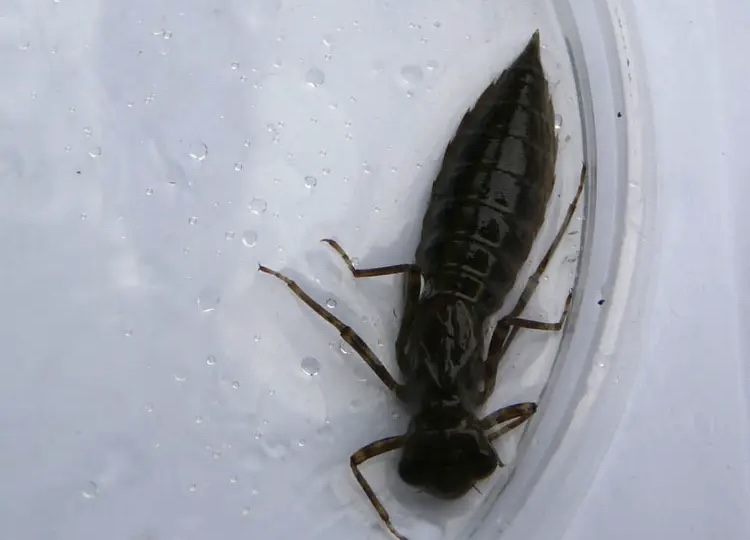
This final stage is triggered by temperature and day length and they will wait until night to carry out the slow and laborious process of emerging, to leave their last larval moult, called an exuvia, behind them and become an adult. After they have emerged they have to wait for their legs and wings to harden and this when they are at their most vulnerable to predation.
Newly emerged dragonflies are called Tenerals, and hunt around the countryside for about a week before they move back to water to breed.
Dragonflies can fly very long distances, given the right weather conditions, and in some years numbers of native Brown Hawkers are bolstered by visitors from the European mainland which fly all the way across the English Channel and North Sea.
A B-H
 Northwest Nature and History