
There are eight species of Ermine moth in the British isles with the Bird Cherry Ermine which, as you might have guessed, prefers Cherry trees, being the most common, the adult moths can look very similar and some can only be differentiated by the food plants they are found feeding upon.

Explodes in numbers
Every few years a particular species of Ermine moth explodes in numbers, with colonies of its larvae occurring in greater frequency across the country than usual and being more prominent.
These colonies can be quite startling in their size and big enough to strip a target tree of its leaves, the trees normally recover the following year though so it is not as drastic as it looks, next year the species will find another tree to spin their webs upon, recently this phenomenon has become more and more common.

Protective Shield
This web-spinning behaviour is called ‘tenting’ and only some species of moth are able to manage it, by co-operating and keeping close together the caterpillars are able to conceal themselves in a protective shield of dense, cotton-like webbing.
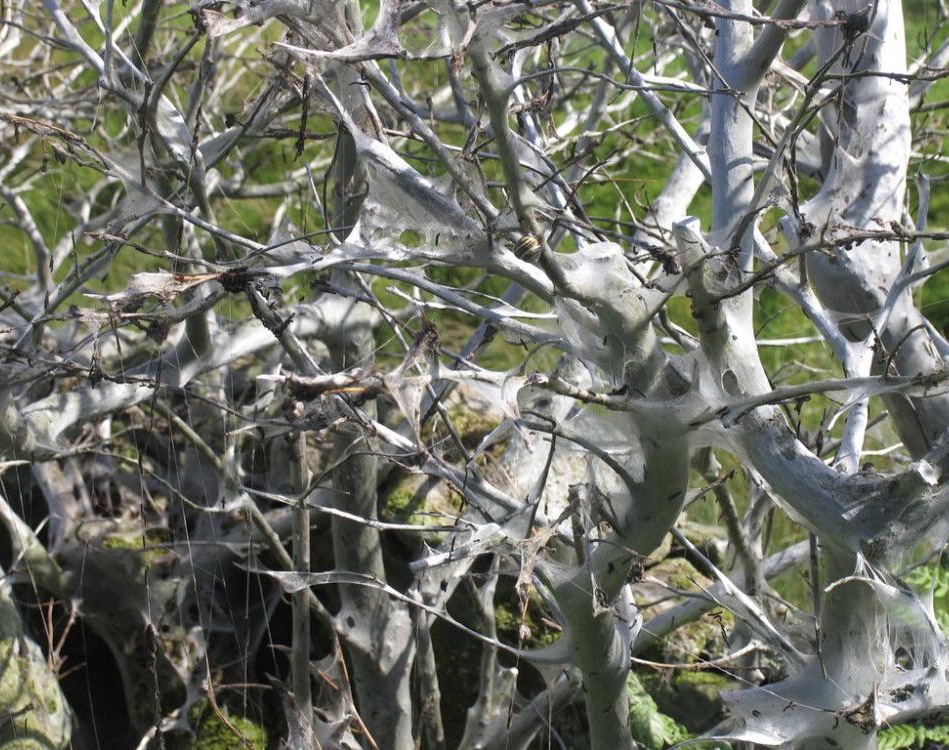
This veil confuses predators like hungry birds well enough to keep them at bay while the dense colonies of caterpillars stay put, safe within the drapes of white webs and gorge themselves on the leaves of their food plant, these webs can even become black with their droppings.

Eerie envelopment
This eerie envelopment will often cover whole stretches of trees and hedgerows, even covering nearby plants which aren’t food plants, occasionally objects like signposts and fences too, looking for all the world like someone has gone a bit mental and sprayed everything with one of those cans of cobwebs you can buy for Halloween!
However the trees will not be killed and will have recovered by the next year, by which time the caterpillars will find somewhere else to spin their webs. In the accompanying videos the a Spindle, Euonymus europaeus, which is a native deciduous tree, has been colonised and you can see a closer view of the caterpillars too (please excuse my whiny terrier in the background!)
Thoughts and Theories
One thought about why these swathes of webs can form so densely is that multiple females gather to lay their eggs on the same plant when other specimens of that species are scarce in an area, so there is no other choice, in the case of the Spindle here I know of no others in the area we found it. In parts of the country where increasing urbanisation has destroyed their food plants they might converge on the only ones left.

Another theory for why these colonies are becoming more common suggests that climate change is having an impact, as the eggs can survive better over the increasingly warm and humid winters, whatever the reason for the increasing frequency of this phenomenon it is always a very unique and fascinating thing to happen across when you are out walking the lanes and by-ways of the countryside.
A B-H
 Northwest Nature and History
One thought on “Ermine Moth Colonies”