
Water Voles, Arvicola amphibius, prefer the banks of slow-moving rivers, streams and lakes with plenty of cover and minimal disturbance.
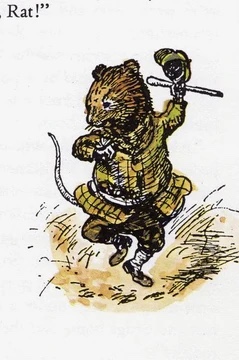
They are much larger than other voles, their bodies can be up to 20cm, with a long tail and short, brown fur, which means they are very often mistaken for brown rats, they have a blunt nose however, compared to the rats more slender face and, unlike rats, tend to shy away from human habitations. The character Ratty, from The Wind in the Willows by Kenneth Graham, was a water vole, and like their literary counterparts real water voles like a quiet life.
Messing about in the water
They spend most, if not all, of their time messing about in and around fresh water, as Ratty says to Mole; “Believe me my young friend, there is nothing, absolutely nothing, half so much worth doing as simply messing about in boats”.
Two signs that they are about are a faint ‘plop’ as you approach a pool as they disappear into it at the sound of your approach leaving only ripples, and a circular patch of cropped plants around their burrows where they have been grazing in the proximity of safety.
An ideal water vole habitat will have steep banks into which they can burrow to create their nests, where they will rear young from March to October, above the water table, and will have soft soils to dig in too. The best habitats will have continuous swathes of tall grassy vegetation to provide both food and cover, such as bulrushes and reeds.

One of our most threatened mammals
The water vole is one of our most threatened native mammals, here in the Northwest there are two locations I have seen them myself, both in the Forest of Bowland; the river Hodder and river Loud, which both have stable populations, they are also common around some of the more isolated ponds and splashes on the fell tops, where they burrow into the soft peat hags, nibble on the bogrushes and graze watercress in the clear streams.
The species has seen a dramatic decline in numbers over the decades and is now fully protected under Schedule 5 of the Wildlife and Countryside Act 1981. It is classed as a priority conservation species which means that intentionally capturing, killing or injuring water voles is illegal, as is damaging, destroying or blocking access to their places of shelter or protection, intentionally or by not taking adequate care at a site they are recorded as frequenting.

Reasons for decline
The reasons for this decline are, as with most endangered species, complex and manyfold but include:
Habitat loss and disturbance from development, it is required by law to hire ecological surveyors to carry out Water Vole evaluations.
Overgrazing, particularly where intensively grazed fields are not separated from rivers and streams by fences or hedges. Erosion from sheep and cattle hooves, disturbance from the noise and movement of the animals and overgrazing of the Voles food plants and cover can render a whole watercourse unattractive, this can be fixed by simply fencing off watercourses from cows and sheep.
Predation by Mink. Water voles have many native predators in the British isles but none really threaten the survival of the species. However the non-native American Mink is a highly adaptable and opportunist predator, and female Mink are small enough to follow voles into their burrows. A female mink which is hunting to feed its kits will be a major threat to nearby water vole colonies, luckily Mink numbers are dropping in the northwest due to concerted control programmes by Conservationists, Gamekeepers and Fishermen.

American Mink
American Mink are a highly damaging predator in the British isles, having been introduced accidentally through escapees from fur farms and release by well wishing animal rights activists, a Mink farm near Slaidburn was mainly responsible for their presence in the Hodder valley but this closed in the 90s. They have brought many native species, including the Water Vole, to the brink of extinction hence they are the sworn enemy of the Gamekeeper and Fisherman as well as the conservationist due to the havoc they can cause.
Gamekeepers use a contraption called a Mink raft to monitor and control Mink numbers, these are anchored, floating platforms with soft clay on them to record the footprints of Mink, when Mink are recorded a baited trap will then be placed.
Recently these traps original purpose has become almost obsolete and they have been repurposed as Water Vole monitoring stations, they are simply used the same way but of course traps aren’t used, they have recorded the presence of Water Voles in many parts of the area and some of the sites haven’t had Water Voles recorded at them before so hopefully this means that their numbers are finally on an upward trend again.
A B-H
 Northwest Nature and History
5 thoughts on “Water Voles”