
The month of September marks the end of Summer and the beginning of Autumn, a season of change and movement, when our days noticeably cool and our nights become longer. For many creatures this transition from Summer to Winter triggers ancient instincts which compel them to find safety and shelter from the cold and inclement weather which is sure to come.
One species which feels this need to move very keenly is the Golden Plover, Pluvialis apricaria, which gathers together now to form winter flocks and head down from their summer breeding grounds on the uplands to their wintering grounds on our coasts.
Golden Plumage
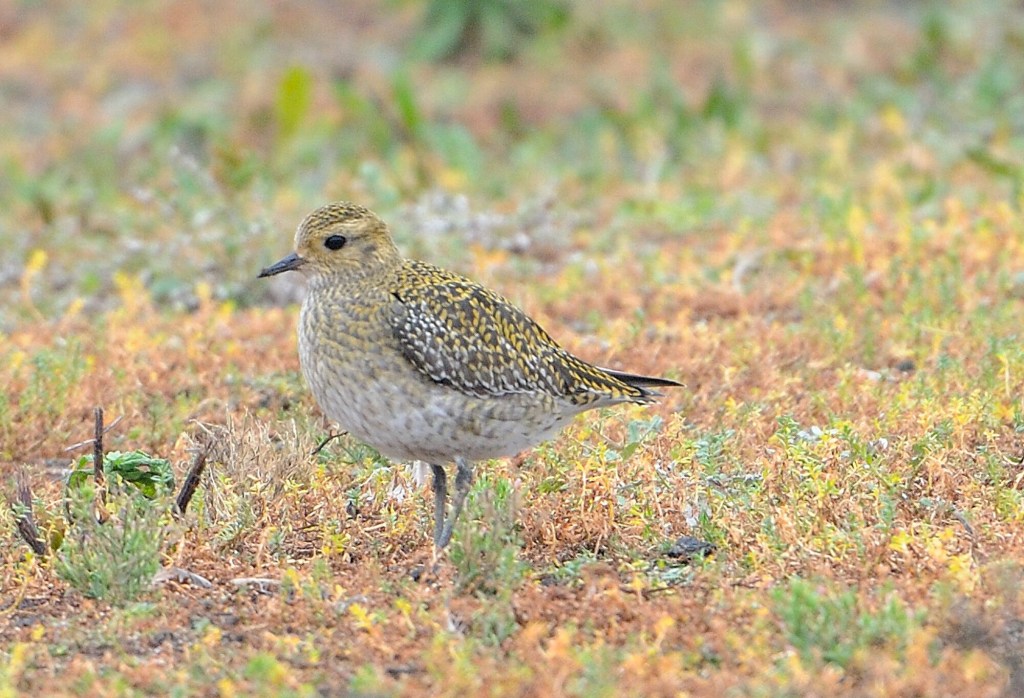
Golden Plover are a largish shorebird with narrow, pointed wings and a short bill and get their name from their striking, speckled golden plumage that strongly contrasts in the summer with its black front and face, which darken as breeding season approaches, with the males being darker than the females.
Outside of the breeding season the black plumage changes to buff and white and it can seem like an entirely different species. In appearance is does resemble the Grey Plover but can be differentiated by the white flashes it shows on the underneath of its wings when flying and by the lack of a hind toe, it is also smaller in size and more of an inland bird than the Grey.
From rain to sun
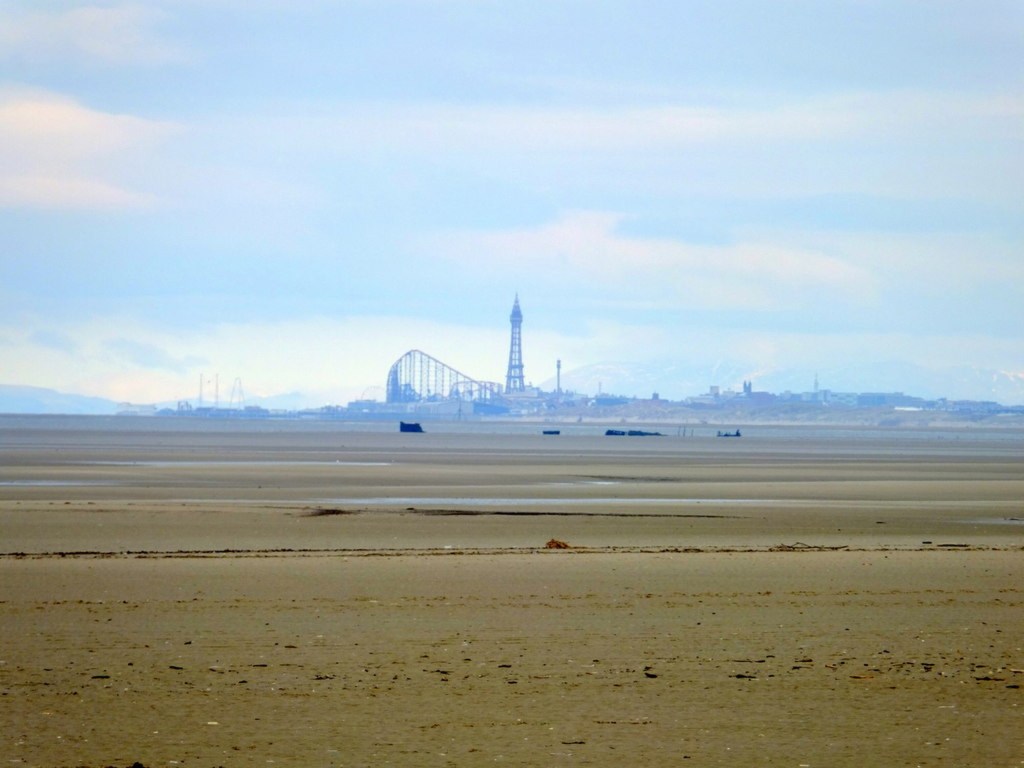
The scientific name of the Golden Plover comes from Pluvialis, meaning ‘to rain’, and apricaria, meaning ‘touched by the sun’, and describes its migratory habits quite well, as in the summer Golden Plover move from the coast to their sunlit upland breeding areas, but in the winter large flocks form on lower lying grassland, estuaries and coastal marshy areas to escape the winter rain and snow on the hills.
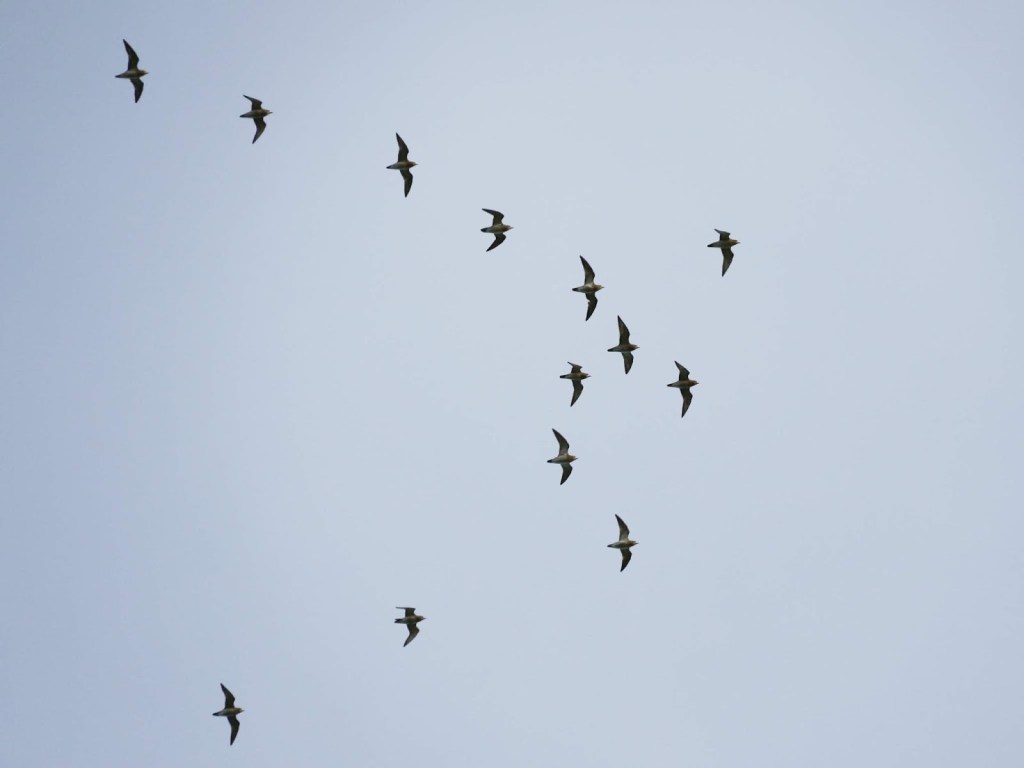
When migrating they can be seen flying in close, often v-shaped formation between the two habitats, quite often in mixed flocks with Lapwing, although they usually leave the slow flapping Lapwing behind as they fly very swiftly.
The species is resident in the UK, but numbers are swollen in the winter by visitors from further north and these mixed groups of local and migrant birds will hang out together in huge flocks on the same grasslands and marshy areas every winter.
Here they feed on any invertebrates they can find; grubs, beetles, worms etc, occasionally berries, seeds and some types of grasses. In the north they are known as the ‘sheep’s guide’, as they will notice the approach of humans very quickly and warn the rest of the feeding flock.
Magical to hear and observe
On the wing the gregarious Golden Plover calls constantly with a loud and far carrying “tooee”, and when the flock gathers to roost in the evening they indulge in elaborate aerial dances together, which can be magical to observe. When they have finally settled they all seem to murmur to each other before going to sleep, they can be nocturnal birds however if the skies are clear enough for them to fly and their plaintive call can be heard far above in the night sky sometimes.
When nesting the male will usually stand guard and issue a long, warning “toooee” if he spies danger such as a marauding Fox or loose dog, the latter being an increasing threat as more people take their dogs up to the fells in breeding season. When the threat has been deemed safe the male will notify the female, sitting tight and superbly well camouflaged on her nest, by giving a single, low “too”, call.
Breeding season
Golden Plover are very particular about where they nest and a male will display over a chosen nesting area and protect this with great vigour, wheeling and trilling in the air to attract a mate and defending against any intruders quite aggressively. The final site for the nest will be a shallow, cup-shaped scrape in a slight tussock intended to prevent water gathering in it and persuade sheep to walk around. The male will stand guard over the nest and try to lead a threat away if it approaches too close.
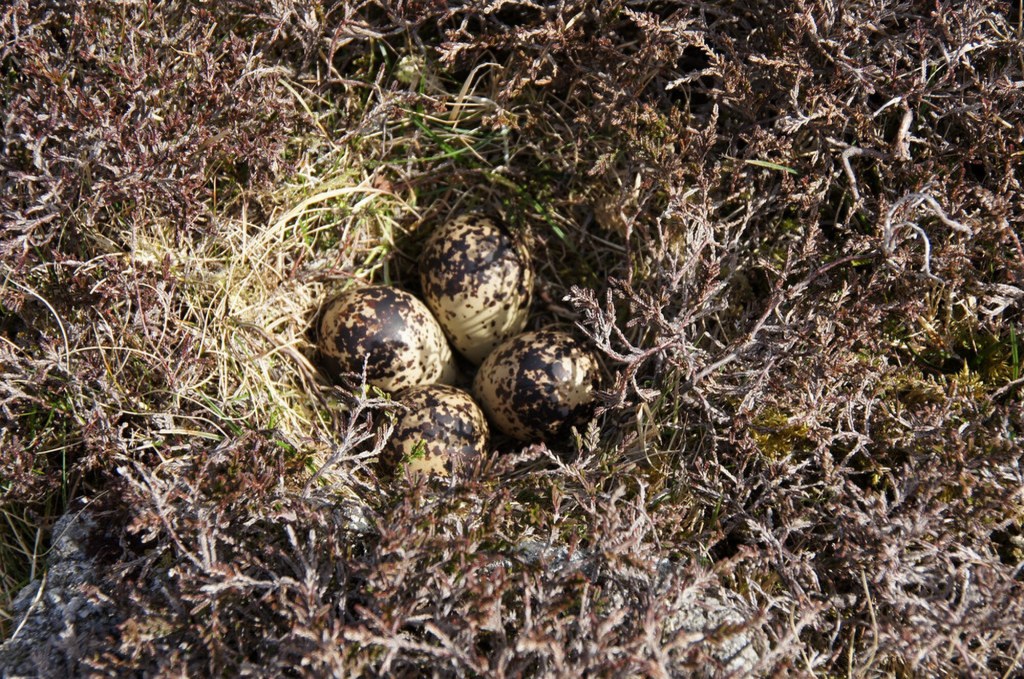
A pair of Golden Plover will produce only one brood a year, the hen laying about four eggs which she will incubate for about a month. The chicks, which are supremely well camouflaged, take 20 to 30 days to fledge and during this time predation by birds such as Crows, Gulls, various birds of prey, with Peregrine in particular having a taste for Plover and by ground predators such as Foxes, Weasels, Stoats and Mink can be a severe problem.
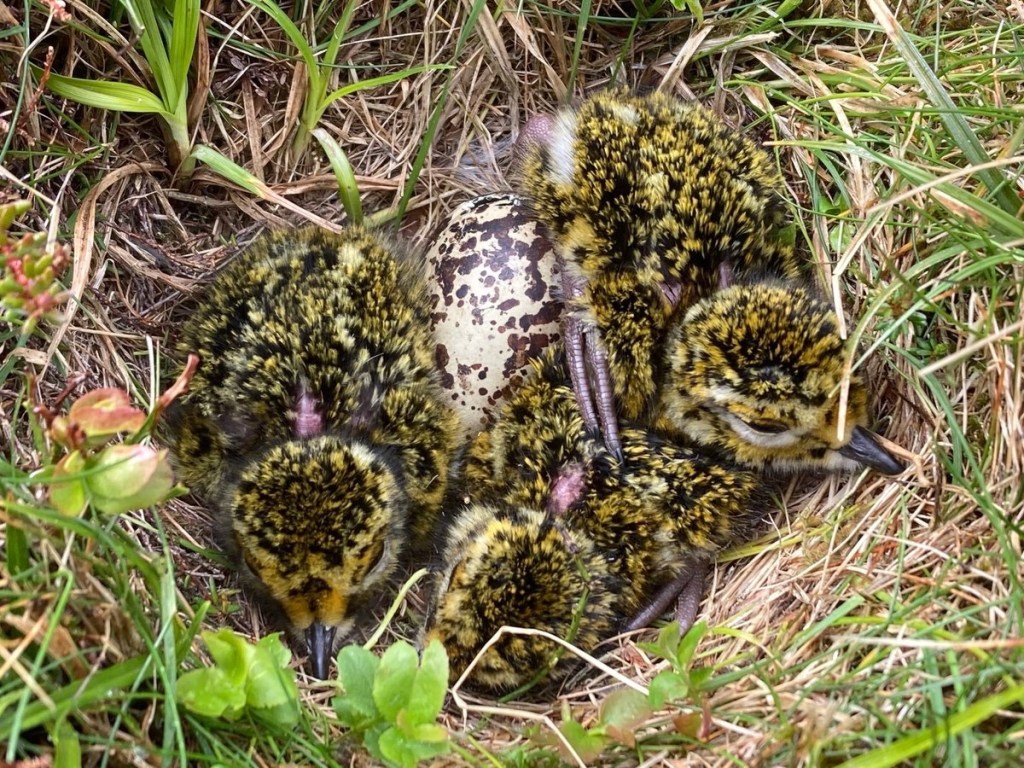
However, the main threat to ground nesting species like the Golden Plover is from changes in land use, such as drainage of the peat-bogs and marshes it needs, agricultural improvement and general disturbance from man. Their strict requirements for breeding territories do mean that a certain amount of management by man is needed to keep populations stable.
Pairs of Plover nest in heather and broods are found on patches of moorland where grass covers less than 1% of the area, they also require vegetation to be shorter than 15cm so often nest on patches of moorland where the heather has been burnt regularly.
This is so they can nest in peace and quiet and the male can safely keep an eye out for a distance around the nest without them being surprised by any predators using vegetation as cover to approach the nest, they also prefer the ground to be flat, with no more than 10 degrees of slope to it, wide-open and unenclosed by walls or hedges for the same reasons.
As well as threats from predators, disturbance and loss of habitat, there are concerns that Golden plover are becoming less able to breed successfully because of a lack of Crane fly adults and larvae. This is thought to be due to increasingly warmer springs bringing forward the hatching times of Cranefly and drying out the top few inches of peat that the larvae inhabit, the larvae and newly-hatched adults are an important food source for the chicks so if they hatch after the peak Cranefly hatch this can lead to starvation.
Read more about how crucial the Cranefly hatch is to breeding birds here;

It’s future
Despite all of these problems the Golden Plovers conservation status in the UK is green, signifying ‘of least concern’ and there are estimated to be between 38,000 and 59,000 breeding pairs, as its numbers are stable it is still a quarry species and can be shot between the 1st of September to the 31st of January, but shooting of them is rare and is not thought to have a significant impact on the population, though there are no British bag counts to support this theory, rather just anecdotal evidence.
Wildfowlers will occasionally take a pot-shot at passing Plover as they are considered to be a fine tasting bird and a challenging shot but on most Grouse moors they are not shot and in the northwest they are a rare and fleeting bird which land managers are trying to encourage rather than scare off.

Plover and the Guinness book of records
Golden Plover are enormously fast birds and in 1951 Sir Hugh Beaver, the owner of the Guinness brewery, overheard a shooting party vociferously discussing which was the fastest game bird. Upon realising that there was no official book of records to consult for the answers to such questions this inspired him to establish the Guinness book of records, with the first edition being released in 1955.
The question didn’t actually get answered in the book until 35 years later though when this vague and inconclusive answer appeared in the 36th edition which was published in 1989: “Britain’s fastest game bird is the Red Grouse Lagopus scoticus, which, in still air, has recorded burst speeds up to 58-63 mph over very short distances. Air speeds up to 70 mph have been claimed for the Golden plover Pluvialis apricaria when flushed, but it is extremely doubtful whether this rapid-flying bird can exceed 50-55 mph – even in an emergency”
A B-H
 Northwest Nature and History
5 thoughts on “Golden Plover”