
The Edible boletus, or King boletus, Boletus edulis, edulis indicating that it is edible and boletus coming from ‘clod’, as the round fist-sized caps of some of the most highly prized specimens are earth-coloured, is considered to be amongst the best edible funghi to be found in the world and is widely collected across the country.
In Italy it is known as ‘porcini’, Germany; ‘steinpilz’, and in France as the ‘cep’, as well as being popular amongst humans for its flavour and aroma, it is also highly sought after by wild animals with mice, voles, squirrels, badgers and wild boar all having a taste for its mushroomy flesh.

Identification
Its spore bearing fruits, which are only a fraction of the overall size of the whole organism, appear above ground in late summer and autumn and can reach over 30cm in diameter and over 3kg in weight. They can be identified by the shape of their spore producing apparatus, which is tube-like in shape, rather than gill shaped as with the traditional mushroom you or I might imagine.
These tubes, or pores, produce spores when the fruiting body is mature, by which time the underneath of the body, called the pore surface, has become a yellow-green, but when immature this surface is creamy-white in colour. The stem of the body is also a pale colour and can reach over 30cm in length and over 20cm in width, its surface is covered in a raised, fibrous pattern.

Habitat and Ecology
The edible boletus is an ‘ectomycorrhizal’ fungus, meaning it has a symbiotic relationship with the species of plants whose roots its mycelium grows entwined with. In this case the edible boletus grows within the root systems of more than 30 plant species, 15 of which are broadleaved and coniferous trees. These include Beech, Birch, Fir, Oak and Spruce, there is also a species of edible boletus which grows with the Alder, called the Alder bolete, Gyrodon lividus, and several others which specialise on one species of tree only.

Bolete years
Last week, whilst out foraging and generally rootling about in the woods above where I live, I found several soup-bowl size boletus caps which were supported on stalks about as round as my fore-arm. I’d got to them just as they were passing their finest moment and they were beginning to go soft, which is the stage before they start to become mouldy and inedible, to humans anyway.
I always count myself lucky when I find a decent size edible bolete which is in good condition as they are a very delicious and meaty mushroom, enormously versatile, in fact they are widely considered to be among the tastiest edible fungi in the world, especially in ‘mycophilic’ countries, such as France, where you can take a mushroom to the local pharmacy to find out if it is edible or not.
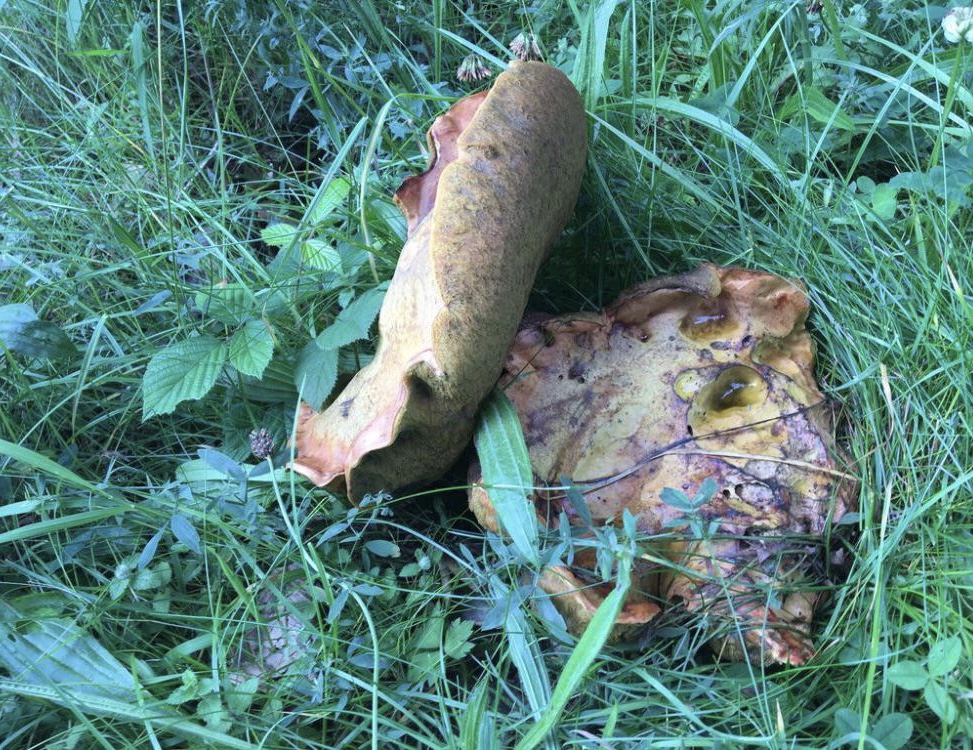
Indeed the market for this funghi on the continent in countries such as France, Poland and Spain and elsewhere around the world is so huge that some estimates for the total worldwide consumption of this species are put at over 20,000 tons, all this is harvested from the wild though as it cannot be cultivated due to the sporadic nature of its appearance.
In some years the edible bolete might not appear at all, in others it might emerge earlier or later, it seems to be intrinsically tied with the weather, those years with above average rainfall may result in the emergence of large numbers of boletes, these years are known as ‘bolete years’ on the continent.

Preparing and eating
Porcini may be cooked freshly gathered from the woods, making sure they are cleaned first or, to make them last longer, they can sliced very thin, dried until crispy and then put in jars with the lids screwed on tight. When left for a while, the aroma that is released from the jar upon opening will bowl you over, but in a good way! And a spoonful of this added to the ingredients of a pasta dish, risotto, moussaka, omelette, soup or casserole will enhance its flavour enormously.
A note of caution
There are many kinds of Boletus, most of them delicious, but some can cause stomach upsets and illness, none are deadly and those that will cause illness look unappetising anyway. All the same it is really important to be very careful with identification and to never take risks, especially with white, gilled mushrooms that you might find in the woods, leave those well alone, they won’t be Boletes anyway as they have pores rather than gills.
Avoid if:
- There is any red colouration on the stalk, cap or pores
- The flesh turns blue immediately upon cutting discard
- You are uncertain at all about the species
Do careful homework. Use at least two books for comparison to identify those species which are good from those which are bad, I always take Collin’s ‘food for free’ and an identification guide by Josephine Bacon, there also several good websites to use for research, such as WildfoodUK, lastly select only about half a dozen relatively common types to collect, avoiding the rest until you’ve learnt more about them and are more confident about your identification skills.
Happy foraging!
A B-H
 Northwest Nature and History
One thought on “The Edible, or King Boletus”