
Jenny Wren
The Wren, Troglodytes troglodytes, is the second smallest bird in the British isles, after the Goldcrest, and for such a small bird it has a huge personality.
When you take into consideration their diminutive size they are incredibly loud, their familiar song, which is full of complex chirps, whistles and rattles is delivered with a great gusto that belies their tiny stature.
This unmistakeable sound can be heard throughout the British isles as they are one our commonest birds, found virtually everywhere in the country and in any kind of habitat; from built up urban centres with hardly a scrap of green to windswept and barren mountain summits, thickly overgrown woodland undergrowth to back-gardens and everything in-between.
I’ve seen them whirring between the heather on the tops of the fells many times and once, on a trip to the bird observatory on the Copeland Islands off the coast of Northern Ireland, an exposed collection of islands a mile or two out in the choppy Irish Sea, with no trees and hardly any vegetation over a couple of feet high, I was surprised to see them there in abundance and still wonder how they got there in the first place!
Appearance
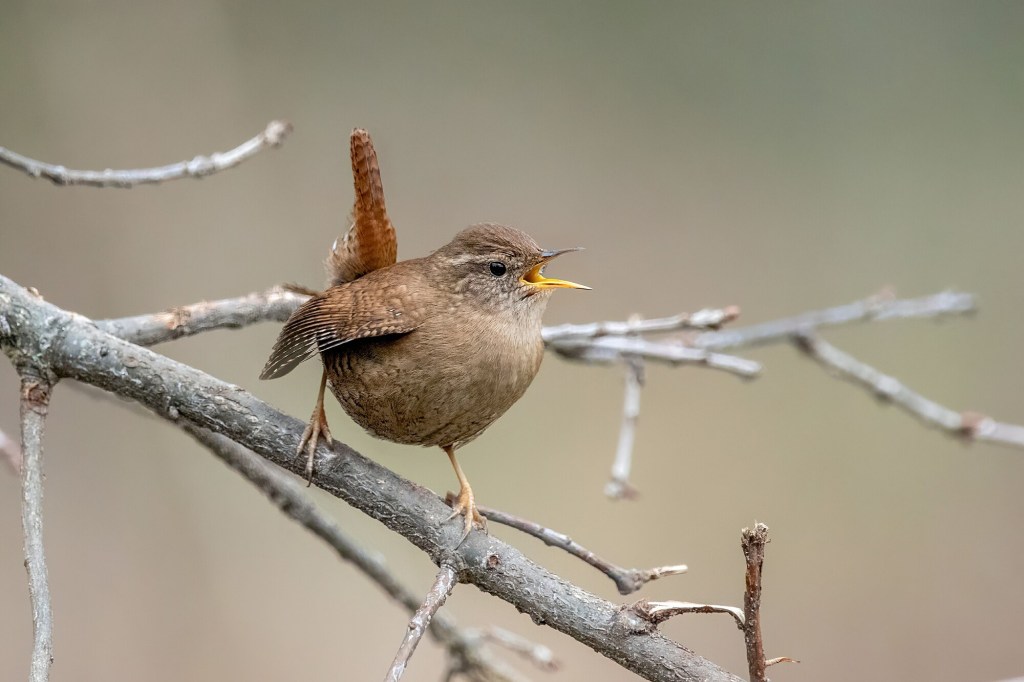
The Wren is perfectly camouflaged for living in this wide variety of places, possessing a finely barred brown plumage which helps it blend into the undergrowth in which it likes to hide. Apart from its prominent light eye-stripe and shiny black, inquisitive eyes, you might barely notice it at all. Unlike other small birds that you may find bustling in the hedgerows, such as Dunnocks and Sparrows, Wrens possess a distinctively fat body and when a Wren puffs out its feathers to keep warm on a frosty morning they can appear almost spherical!
The most unique characteristic of the Wren is its short tail which is almost permanently stuck up in the air, and from which the bird takes its name; ‘Wrenne’, which comes from an old Germanic word that means ‘short-tail’. Its scientific name, Troglodytes, means ‘cave-dwelling’, and is thought to refer to its habit of skulking in the undergrowth.
Their tiny size, measuring only around 10cm from the tip of their bill to the tip of their tail, coupled with the fact that they hardly weigh anything, only about 10 grammes, means that Wrens have to keep very busy foraging for food to keep them going. They hardly sit still for a second as they seek insects and spiders in the undergrowth and always feed on or near the ground, sticking to dense low-lying cover and using their thin, slightly curved bill-like pincers to root out their insect prey.

Nesting
In spring the male Wren will build a number of nests within his territory, each one will be an elaborate, domed structure of leaves and moss which will usually be hidden very carefully somewhere in thick undergrowth.
As each male constructs several nests suitable sites for them can run out fairly quickly, so they are famous for often picking very unusual nesting spots. They have been known to build nests in places as bizarre as Old Boots, Hanging Baskets, Flower Pots, and even Landrovers, as in the image below!, anywhere that is tucked away and warm is fair game. If you find a nest and are uncertain whether it belongs to a Wren, this site has a really useful and easy to follow guide to identifying birds nests.

When he’s built a selection of nests the male sings to attract a female, when a potential mate shows interest in him the male will then proceed to show her each nest consecutively in the hope that she will be suitably impressed with at least one of them. Once she has chosen a nest the female lines it with feathers and other soft materials like thistledown and after mating lays a clutch of 5 to 6 eggs which are White with Red speckles.

The male continue to sing to attract a female, even if he has already been successful, in order to try and fill another one of the nests he has put so much time and energy into building, however, if he is unsuccessful in this he will stay faithful to the first Wren and help to rear the brood.
The female is left to incubate the eggs which will take about a fortnight to hatch, then she will be left solely responsible for feeding the chicks, which typically fledge after around 16 days. It’s very common for a Wren to raise two broods a year unless severely cold weather or a a very dry spring mean a shortage of insects.
The King of the birds
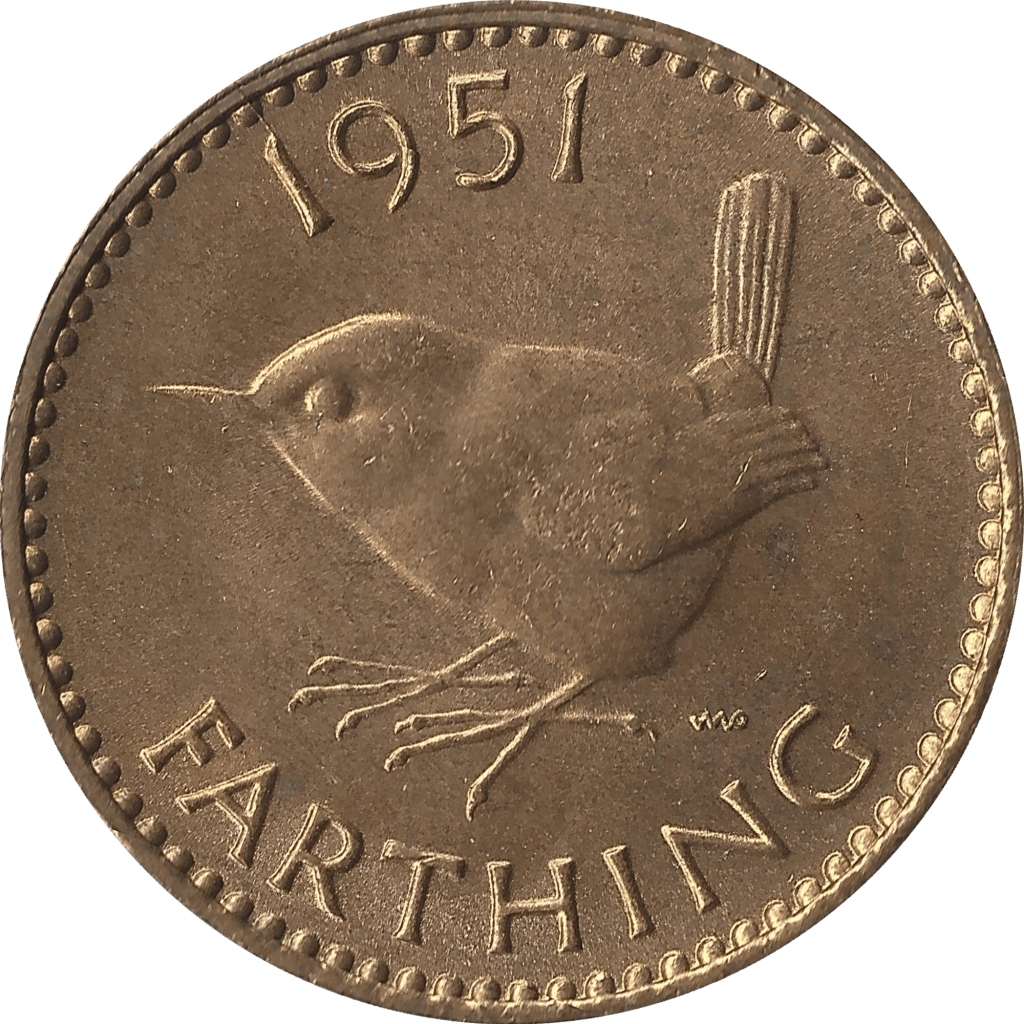
The Jenny Wren features a lot in British folklore, indeed it used to be depicted on the old Farthing Coin. One fable about the Wren that many people know is that of how the Wren came to be the King of All Birds, which goes something like this;
One day all of the birds were having an argument about which one of them was the fastest,
The Hummingbird said she must be as “my wings move so fast they are but a blur!”
The Gannet said he was as he plunged into the sea from such a height that “by the time i reach the waves no bird can possibly catch up with me!”
The Swift said “I must be as I can catch the fastest insects, I hardly ever stop flying not even to sleep and my very name means speed!”
Obviously the Peregrine and the Swallow and the Duck and all the other birds demanded that their claims to be the fastest be heard too,
The Eagle, meanwhile, hitherto understood by all them to be the undisputed King of All the Birds, sat upon his perch quietly, listening to all of the bickering, thinking to himself ‘not one of these birds can possibly catch up with me, I’m faster than all of this lot!’. At last he stirred and spoke;
“As all of you understand I am the King of All the Birds, always have been and always will be!”, “but” he said, “you all know me to be fair and just, so, if we are to decide who is the fastest, we shall have a race, and whoever crosses the finish line first, shall take my Crown, as King of All the Birds!”
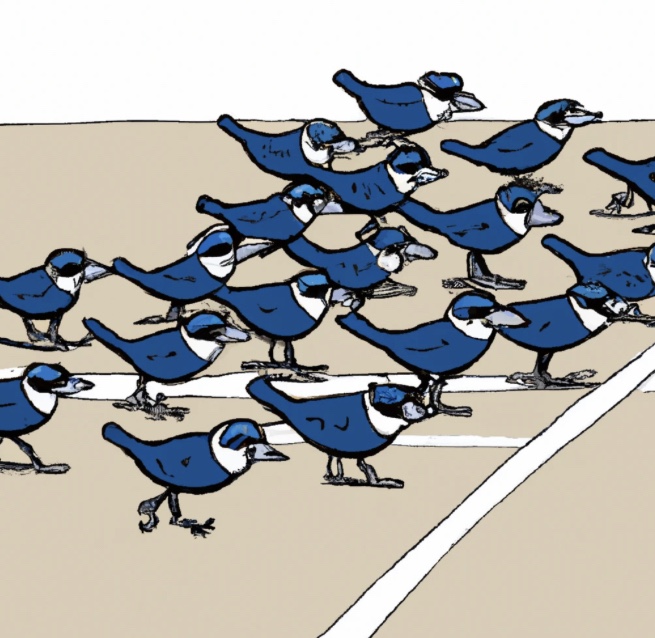
The king smirked to himself as he knew he would win, even if any of the birds could beat him in a contest of speed they wouldn’t dare to! He put the Owl in charge, who wasn’t competing as he knew he was too fat and slow to even have a chance, and after all the commotion and excitement had died down all of the birds went home to prepare for the big day.
Throughout all of this the Wren, tiny and unseen by any of the other birds, had been hiding at the back of the crowd listening and plotting, he knew he couldn’t win, but he had a cunning plan,
On the big day all of the birds lined up at the start of the course, the Eagle, King of All the Birds, the Hummingbird, the Gannet, the Swift, the Peregrine, all of them, and waited for the Owl to blow the whistle,

Meanwhile the Wren quietly snuck up to the King, and when the Owl put the whistle to his beak, he darted, unwitnessed, under one of his big wing feathers,
The race was a dramatic affair, as whoever could be second place to the King would surely be the most famous bird in all of the kingdom and would never want for anything, also the trophy was very big and nice and shiny! But nobody even thought to ask whether the Wren was competing, or even how he was,
The Wren clung on all through the race, hidden under the King’s huge wing, his tiny feet aching from gripping on to the King’s feathers, until at the last moment, just before the finishing line, he carried out the final piece of his cunning plan,
He darted and whirred from under the King’s wing, and, to the astonishment of all the spectators, and competitors, crossed the line!
The Owl declared Wren the winner, as he hadn’t broken any rules, there wasn’t any really! And he had crossed the finish line first,

The King was astounded, flabbergasted even, but he wasn’t lying when he said he was fair and just, he accepted the Owl’s decision, he couldn’t deny it, he’d seen the Wren bursting out from his own wing with his own unbelieving yellow eyes!
“Rules are rules, and Wren crossed the finish line first, so I, who until this moment was the King of all the birds, declare that Wren is the winner, and therefore I give him my crown!” The King said,

That is the story of how the Wren came to be the King of all the birds.
A B-H
 Northwest Nature and History
3 thoughts on “The Tiny Wren, and the Tale of how he became King of All the Birds”