
Now that the first flurries of snow have dusted the Pennine Peaks (it’s just started snowing here in Padiham as I edit this! (Nov 2023)) I thought it would be a good time to publish this short guide to identifying some of the animal tracks you might see whilst out and about.
A good way to find tracks is to walk along a snowy lane or footpath and look at where animals have crossed over from holes in walls or fences on their habitual routes. A gamekeeper will often ‘walk the bounds’, walking around the boundaries of his beat when it snows to find out exactly what lives there and where their paths are.
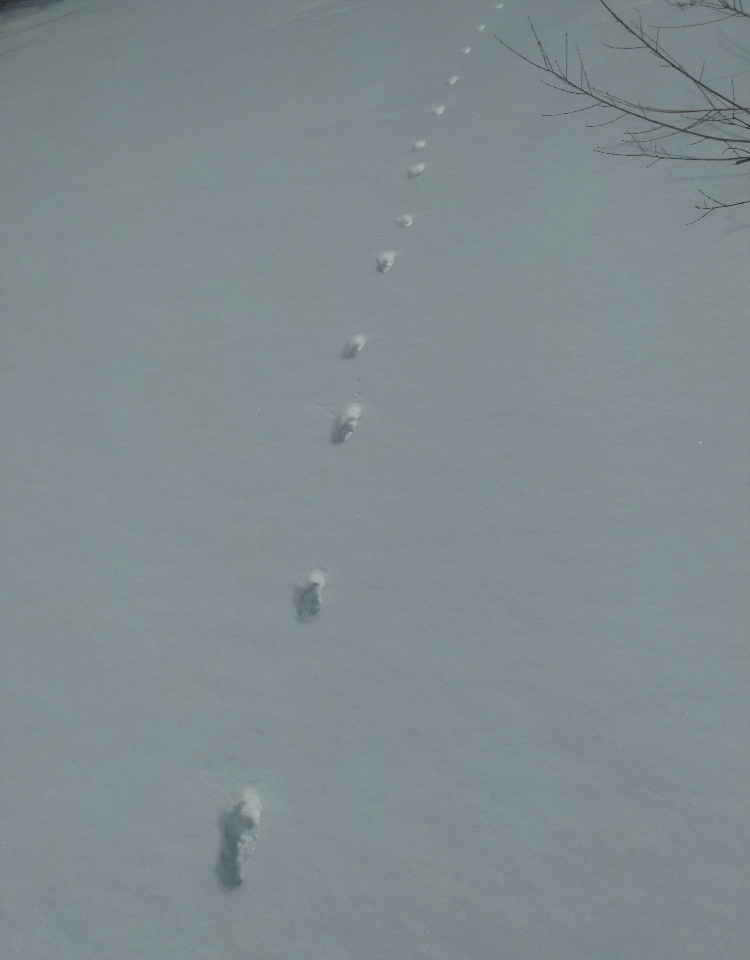
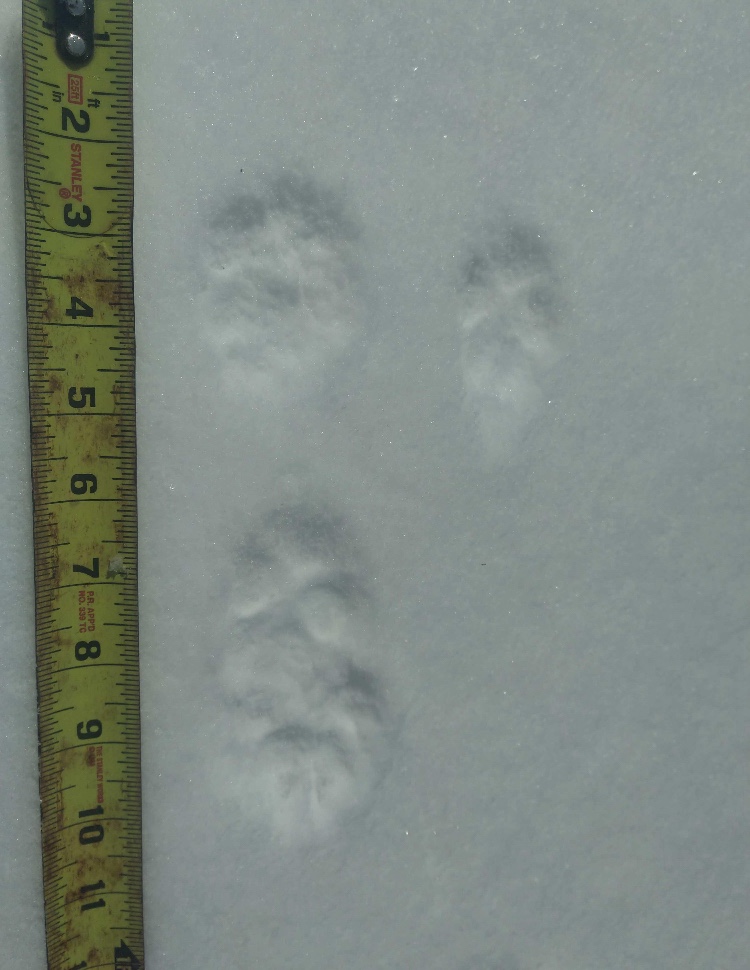
Fox
Foxes can be found almost everywhere in the British isles, and a single fox will cover a great distance overnight to hunt. Its paw prints are very similar to a dogs although foxes are much smaller than most dogs.
Depending how deep the snow is and the speed of the fox the tracks can be paired, singles or triples. This is caused by the fox moving forward at a slight angle to the direction of its travel, so it travels slightly sideways but in a straight line. This means that some of its paws land in almost the same spot, leading to number of paw prints almost always being less than four.
Much like a cat a hunting fox will carefully place its back paws in the prints of its front ones. If a dog fox (a male fox) has just passed by you might be able to smell its unmistakably sweet yet strong musk.

Hare
Hare leave four paw prints with the paired front prints actually being the hind paws. The front paws hit the ground one after the other and then the larger hind paws come either side of them and then further forward powering the next jump.
The paw prints show four toes with the hind paw prints being almost three times larger than the front paws and having a pear-shaped outline. They have hairy hind paws that act like snowshoes.
You might be lucky enough to find where its ‘form’ or where it likes to rest is, this will be a shallow depression in the grass and snow somewhere quiet and out of the way but with a good field of view.
(Rabbit tracks look similar but smaller, I’ll cover rabbit tracks in a different post)
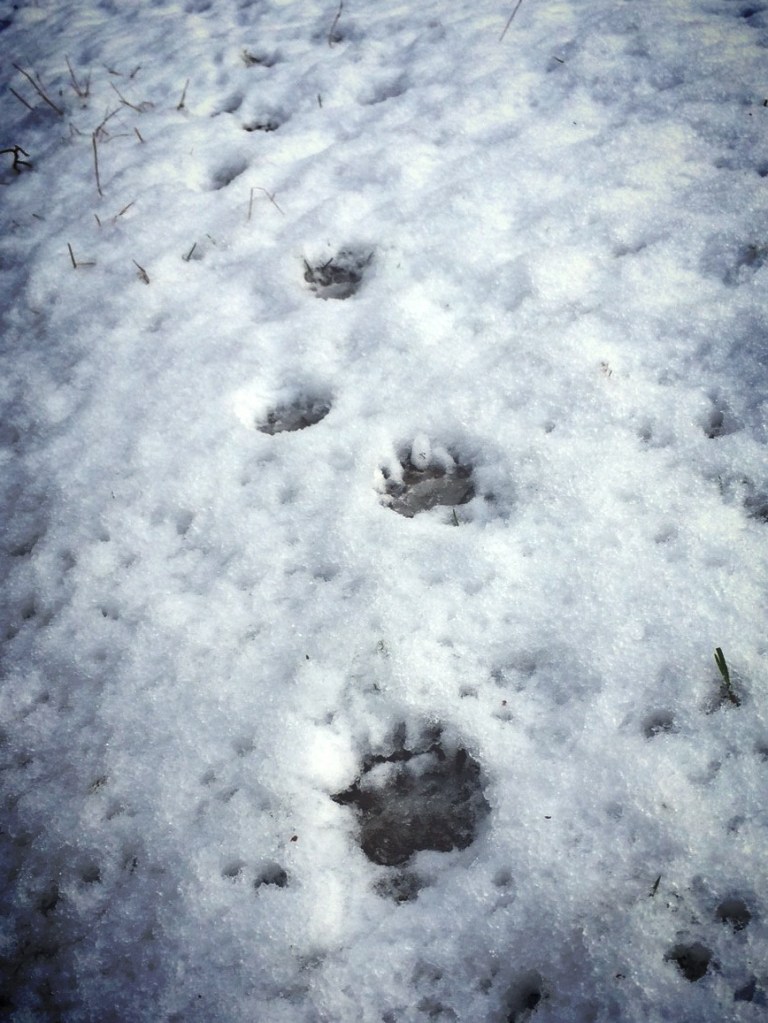
Badger
It’s quite easy to identify the route a shuffling badger has taken on its nightly wandering, badger tracks have five toes positioned ahead of a broad rear pad and claw marks will also be visible. It’s possible to confuse a badger track with those of a cat, although they are easy to tell apart when you know what to look for.
Cat tracks only have four toes and no claw marks, as they retract their claws when walking. Badger tracks are also larger at around 5cm long and up to 6cm wide, compared to 3cm long and 4cm wide for cats.
If you find where a badger has squeezed under a fence you might find some of its ‘guard’ hairs, coarse outer hairs, stuck in the wire, fly fishermen prize these for tying flys.
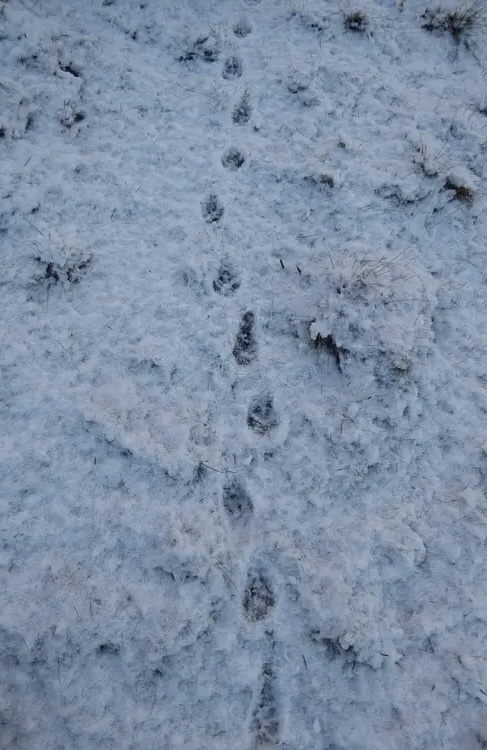

Stoat
The tracks of the stoat are similar to but just a bit bigger than those of rodents, they can be discerned from rodent tracks as they are usually slightly shifted whereas with rat, mice and voles they are always parallel, the distance between the front and rear prints is about 50 cm but with rodents it’s about 10 to 20 cm.
When jumping stoat will leave the prints of their hind paws in the prints of the front paws, it is only in shallow snow that prints of front paws will be made parallel behind the hind paws with all four prints being visible. In deeper snow the tail will also leave a visible furrow.
The prints of their front paws can look similar to those of young rabbits in which case you should look around for more tracks.


Deer
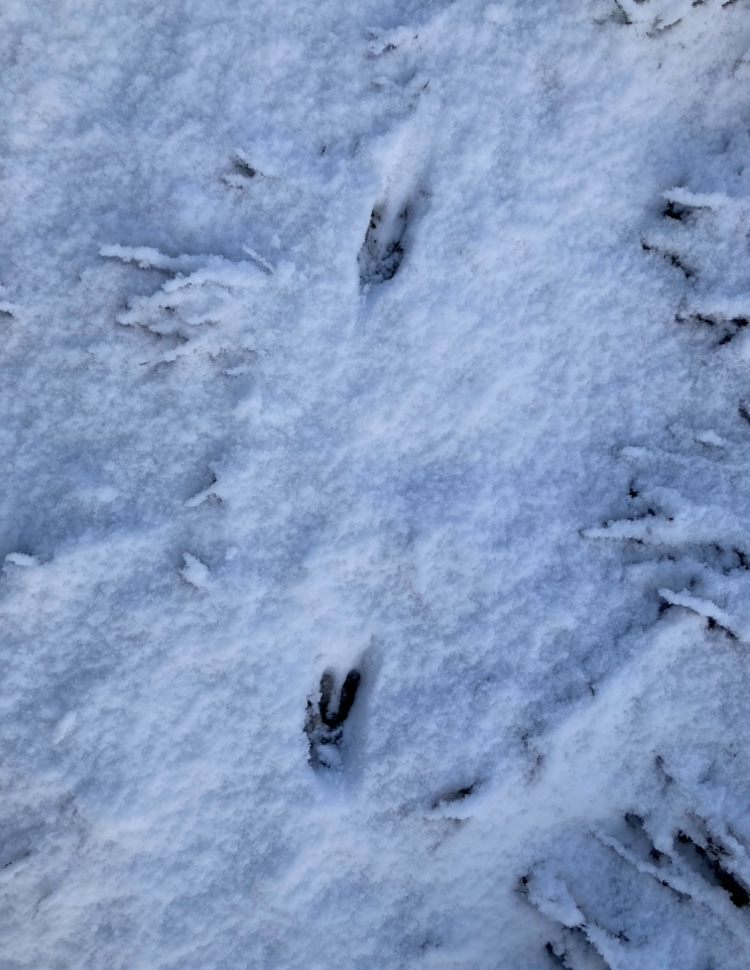
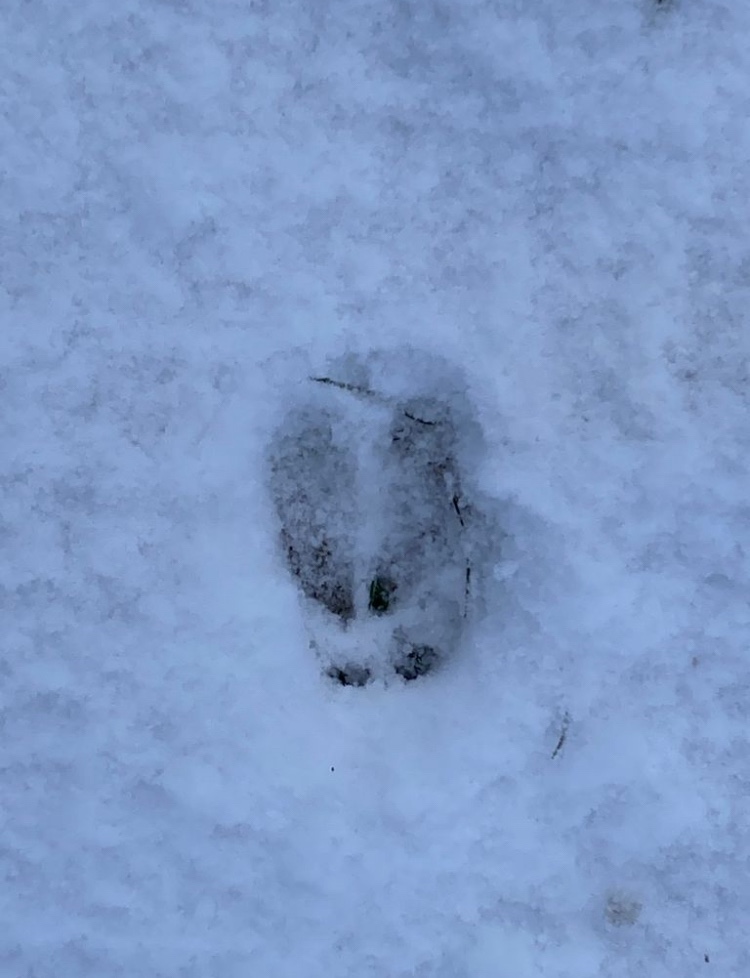
Deer hooves are splayed, meaning they leave two long imprints, called ‘slots’ by hunters, in the snow with a gap in between. It can be hard to tell different species apart, although size can be a clue.
A muntjac’s tracks are typically just 3cm long and 2cm wide, while a red deer stag may leave prints as large as 9cm long and 7cm wide. Roe deer tracks are around 5cm long and 4cm wide, and fallow deer tracks are around 7cm long and 5cm wide.
In the day deer will lay up in thick, quiet bits of the woods or hedges to sleep and melt the snow leaving a bare patch.
Deer tracks can be easily confused with sheep tracks, although a sheep’s slots tend to have more rounded ends, while the front of deer tracks typically come to a point.

Bird
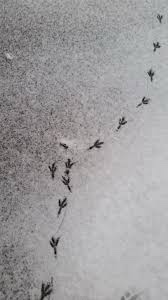
Bird tracks come in many shapes and forms which take a bit of experience to identify, some waterbirds like the coot and ducks have webbed feet whereas other waterbirds don’t.
A useful way of identifying bird tracks is by looking at where the bird has landed or taken off and estimating the wingspan from the marks the wingtips or primaries have left in the snow.


Mice
Mice, vole and shrew tracks are even harder but if it looks like the animal has been jumping it’s probably a mouse and if there are tunnels it’s probably a vole.
The compacted snow on the outside of a vole’s tunnel will often take longer to thaw than the snow and a kind of icy tube, a ‘subnivean’ tunnel, will be left behind. It’s quite fascinating to follow and see how far they’ve travelled and what they’ve gnawed on under the snow!
A B-H
 Northwest Nature and History
2 thoughts on “Tracking Animals in the Snow”