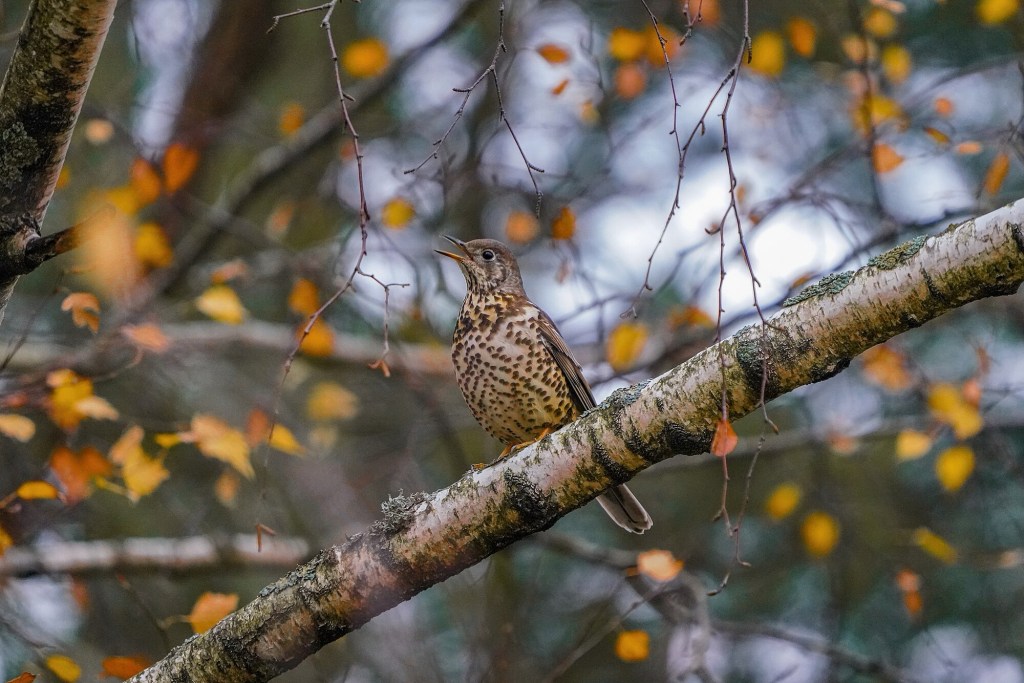
The Mistle Thrush, Turdus viscivorus, is a large pale Thrush with dark speckles, quite often seen high at the top of a tree, singing its flutelike song, or in gardens and fields bullying smaller birds for food.
Both its scientific name, Turdus viscivorus and its common name mean ‘the Thrush that eats Mistletoe’ as they have a quite a taste for its sticky white berries and play a very important role in propagating the parasitical plant, Mistletoe is very rare here in the North of England though, more commonly found in the South.

The Storm Bird
Another common name for the Mistle Thrush is the ‘Storm Cock’, or ‘Storm bird’ this is because it has a habit of singing just before stormy weather and is thought to be able to predict changes in air pressure, much in the way Elephants can sense thunderstorms hundreds of miles away on the Serengeti. It will continue to sing through a storm when most song birds prefer still conditions for their performance, this being the reason that birdsong is loudest at dawn and dusk.
They start nesting very early in the year, sometimes laying their first clutch of eggs before February is over, which means that the male bird has to start singing to establish a breeding territory early in the year. He will sing from a tall perch with a song that is very similar to that of his close relatives, the Blackbird and the Song Thrush, although slower and less complex. The song of the Mistle Thrush is louder than its relatives though and on still, clear days can be heard over 2 miles away.
Identification and Diet
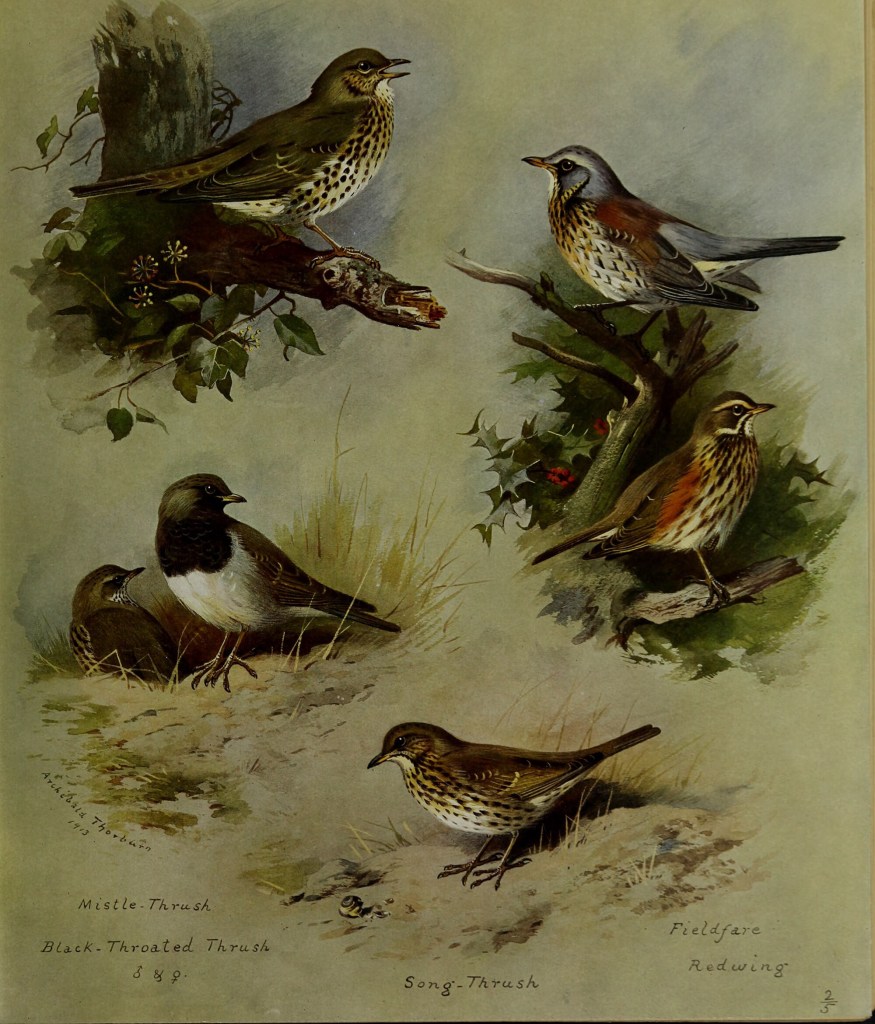
Mistle can be confused with Song Thrush but are larger, paler, have more pronounced spots on their front and a more upright stance. They are easily identifiable by their flight as well, flying between their tree or rooftop singing stages in undulating glides, similar to those of the Jay, interspersed with a few quick wing beats to gain height which is when the underneath of their wings flash a brilliant white.
In the winter the diet of the Mistle Thrush consists mainly of berries such as those of the Hawthorn, Holly, Rowan and Yew and they will aggressively defend their feeding patch from any intruding birds. They are fairly bold about tackling other intruders too, especially in the nesting season, shouting at the offending Owl, Cat, Fox or Human with a kind of rattling alarm call which, as with other birds, will be subtly different depending on the type of intruder and the threat level it poses.

Early breeders
As Mistle Thrushes start breeding so early in the year they can rear two broods and both the male and female will take turns building the nest and rearing their young. The female will lay a clutch of around 4 shiny blue eggs that are dappled with red/brown speckles and incubate them for around 2 weeks, with the male occasionally sitting them. The chicks fledge around 2 weeks later and the pair will take turns feeding them for a short while after.
The nest is a large and cosy looking affair made of densely compacted earth, roots, moss, leaves and lined with grass. It is usually built in a fork or hole in a tree but they will also build in dense bushes or nooks and crannies in old buildings such as barns, occasionally they will construct a nest in an odd location such as a traffic light!

Stormcock in Elder
by Ruth Pitter
In my dark hermitage, aloof
From the world’s sight and the world’s sound,
By the small door where the old roof
Hangs but five feet above the ground,
I groped along the shelf for bread
But found celestial food instead:
For suddenly close at my ear,
Loud, loud and wild, with wintry glee,
The old unfailing chorister
Burst out in pride of poetry;
And through the broken roof I spied
Him by his singing glorified.
Scarcely an arm’s-length from the eye,
Myself unseen, I saw him there;
The throbbing throat that made the cry,
The breast dewed from the misty air,
The polished bill that opened wide
And showed the pointed tongue inside;
The large eye, ringed with many a ray
Of minion feathers, finely laid,
The feet that grasped the elder-spray;
How strongly used, how subtly made
The scale, the sinew, and the claw,
Plain through the broken roof I saw;
The flight-feathers in tail and wing,
The shorter coverts, and the white
Merged into russet, marrying
The bright breast to the pinions bright,
Gold sequins, spots of chestnut, shower
Of silver, like a brindled flower.
Soldier of fortune, northwest Jack,
Old hard-times’ braggart, there you blow
But tell me ere your bagpipes crack
How you can make so brave a show,
Full-fed in February, and dressed
Like a rich merchant at a feast.
One-half the world, or so they say,
Knows not how half the world may live;
So sing your song and go your way,
And still in February contrive
As bright as Gabriel to smile
On elder-spray by broken tile.
Ruth Pitter, (1897-1992) was a very popular British poet who published from the 1930s up until her death, in 1955 she was the first woman to receive the Queen’s Gold Medal for Poetry and was appointed CBE in 1979 to honour her contributions to English literature.
A B-H
 Northwest Nature and History
well put together. Interesting. Thank you
LikeLiked by 1 person
Thank-you, I’m glad I thought of the Ruth Pitter poem when I wrote that, it fitted quite well
LikeLike