
The White-Clawed Crayfish, Austropotamobius pallipes, is the only species of Crayfish native to the British isles, they are small crustaceans similar in appearance to a Lobster but a lot smaller.
Some of the Northwest’s rivers, including the Lune, Wyre, Ribble and their tributaries, count amongst the crayfish’s strongholds in the British isles, they are very hard to spot though, being very secretive and nocturnal. During the day they tend to skulk under tree-roots, rocks or overhanging plants, coming out only at night to hunt and forage.

Diet
The diet of the White-clawed Crayfish is varied, they are omnivores, feeding on plants, carcasses, fish fry and invertebrates, having a particular taste for Caddis fly larvae. They are preyed on themselves, being a vital part of a river’s food chain, hunted by Otters, Herons and larger fish such as Pike.
They are locally common in the clean limestone waters of Cumbria, Bowland and the Yorkshire dales which suit the White-clawed Crayfish very well as it requires a lot of Calcium in its diet to build up its shell, or exoskeleton.

Susceptible to pollution and disturbance
White-clawed crayfish are regarded by ecologists as ‘bio-indicators’, demonstrating the health of riverine ecosystems, as they will only settle in streams, rivers and ditches with clean stony beds and clear, well-oxygenated water free of pollutants, including microplastics.
Recent studies using invasive Signal Crayfish (see next chapter) as a model to measure microplastic accumulation and its effects on native Crayfish have found evidence of a negative correlation between the individual carapace (shell) length of Crayfish and microplastic abundance.
This is thought to be due to microplastics lining the gastro-intestinal tracts and preventing absorption of nutrients. This form of pollution has been found to be more prevalent downstream of urbanised areas and with more and more land being developed it will only become more of a problem in the future.

Another major problem for native Crayfish, which goes hand-in-hand with land development, is silt and soil runoff into watercourses, this is a particular problem during the construction phase. Completed developments can carry on being a threat to riverine ecologies if they are designed with poor drainage systems, especially as lax planning regulations allow people to pave over their gardens with hard standing thus overwhelming drains and watercourses every time it rains.
As this Crayfish is not a very good swimmer it is susceptible to being washed away by floods, which can be exacerbated by the developments mentioned above and with predicted increases in severe weather due to man-made climate change these threats may become severe enough to wipe out whole communities of Crayfish.
However if there are pools over a meter deep or rocks to hide beneath they can hold on fairly stubbornly against all but the strongest currents, this is something that limnologists (scientists who study rivers and streams) may factor in when trying to restore watercourses to optimal ecological condition.

Signal Crayfish
A main reason for the decline in the population of the native Whiteclaw has been the introduction of an aggressive, larger and disease-carrying species of Crayfish; the North American Signal Crayfish, Pacifasticus leniusculus.
This invading species of Crayfish, one of six non-native species introduced to the British isles but the most damaging and widespread, competes with our native Crayfish for food, being much larger and aggressive, it will also harass the females when they are carrying their eggs, which they do for nine months, and when her young hitchhike on her back for a week after to keep safe from such predators.
The breeding season for the White-clawed Crayfish is from September to November when the water is cooler, the females carrying the eggs under their tails all winter until releasing the hatchlings the next summer, this is when they are most vulnerable.
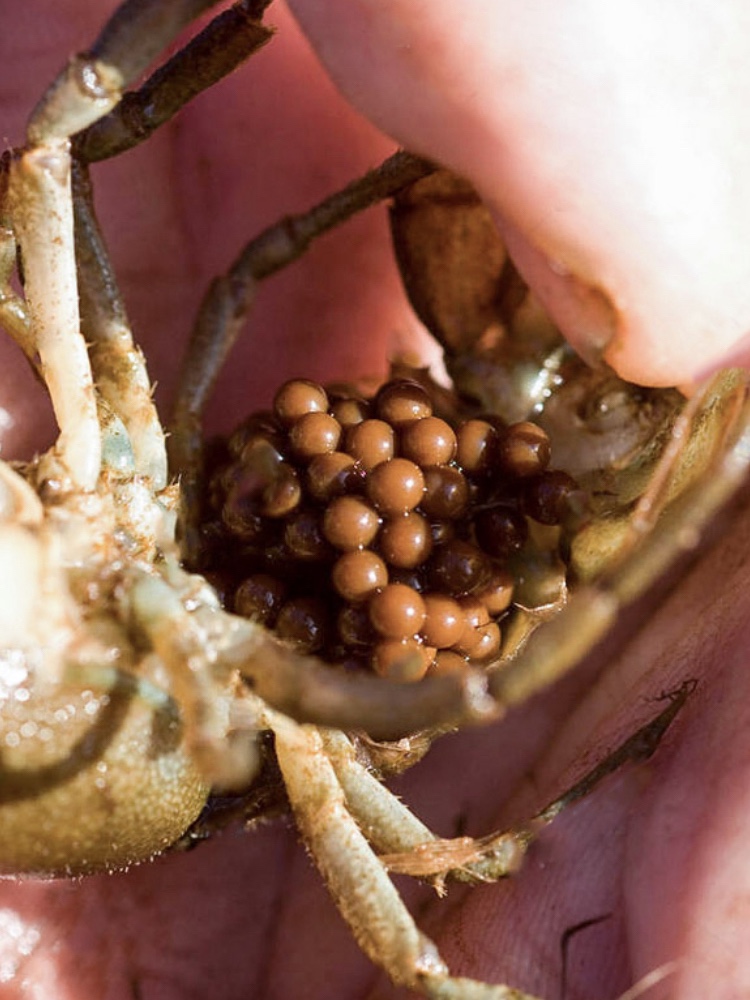
The invading Signal Crayfish also carry a disease which the Whiteclaws have no immunity to; Aphanomyces astaci, ‘Crayfish plague’ which has wiped whole river systems of native Crayfish. In Northwest England American Signal Crayfish were farmed at several locations, from one fishery near Slaidburn in the Hodder valley large numbers of Crayfish escaped from ponds when heavy rains flooded over the banks, the Crayfish ended up in the Hodder river and spread up and downstream, though large numbers of them have been trapped in recent years.
Escapes of non-native Crayfish, loss of habitat and predation from Mink, another non-native species that has caused havoc on the country’s rivers, means that the native Crayfish, once widespread, is now under threat. Estimates put the decline at up to 70% since the 1970s and in some parts of the country it is effectively extinct.
White-clawed Crayfish are a protected species now but in my childhood it used to be a summer pastime to buy a cheap pond-dipping net from the shop, the ones with bamboo handles, lie on a river-bank and feel under the waters edge for Crayfish.
Any you did find would swim out into the net if you got it right, then you could transfer them into a bucket to look at and afterwards put them straight back again. Of course I wouldn’t advise doing that now as you could be prosecuted and they need to be left well alone!
A B-H
 Northwest Nature and History
Thank you, I’m enjoying your insights into the flora and fauna of our native Lancashire very much. I enjoy exploring our countryside, but am so often ignorant of what’s under my nose. I look forward to reading more.
LikeLiked by 1 person
Thank you, i’m really happy you like my posts, we’re very lucky here in Lancashire to have so much countryside and wildlife to explore, i’ll keep these posts coming!
LikeLike