
Curlew, Numenius arquata are large, brown waders known for their long, crescent shaped bill and evocative call, the ‘cur-loo’ so for it is named, which echoes across the pastures and moors of upland Britain in spring.
Its scientific name is thought to derive from a combination of the ancient Greek ‘neos’, meaning new and ‘mene’, meaning moon, with ‘arquata’ stemming from the latin for bow, relating to the graceful arc of their bill. In Scotland and in some old bird books they are known as the “Whaup”, which can lead to no small amount of confusion.

Dark green =permanent resident
Light green = breeding
Light blue = passage
Dark blue = non-breeding
Long, curved beaks
Their long, curved beaks are used to probe mud and soil for invertebrates and have very sensitive tips so they can feel out anything hiding in the sediment. In the winter they are found feeding on estuaries and mudflats along the coast, locally frequenting Morecambe Bay and the Ribble Estuary, where they can find plenty of lugworms, shellfish and other invertebrates to eat.
In the spring they move inland to breed and will probe for worms in the fields, although they have been known to eat berries from trees, using their long beaks like a pair of forceps to delicately pick them.
They are the largest waders to be found in the British isles at 50 to 60 cm long and with a wingspan up to a metre wide, the female having the largest bill and being slightly bigger, but both male and female being very similar otherwise.

Magical Spectacle
Their plumage is a fairly unspectacular brown with darker streaks and the only discernible features being barring on the tail and a white, triangular patch at the base of the tail which is only visible in flight. They make up for this drab appearance by providing one of spring’s most magical spectacles.
This is their courtship flight, when they rise steeply into the sky above the moors and fields, calling out loudly with a bubbling song which reverberates across the hills, and parachuting down with stiff wings, it is a sight to behold but has sadly been seen less- and-less over recent decades as their numbers have dropped quite steeply.
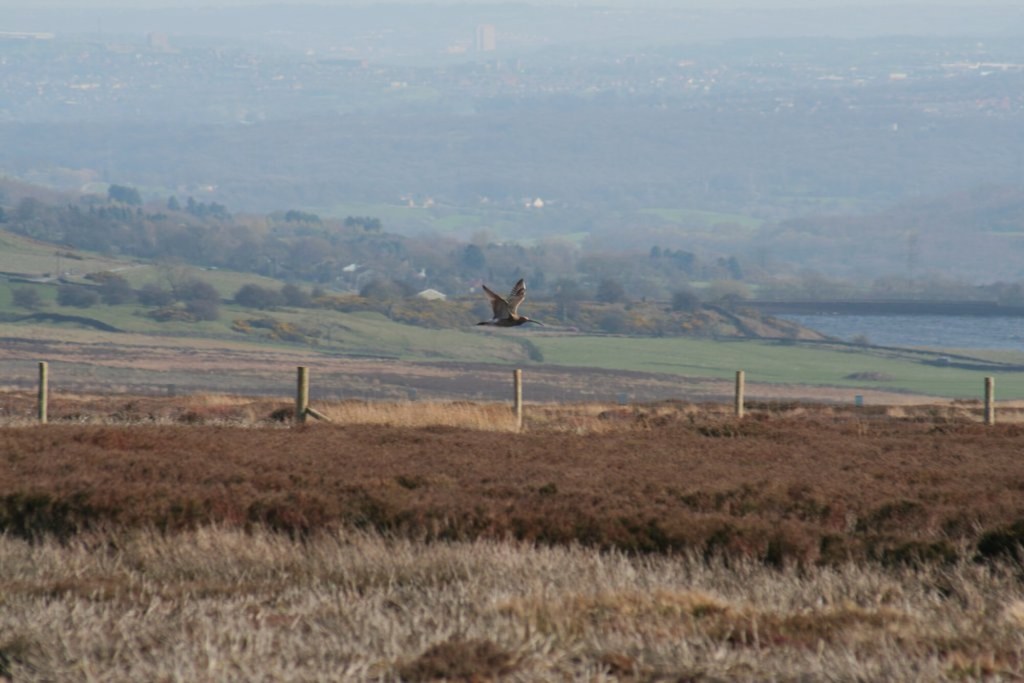
(Mark Anderson)
Some Curlew travel to the British isles from across Europe and can arrive from wintering grounds in places as far away as Tunisia, but around a quarter are resident. These residents are one of our most threatened birds and concerted efforts are being made to help them recover and build their numbers back up.
Until 1942 they were considered a delicacy and were commonly available from butchers, now they are listed as threatened, although they are still legal quarry in Northern Ireland but rarely shot there out of respect for their threatened status.

Nesting
Curlews are monogamous and both the male and female contribute to incubating the eggs. Around the first week of May the female will build a shallow, cup-like nest by swivelling and pressing down to flatten the grass and in it will lay a clutch of up to 4 olive green eggs with brown speckles.
These will be incubated for around 28 days and the young will fledge about 10 days later. The nests are usually fairly difficult to find as Curlews are territorial birds and very secretive of their nest sites, they will land a long way from the nest and walk through the undergrowth to try and hide its exact location.
In many of their lowland strongholds silage cutting is proving a major threat and this is driving our breeding population to Grouse moors where they find that low predation, management of vegetation (burning etc) and absence of silage cutting, which is a lowland practice, is offering better breeding success.
Nesting time is when Curlew are most vulnerable, if a nest fails because of disturbance or if the chicks are lost a pair of curlews will not make a second attempt to nest that year and they are very faithful to a nesting site.
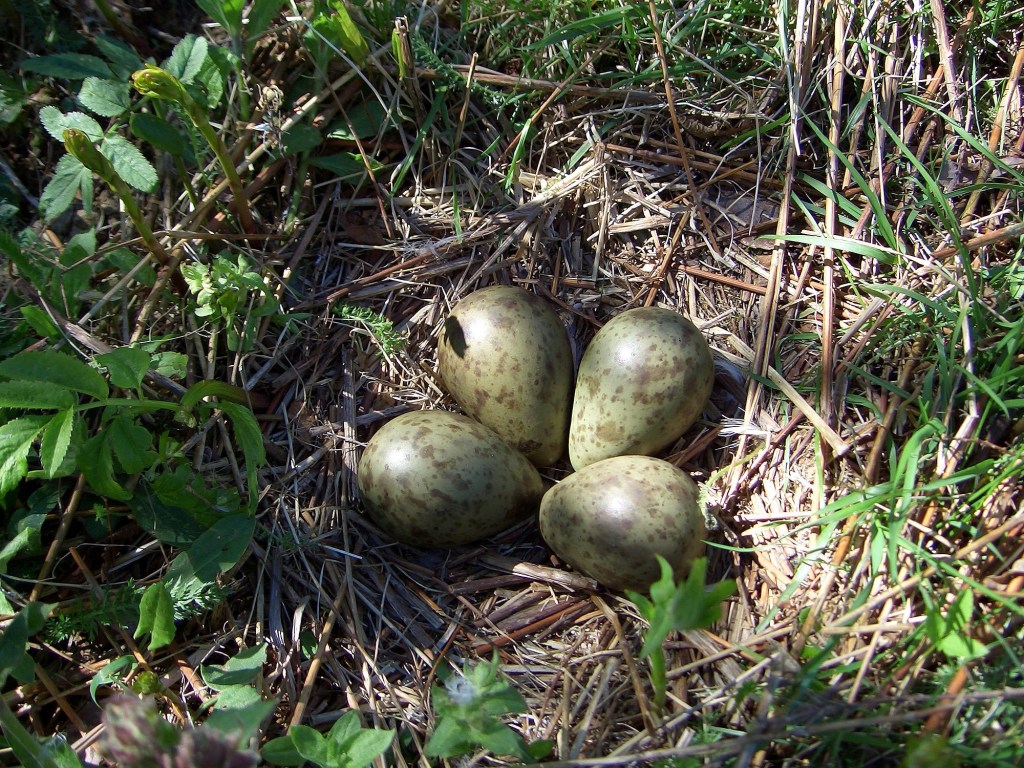
They are also quite particular about where they decide to nest, preferring vegetation that is about 20cm to 30cm high so that they can hide from predators, but still poke their heads above it to see what is going on.
Neither will they nest in heavily stocked fields, choosing sites with flat ground which is drier than their foraging areas and far away from tall trees and hedges which could potentially hide predators.
Vegetation must also be thin enough for the chicks to move through but with cover where they can hide from airborne attack, wildflower meadows with many different species providing varying heights of plant cover are ideal.
There is a correlation between Curlew nesting sites and parasitic plants such as Hayrattle which suppress grasses and provide small, sheltered, open areas ideal for their chicks, also the abundance of insects in wildflower meadows makes them attractive nesting sites.

The Curlew’s future
Despite the threat from birds of prey there is some evidence that Curlews prefer to nest near to where Kestrels nest, even though they will take Curlew chicks. This may be because Kestrels are highly territorial and defensive when nesting and this offers some protection from predators such as Magpies and Crows.
Nowadays the main problems faced by Curlew in the British isles are the results of changing land management practices and uses, such as planting of woodland on previously open land, construction of housing estates and changing agricultural methods, which all mount up adding pressure to the Curlew population.
A lack of predator control on previously keepered land is another threat, as on upland areas and Grouse moors the control of Corvids and Foxes is important for maintaining breeding Curlew populations and encouraging more to breed.

Recently Curlew have been successfully reared in captivity but it is still feared that in the south of England and Wales, where there are estimated to be only about 250 to 300 pairs left, they could become locally extinct.
This iconic wader is part of the soul of the northern uplands and its arrival in the meadows is eagerly anticipated every year as a welcome sign of Spring’s arrival, so it would be sorely missed if it was to disappear, it seems that our ancestors also held the Curlew in high esteem as the ancient poem by unknown authors; ’The Seafarer’ would testify;
I took to myself as pleasure,
the Gannet’s noise and
the voice of the Curlew
instead of the laughter of men,
the screaming gull
instead of the drinking of mead.
A B-H
 Northwest Nature and History
great post – thanks !!
Download 50 Amazing Keto Recipes –> https://ketodietrecipes.co.uk/
LikeLiked by 1 person