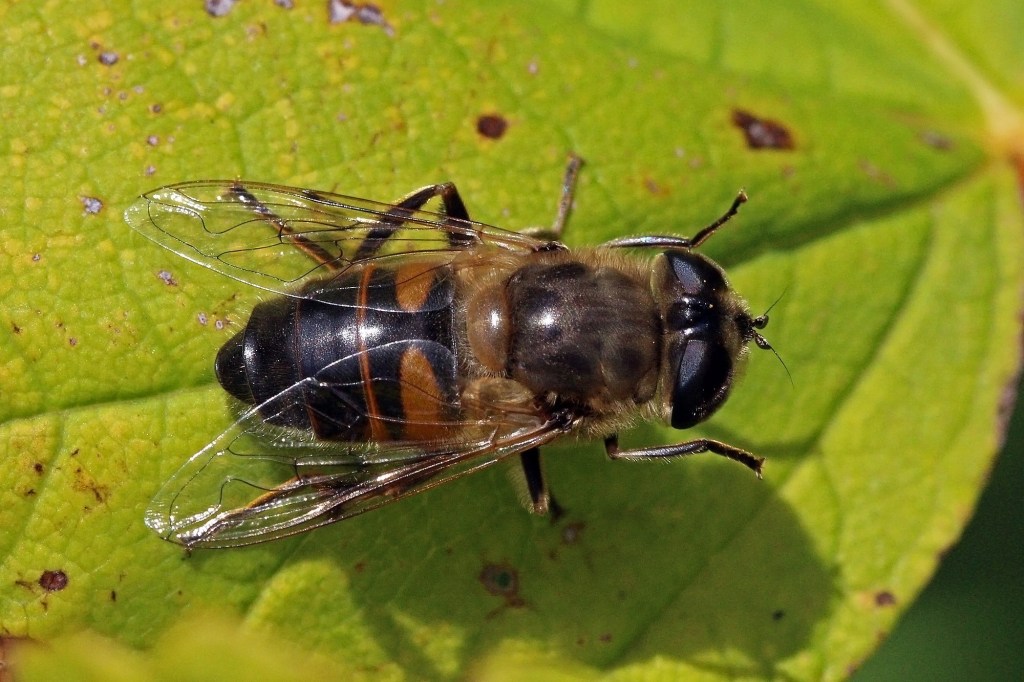
The Common Drone Hoverfly Eristalis tenax, is one of the most common and ubiquitous hoverflies to be found in the British isles, and usually the first to emerge, as adults that have hibernated all winter begin to sense the warmer days outside and venture forth to feed before other flying insects do.
At about 1cm long it’s one of the larger species you might spot and abundant on sunny days in flower-filled gardens, where it might easily be mistaken for a bee due to its clever camouflage. Its orange and brown colour banding mimics that of honey bee drones, hence its name, and is intended to persuade birds and other would-be predators to stay away for fear of getting stung. Hoverflies cannot sting though and they are completely harmless.

(Gavin Taylor)
Batesian mimicry
The idea that a harmless insect can gain an advantage by mimicking a harmful one was first proposed by the nineteenth-century English naturalist Henry Walter Bates, so the phenomenon is known as ‘Batesian mimicry’.
As its name states, a hoverfly is a fly that can hover, it does so like a hummingbird in front of flowers as it sucks nectar from them. The drone hoverfly is a very adept hoverer and even mimics the flight patterns of bees, and other hoverflies will mimic the flight of the species they are trying to look like. This insect is also remarkable for the fact that it has such huge compound eyes that they press against each other and occupy most of the creatures head, with the males usually having much bigger and prominent eyes than the females.
Halteres
Hoverflies are true flies in that they appear to have only two wings, but in fact they have four wings, it’s just that the hind pair are reduced to two small structures that look like tiny table tennis bats, called ‘halteres’, they use these for stabilisation during flight. This is one way of telling the drone hoverfly apart from bees, which have four visible wings, another difference is that bees don’t have a narrow waist, something else that gives away any hoverfly.

Commonwealth Scientific and Industrial Research Organisation (CSIRO)
Snorkel-tailed Saprotrophs
The larvae of the Drone hoverfly are saprotrophs, like many hoverfly larvae are, which means they eat decaying plant and animal matter in the soil or in ponds and streams. Drone hoverfly larvae have the horrible-sounding, but descriptive, nickname; ‘rat-tailed maggots’and are found in polluted water, they obtain air by extending their snorkel-like tail breathing tubes to poke through the meniscal layer, the surface of the water, into the air, and can swim away fast at the first sign of this layer being disturbed.
The colour form of the pupated Drone hoverfly depends on the temperature exposure that the larvae experienced, with lighter forms appearing mid-summer and darker forms earlier in the year.
Hoverflies are also one of the few kinds of insects that can digest pollen, which is a protein rich source for the eggs, and this can effect the colouration of the emerging hoverfly too. This is because the surface coating of pollen, which is resistant to most insect digestive juices, can be digested by the hoverfly, which possesses an enzyme that can break it down.

Useful and entertaining insects
This ability means that Drone hoverflies are good to have in gardens as they act as pollinators when they go from flower to flower feeding. Other species of hoverflies are useful to encourage too as they produce maggots that eat aphids, thrips, leafhoppers and other soft-bodied insect pests, so becoming important agents in biological control.
Drone hoverflies are enormous fun to watch as they have a very characteristic way of flying, they approach a flower, hover at it while they feed, and suddenly dart sideways to another flower, hovering again and repeating the process over and over, they even possess such acrobatic flying prowess that they are able to fly backwards!
A B-H
 Northwest Nature and History
8 thoughts on “Eristalis tenax, the Common Drone Hoverfly”