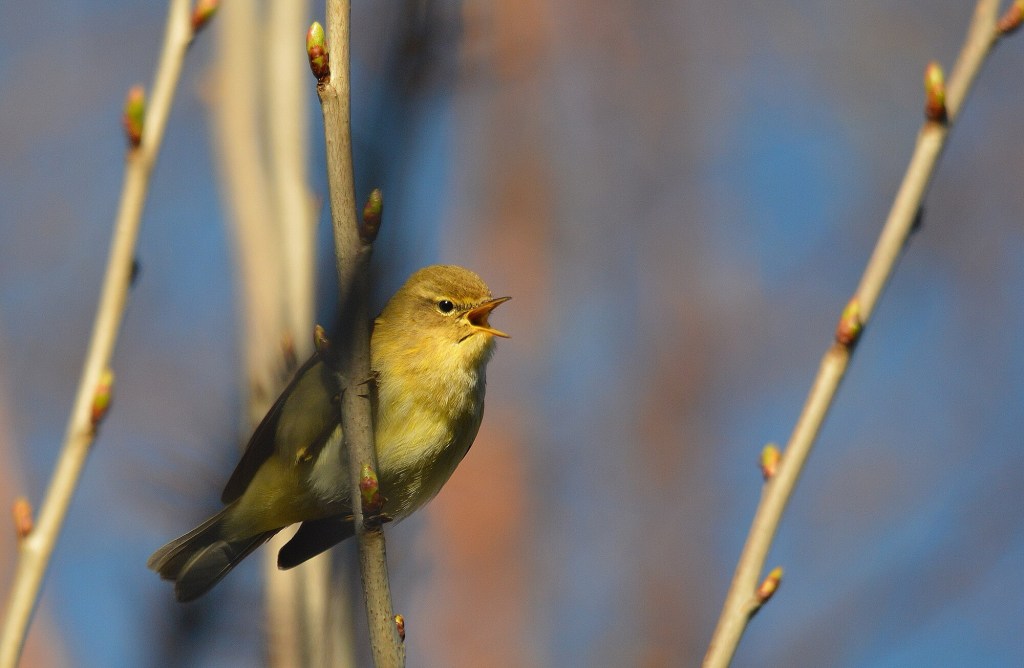
The Chiffchaff, Phylloscopus collybita, has what is called an onomatopoeic name, meaning descriptive of its song, and its scientific name, Phylloscopus, coming from the Ancient Greek phullon, meaning ‘leaf’ and skopos, meaning ‘seeker’, aptly describes its behaviour as it hops about the trees seeking insects for its dinner.
For a lot of people the arrival and first call of the Chiffchaff confirms that spring is well and truly here, as the tiny bird, (they only weigh around 9 grams), completes its arduous journey from the Mediterranean basin. They are a common and widespread visitor to woodlands, as well as a common passage migrant and scarce winter visitor and arriving earlier each year as the British climate becomes more amenable to them.
Willow Wrens
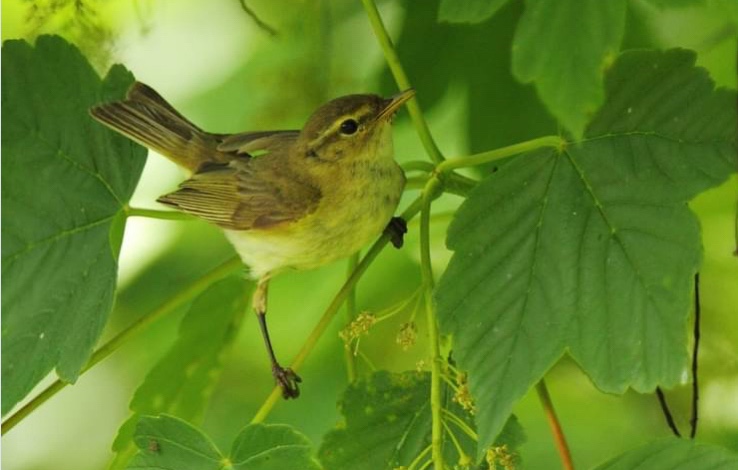
As they are very similar in appearance to the Willow Warbler and about the same size, the Chiffchaff can pose a bit of problem for bird watchers trying to bag the first one of the year. Indeed up until the 18th century Chiffchaff, and Willow Warbler were lumped together as “Willow wrens” and it was parson and naturalist Gilbert White who was first able to distinguish them as 3 separate species by their song.
Chiffchaff and Willow Warbler both have plumage which is a dark green above but slightly paler below, a faint supercilium (a stripe which runs from the base of the birds beak to above its eye), a dark eye stripe and a narrow white ring around the eye. They also have dark legs, although paler legged birds have been recorded and as the British population of Chiffchaff can sometimes include birds passing through from Scandinavia and Siberia, which are a lot paler all over, this can further complicate things.

How to differentiate
There are several ways of telling the two birds apart, one is by paying attention to their legs, as those of the Willow warbler are more of a pink colour compared to the brown of the Chiffchaffs legs. Another difference is that the wings of a Willow Warbler are longer, as they have a greater distance to cover on their migration, travelling from sub-Saharan Africa.
One other way to tell the two apart, as Gilbert found out, is through their song. The most frequently heard call is a quiet “who-it”, and their song is the distinctive “Chiff-chaff”, usually repeated five or six times and sang all through the day. The author Alan A Milne, best known for his books about Winnie-the-Pooh, wrote;
“Why does a silly bird go on saying ‘chiff-chaff’ all day long? Is it happiness or hiccups?”

Diet and breeding
Chiffchaff feed solely on insects such as aphids, caterpillars, midges and moths, which they find by foraging in the tree canopy, when large aphid populations are available the Chiffchaff will live almost entirely on them, preferring them over other insects as they are very high in calories.
Breeding begins in late March or early April and continues through to May, a pair will try to rear two clutches of 4 to 9 eggs a year. The female will build the nest which is a dome-shaped affair and usually built low down in dense foliage, and will incubate the eggs for around 2 weeks, with the young fledging around 2 weeks later, the father only playing a marginal role in their upbringing.

A B-H
 Northwest Nature and History
One thought on “The Chiffchaff”