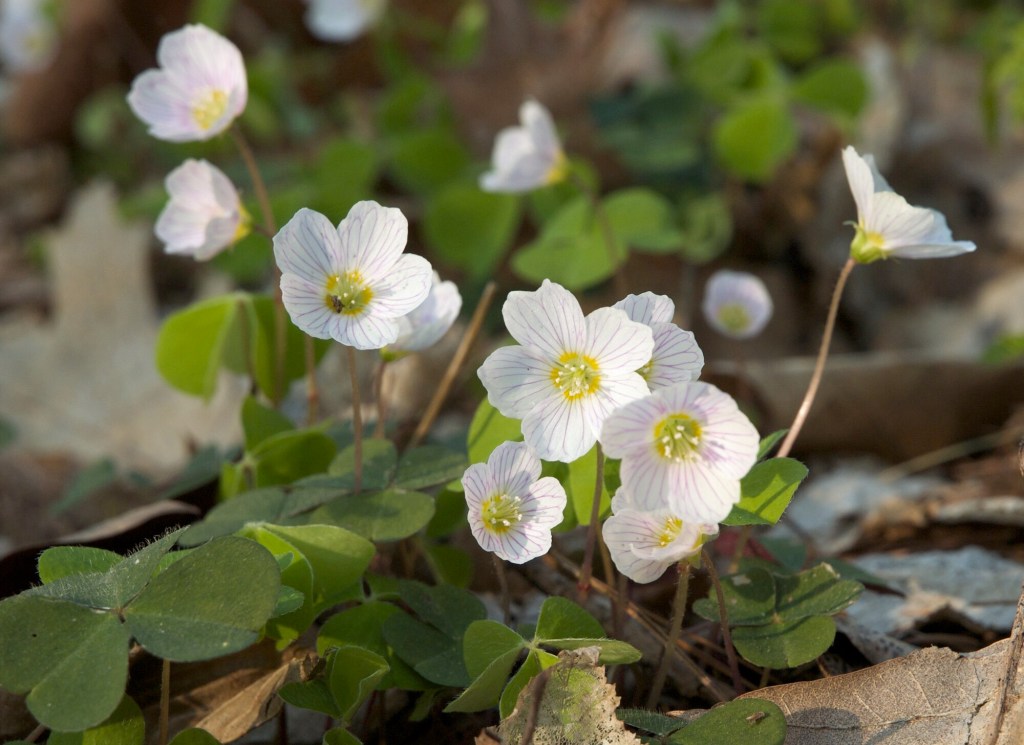
Wood Sorrel is one of the earliest spring-flowering plants of the woodland floor, along with Wood Anenome, Bluebell and Wild Garlic and is characteristic of old woodland, forestry plantations and shaded hedgerows.
It only feels at home in moist, shady areas and no other native flowering plant thrives on as little light as this species does; it manages to photosynthesis perfectly well in just 10% daylight and can even survive on just 1% daylight.
In shady areas it carpets the woodland floor, growing its stems horizontally under the surface of the leaf litter, budding at intervals along these stems to produce new tufts of leaves and side shoots, this is called ‘axillary’ growth as the buds grow from the points where the stems branch, called ‘axils’ in botany.

(Björn S)
Five-petalled Flowers
It flowers from around April to June and each tiny, white, five-petalled bell-shaped flower is held solitarily on a stem which grows directly from the roots. These petals are traced with pink veins through to the yellow centre of the flower and sometimes can be quite bold in colour, making the flowers appear pink or purple.
Trifoliate Leaves
The leaves are ‘trifoliate’, meaning that they are made up of 3 leaflets and each of these heart-shaped leaflets fold up in the evening or in overcast weather as do the fragile flowers.
This folding is carried out by a ‘cell turgor’ pressure mechanism in the plant’s cells, basically a force within the cells that pushes against the cell’s walls and causes them to flex and move.
This mechanism also triggers when the plant gets too warm and it prevents the leaves from loosing too much water from evaporation.

growing on trees
Hydrostatic Herbage
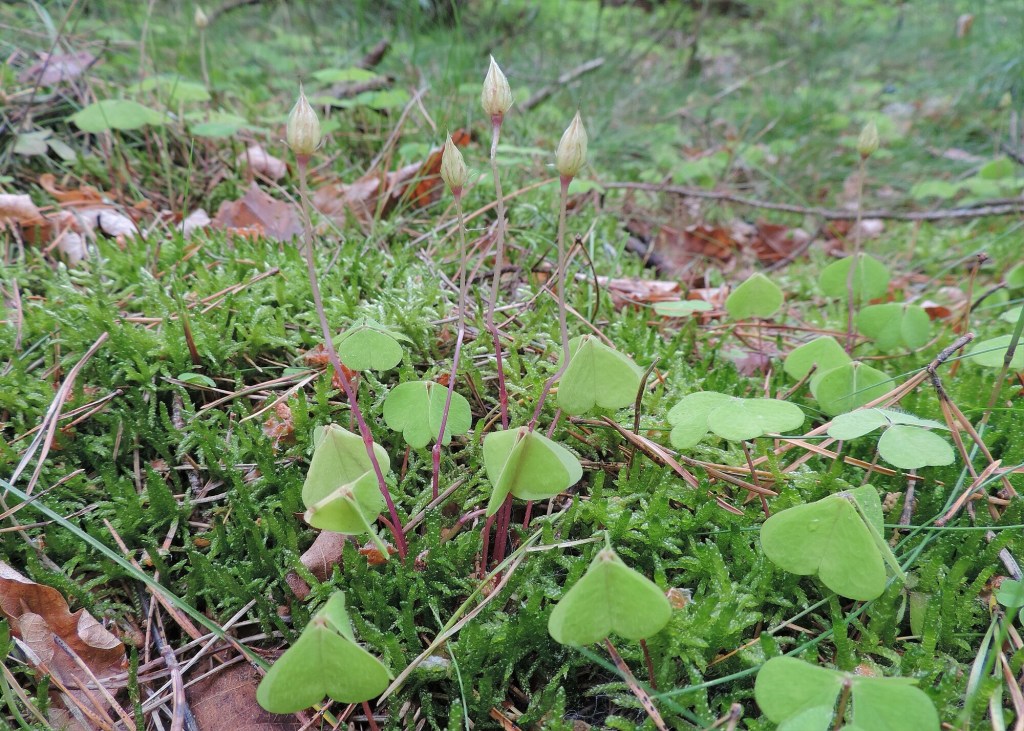
Wood Sorrel also relies upon hydrostatic pressure to reproduce, when the seeds of the plant are ripe pressure in the seed capsules builds up until it reaches as much as 17 bar, this pressure is enough to catapult the mature seed up to 2.5 metres away from the parent plant.
Sometimes a seed will land on a tree, but Wood Sorrel is equally at home there as in the soil and will thrive if the landing site is moist enough. If the seed lands on very damp ground the tissue which surrounds the seed case swells, causing it to burst and propelling the seed once more through the air for as much as a metre.
Incidentally, Wood Sorrel not only grows the bright white flowers which open up to allow pollination by insects and bees, In summer and autumn, it will also develop pinhead-sized flowers which remain closed and pollinate themselves.
It is not known why the plant produces these flowers, which are known to botanists as ‘cleistogamous’, flowers, ‘cleistogamous’ meaning ‘closed marriage’.

(John Bebbington)
Oxalic Acid
If you were taste the leaves of this plant (it is edible but please be very careful with identifying wild plants if you wish to eat them) you will find that they have a sharp, acid taste to them, this is Oxalic Acid you are tasting and gives the family of plants its name; Oxalidaceae. It’s not an entirely unpleasant flavour and is very much like apple skins or those sour apple sweets you can get.
They were and still sometimes are used to make various ointments and salves by herbalists and are still often used in salads or soups, it can even be made into a kind of Lemonade!
You have to be very careful to not eat too many of the leaves though as they will give you Oxalate poisoning, I very often pick them to put in salads at home but you’d have to eat very high quantities to suffer the severe symptoms of Oxalate poisoning.
Uses
Indeed the presence of Oxalic Acid and other chemicals in the plant gives it many medicinal uses, these include curing mouth ulcers and whooping cough, treating biliary colic and gastrointestinal cramps and even stimulating the liver to help prevent stone formation. Since it also contains vitamin C it can even be used as an ‘antiscorbutic’, to prevent scurvy.
Not too long ago it would be used as a natural dye, although I’m not too sure what colour it produced, I’m guessing it bleaches fabrics as it can be used to remove iron marks from linen.
The leaves would be gathered and boiled in a large container and after a while they would be skimmed off and fabrics boiled in the resulting broth, it can be used to clean brasses too so it must be fairly abrasive stuff!

Shamrocks
The Wood Sorrel is the original ‘Clover’ that is now known as the Shamrock and used as a kind of universal symbol for Ireland, the name comes from ‘seamróg’ and it was a sacred plant of the Druids, often depicted as the Triskelion, long before Saint Patrick came to Ireland.
Saint Patrick picked one at Tara, where he started his Irish mission and held it up as a symbol of the three Divine Persons or Holy Ghosts and how they came together to make a whole identity, this explaining the new religion of christianity to the druids who were already so familiar with the plant.

Lá Fhéile Pádraig Sona Duit!
Hail Glorious St Patrick
Hail, glorious St. Patrick, dear saint of our isle, On us thy poor children bestow a sweet smile;
And now thou art high in the mansions above, on Erin’s green valleys look down in thy love.
Ever bless and defend the sweet land of our birth, where the shamrock still blooms as when thou were on earth,
And our hearts shall yet burn, wherever we roam, for God and St. Patrick, and our native home.
A B-H
(Updated March 2026)
 Northwest Nature and History
2 thoughts on “Wood Sorrel, the original Shamrock”