
John Flamsteed, 1776
The Vernal Equinox
On the 20th of March falls the spring, or vernal, equinox, this is the date when the day and night both last 12 hours, so are almost but not entirely equal in length, giving it the name equinox, originating from equi, meaning ‘equal’, and nox, meaning ‘night’, this date marks the beginning of spring on the astronomical calendar.
The reason why the equinox isn’t exactly equal is quite simply because it begins and ends at the instant the disc of the sun has completely appeared, or disappeared over the horizon, which differs in elevation and shape wherever you are in the world.
Meteorological spring, which is the official start of spring according to the calendar, began on the 1st of March this year (2026), this date is decided according to things like proportioning the year into equal measures for statistical purposes, this can’t be determined according to astronomy as it then would become enormously complicated to work out!

Spring constellations
Vulpecula
Vulpecula is a small, unobtrusive constellation in the middle of the Summer triangle which represents the Fox (Vulpes vulpes). The Summer Triangle being an astronomical ‘asterism’, meaning a ‘pattern of stars which is not a constellation’, in the northern sky made up of the stars Altair, Deneb, and Vega.
It wasn’t originally a constellation that represented a figure in Ancient Myth but its creator, the Polish astronomer Johannes hevelius saw it as representing the Fox bringing a Goose to Cerberus, which is another constellation he created, Cerberus being the three-headed dog that guards the underworld.
Vulpecula is no longer recognised as a constellation and has, over its lifespan, gone through several changes, when Hevelius named the constellation it was called ‘Vulpecula et Anser’, or the Fox with the Goose, it was then broken up into two constellations called Vulpecula the fox and Anser the goose.
They were then merged once more but this time the Goose lost its starring role and now the whole constellation is simply called Vulpecula. The goose, however, still features as the only named star in the constellation ‘Alpha Vulpeculae’, which is also called Anser.
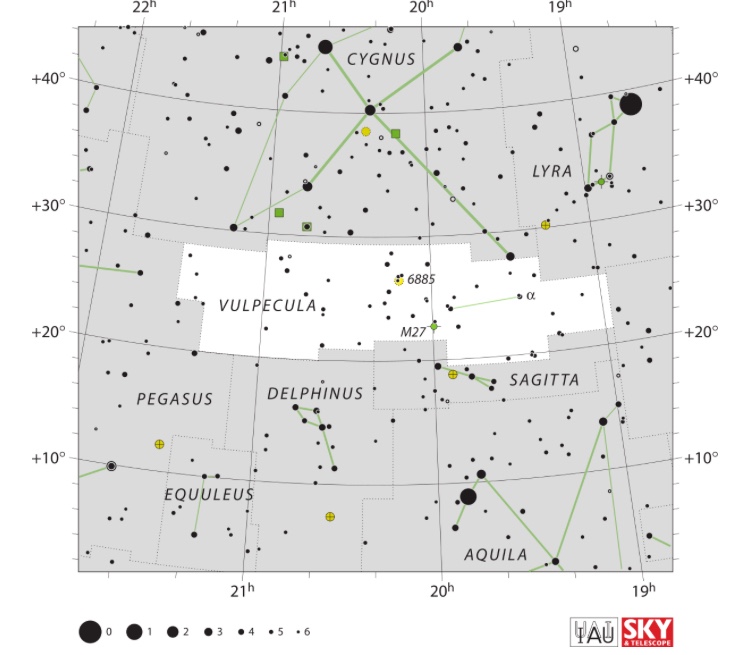
IAU and Sky & Telescope magazine
(Roger Sinnott & Rick Fienberg)
Delphinus
Delphinus, the Dolphin, is one of the smallest constellations in the night sky and you can see it in the east on the early mornings of spring. There are quite a few stories associated with the constellation and it was created by the Greek astronomer and mathematician Ptolemy in the 2nd Century.
The first story is that it was a Dolphin sent by Poseidon to find a sea nymph, or Nereid, called Amphitrite that he was in love with. Another story is that it represents the Dolphins that saved the Greek Poet Arion’s life at sea.
He had been kidnapped by pirates who were out to steal the many prizes Arion had won at a musical competition, and the pirates offered Arion a choice, this was either to commit suicide and be rewarded with a proper burial on land, or simply be thrown out to sea to die.
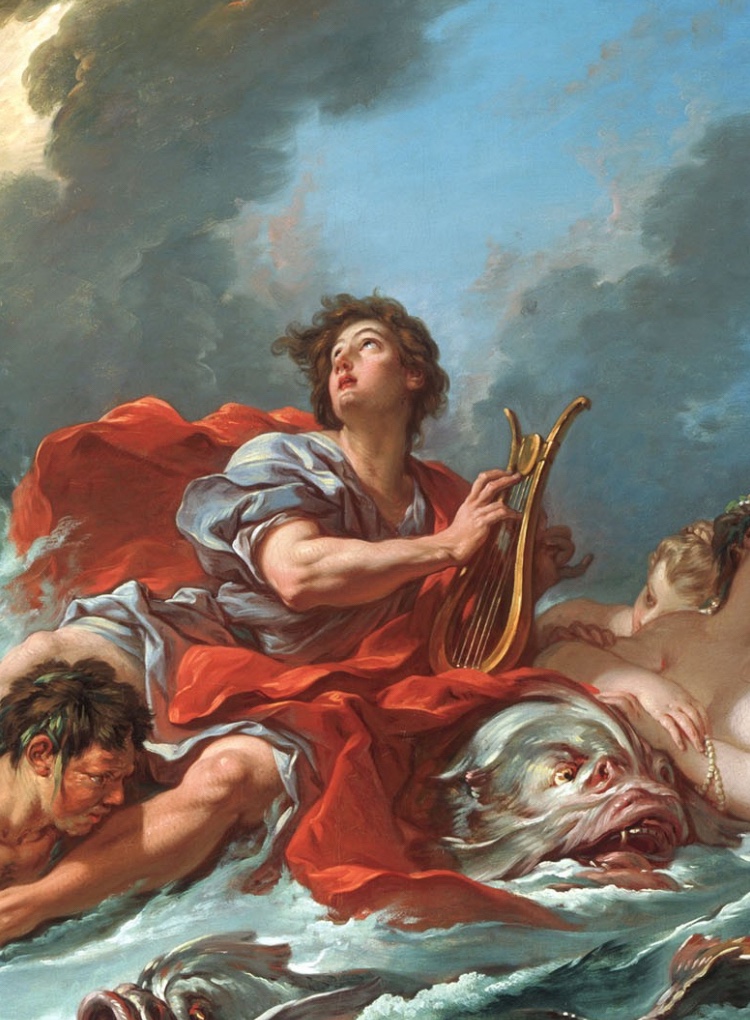
François Boucher, 1748
Arion asked if he could sing one last song, and chose one which was full of praise for Apollo, the god of poetry who usually appeared as a dolphin, before the pirates threw him in the sea, the song, however, attracted a pod of Dolphins to the boat, which carried Arion safely to shore.
This year the spring equinox has brought with it some clearer and milder weather, so it may be suitable to go out stargazing, in which case there are many locations around the Northwest you could visit, if not from your back garden.
Beacon Fell, near Preston, is one good, high, location which gives you a sweeping view of the North sky as is Waddington Fell but of course you can find your own secret spot to try and spot the Fox, the Goose and the Dolphin playing in the night sky.
A B-H
(Updated every year)
 Northwest Nature and History