
In Lancashire’s rolling green countryside you can find every species of owl that is native to the British isles, even one species which some might argue isn’t technically native yet, despite having successfully bred here, the Eagle Owl.
So far I’ve written about the Tawny Owl, the Short-eared Owl and I’ll get around to sharing my encounter with the Bowland Eagle owl one day, but I thought it was about time to look at a species which I’m quite fond of and that fares very well here, the Little Owl.

Interesting Introduction
The Little Owl, Athene noctua, named after the goddess of wisdom is, like the Eagle Owl, (which is at the other end of the scale size-wise!) not originally native to the British isles, having been introduced in the 1870s by the owners of Stonewall park estate near Edenbridge in Kent, who thought it would be an interesting bird to have hanging around the place.
Further releases across the country helped it to establish itself and the Little Owl can now be found everywhere except the north of Scotland.
Originating in Africa, Asia and continental Europe the Little Owl prefers to live where there is a mixture of habitats in a compact area, something we are lucky to have here in Lancashire, they seek territories with scattered trees and bushes to hunt from and to roost in. They also like cattle pastures as these provide a constant source of food.

Crepuscular Characters
Their diet consists mainly of worms, beetles, insect larvae, moths, small mammals and occasionally small birds, they will raid nests too. They hunt by sitting motionless on a telegraph pole, gatepost, branch or similar perch, sometimes for hours, until they spy movement. Although crepuscular, meaning active at dawn and dusk, they are day rather than night owls, even sunbathing if they find a good spot! (although I think the one in the video is maybe ‘anting’, using ants to clean parasites from its feathers)
There are a few spots that I’ve seen them repeatedly over the years, as they are creatures of habit these usually the same old perches, and you are more likely to see them in April, May and June, when they are busy feeding their young. The female lays a clutch of around 4 eggs and they will use the same nesting sites too, the young fledging after about 5 weeks and becoming independent a month after that.
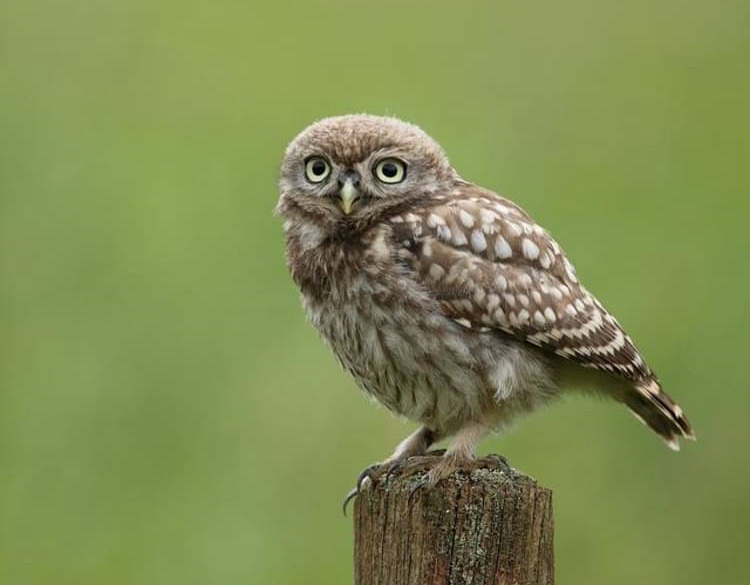
(Martin Cooper)
Preferred Perches
Favourite perches I’ve regularly seen Little Owls around Lancashire include a spot on Waddington fell, where they sit on a post opposite the quarry on a dip on the road, near Higham where one can be seen occasionally on the gable end of a small barn, near Whitewell where the road from Whitewell to Cowark leaves the trees and passes through open fields, here they perch on a fence pole on the inside bend, and on the Slaidburn to Bentham road where I’ve seen them on the drystone walls.
When they are disturbed they have a quite endearing habit of bobbing their heads up and down at you and staring with their very yellow eyes, then they will swoop away very low over the ground, occasionally flapping their short wings quite rapidly, until they alight a short but safe distance away to scowl at you until you’ve gone.
They also have a peculiar way of hunting sometimes where they will land on the ground but continue to pursue prey on foot, looking a bit like a short legged man running after a football, this can be a bit perplexing until they stop and stand up to look at you and you finally figure out what they are!
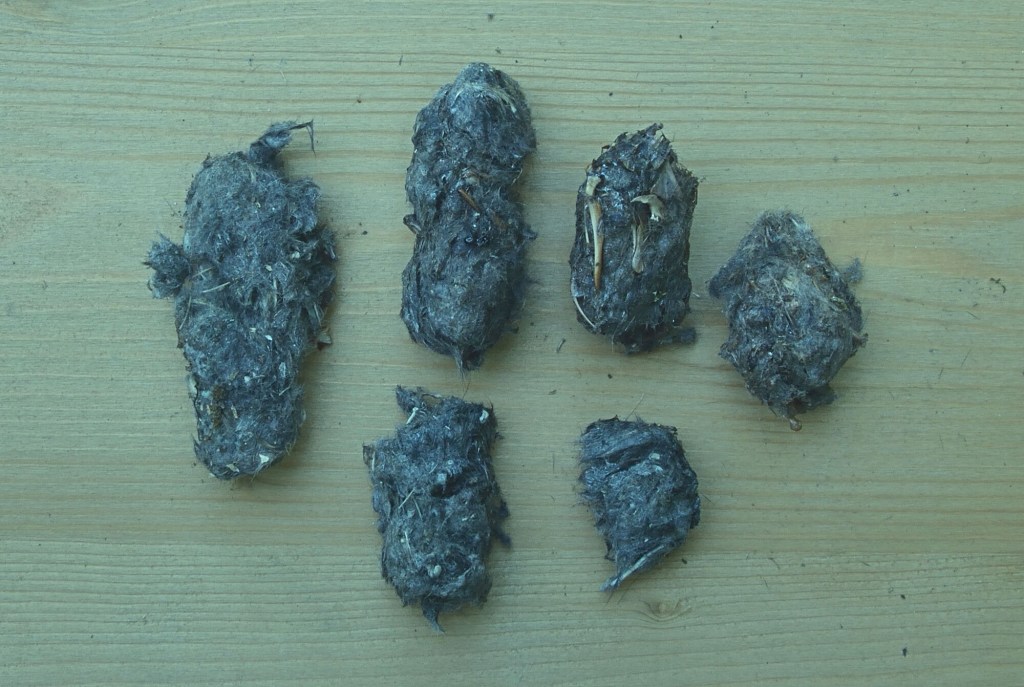
you can find out what they’ve been eating by dissecting them
(that is if you’re not squeamish!)
(Rasbak)
There are estimated to be over 5 and a half thousand pairs of Little Owl in the British isles and their numbers are in decline, one reason is thought to be a loss of habitat, in particular hedgerows, and a scarcity of insects and other prey in agricultural areas like east Anglia where they used to be more frequent. Having predictable habits and surprisingly large territories for such a small bird, up to 80 acres, they are relatively easy to count and monitor.
The wise little owl lived in an oak
The more he saw the less he spoke
The less he spoke the more he heard
Why can’t we all be like that wise old bird?
A B-H
 Northwest Nature and History