
Redwing, Turdus iliacus, the former meaning ‘Thrush’ and the latter coming from the latin term ‘ilia’ meaning ‘flank’ or ‘side’, are flocking into the British isles now, heading south for warmer lands from their summer breeding grounds in Scandinavia and Iceland.
Although they are a member of the thrush family like the Fieldfare and arrive at the same time and quite often in the same flocks, Redwing are quite easy to identify, having distinctive red patches under their wings, hence their name!
They also have striking white ‘eyebrows’ and a light- coloured breast dappled with dark brown spots, their voice is quite different to the Fieldfare too, a whistle rather than a cackle.
Foraging Flocks
Redwing forage as they move much like the Fieldfare, travelling along the edges of fields and picking rosehips, haws, sloes and other berries from the hedges.
They prefer to have cover like hedgerows nearby to escape into in case a predator arrives on the scene and the flock will constantly be on the look-out for danger. Once a risk is spotted alarm calls will be issued and the flock will erupt in a sudden rush for the nearest, thickest cover, with a handful of birds flying up to vantage points in order to keep a sharp eye on the interloper and inform the flock once the danger has passed.
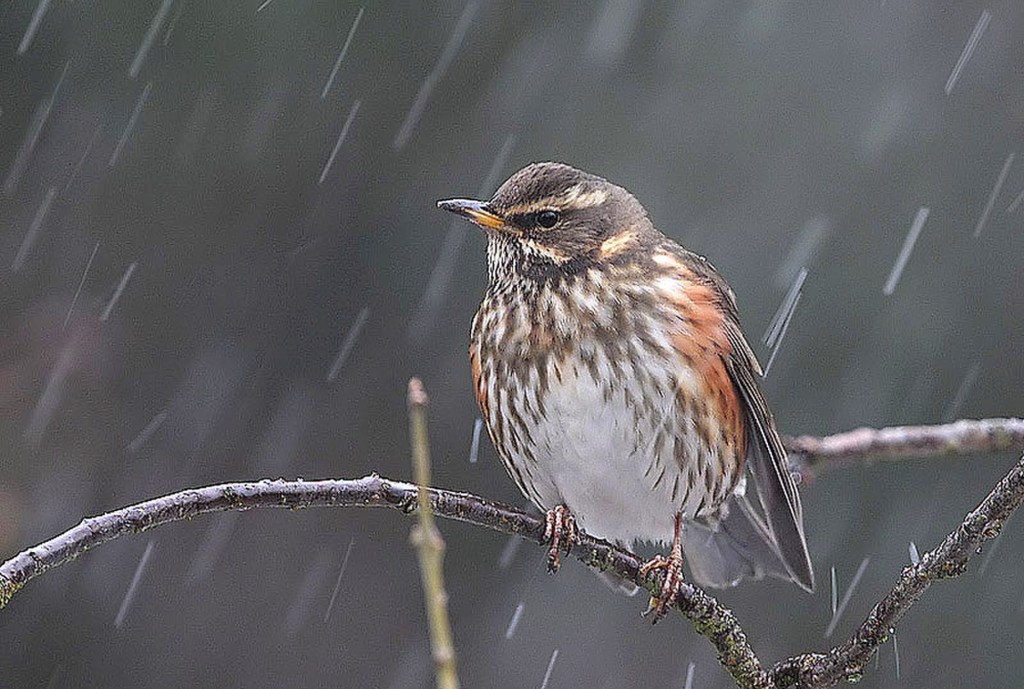
They will stay in the British isles throughout winter, returning north in the spring, although a few pairs are resident in the Scottish highlands, during their stay they will constantly keep on the move and are rarely seen in the same places every year.
They often move across the country under the cover of darkness and you may hear their nocturnal call, often described as a “tseep” or “zeeer”, high overhead in the night sky, and if this is accompanied by a ‘rattle’ this may mean an avian predator is about too.
Ultraviolet Vision
Like many birds Redwing can perceive ultraviolet light, the part of the spectrum which falls between 320 to 400 nm (nm stands for nano-meters), and use this ability to detect berries from afar.
They can even deduce whether the berries are ripe enough, which may explain a curious behaviour I’ve noticed in that they will ignore and fly past what seems to be a perfectly good crop of hedgerow fruit in order to alight on what to you and me would look like a much less bountiful crop further down the hedge.
Obviously they can afford to be picky sometimes, although I have noticed this here in Northwestern England and I doubt they are quite so picky when they’ve just alighted on the north or eastern coasts after such a long flight, their appetite will also depend on the availability of food on the continent, in some years harsh weather at home means that they are virtually starved by the time they get here.
This highlights how essential our hedgerows are to migratory birds and the importance of not cutting or flailing them until long after our visiting friends have refuelled and recovered from their arduous journeys from over the seas.

Plate 12 from the Nederlandsche vogelen
Autumn Birds, John Clare
The wild duck startles like a sudden thought,
And heron slow as if it might be caught.
The flopping crows on weary wings go by
And grey beard jackdaws noising as they fly.
The crowds of starnels whizz and hurry by,
And darken like a clod the evening sky.
The larks like thunder rise and suthy round,
Then drop and nestle in the stubble ground.
The wild swan hurries hight and noises loud
With white neck peering to the evening cloud.
The weary rooks to distant woods are gone.
With lengths of tail the magpie winnows on
To neighbouring tree, and leaves the distant crow
While small birds nestle in the hedge below
A B-H
(Nov 2024)
 Northwest Nature and History
2 thoughts on “Arrival of the Redwing”