
Those cold, damp January days, when nobody feels like venturing out so you can have the countryside completely to yourself, often offer the best opportunities for poking about the bare hedges and woods to see what treasures catch your eye.
In this case, early on the First of January, the prizes I found, shining like golden jewels in the dark depths of the Oak trees, were a type of fungi known as Witches’ Butter.
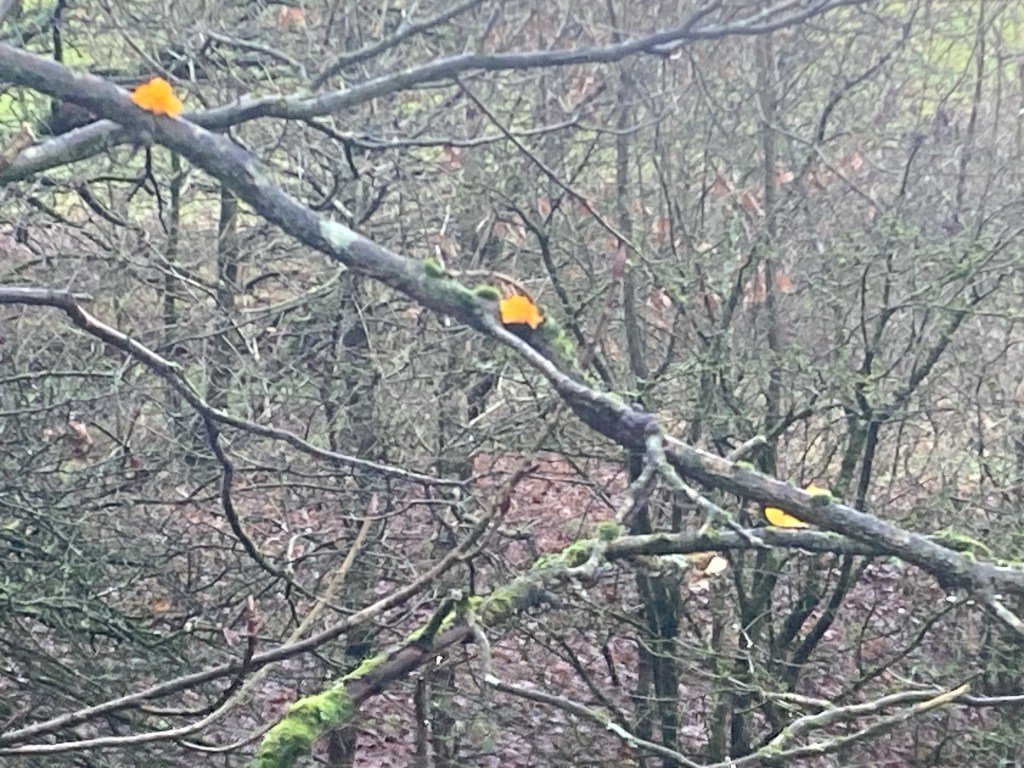
Yellow Brain, Tremella mesenterica, also known as ‘Witches’ Butter*’ belongs to the jelly fungi group, characterised by their gelatinous texture when moist. It appears bright yellow or orange, resembling a blob of melting butter or the folds of the brain, hence its somewhat repellent-sounding common names.
Its scientific name is slightly revolting too, mesenterica indicating its resemblance to the mesenteric ‘middle gut’ membrane by which the intestines are attached to the inner wall of the abdomen, and tremella coming from the Latin word tremere, which means ‘to tremble’.

Benign and Beneficial
Despite being bestowed with such horrible names it is a benign and beneficial fungus.
It is, although unpalatable looking and reportedly completely without taste, edible, and very healthy for you too. The Chinese, infinitely knowledgable in the values and uses of Earth’s fruits, use it in their cuisine to add a silky texture called ‘huá’, 滑 , to broths, soups and stews.
They have long understood that it is good for the stomach and guts, soothing stomach pains and calming the digestion and I wonder if this quality was known by the Swedish scientist Anders Jahan Retzius, who first catalogued it under its scientific name in 1769.

It often occurs to me that only a few cultures have remembered such knowledge that was once widespread, our own ancestors probably knew of this fungi’s uses too but somehow we have forgotten it along the way, only re-discovering it recently.
Research into T. mesenterica has found that the polysaccharide (a carbohydrate) that it holds; glucuronoxylomannan, has immuno-stimulatory, anti-diabetic, anti-inflammatory and anti-allergic properties.
It also combats Helicobacter pylori, (previously known as Campylobacteria) a bacterium which is a main cause of stomach ulcers so, as is very often the case, it seems that Science has only just caught up with something already known by our ancestors for a very long time.
(Michael Langeveld)
From the Witches’s butter churn
This fungus usually exists as a thin, light-brown crust upon the dead and decaying branches of hardwood trees like Oak and is hardly noticeable at all in normal circumstances. It only becomes apparent in cold and humid conditions when it suddenly blooms into the golden yellow fruiting bodies that I found.
This sudden and seemingly magical overnight appearance led to the legend that it was spilled from the butter-skins that witches’ carried it in as they flew about overhead casting spells of a dark mid-winter’s night.
Witches and their cohorts were suspected of concocting and churning spells into butter that they made from stolen or enchanted milk, this is mentioned in The Confession of Alison Device, recorded on the 30th of March, 1612 by Thomas Potts in his ‘Discovery of Witches’ published in 1613;
And further she sayth, that about two years ago, she having gotten a piggin full of blue milk by begging, brought it into the house of her grandmother, where (she [Alison Device] going forth presently, and staying about half an hour) there was butter to the quantity of a quarter of a pound in the said milk, and the quantity of the said milke still remaining; and her grandmother had no butter in the house when she went forth: during which time, her grandmother still lay in her bed.
If the ‘butter’ was found on the timbers of your property it was thought that a witch had been flying around overnight cursing and hexing and being generally malevolent. One cure was to poke the fungus with silver needles!, but of course now we know that it appears like so because this is how it biologically reproduces.

Even parasites have parasites
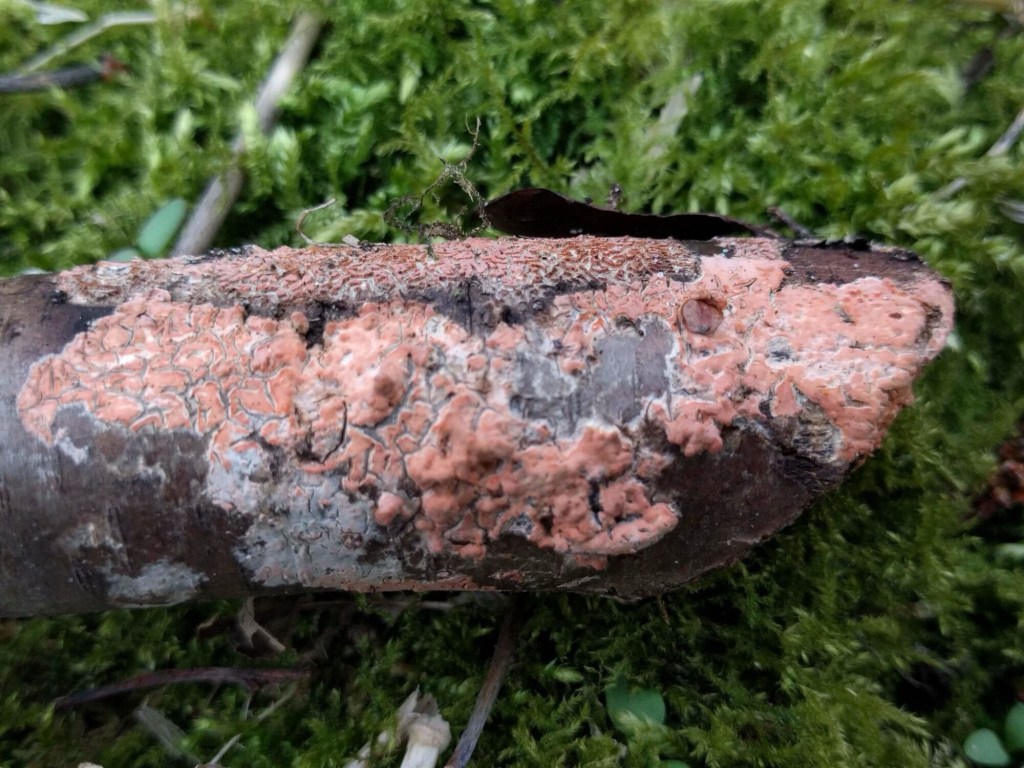
T. mesenterica is a parasite, growing on the mycelia of Xylophagous (wood decaying) fungi, specifically those in the Peniophora genus.
It absorbs the nutrients of the host fungi, essentially parasitising on a parasite, and remains hidden for most of its life, only becoming visible above its woody substrate when conditions are just right for producing spores; damp, cool and dark.
Peniophora itself, which has the common name of ‘Rosy Crust fungus’, feeds on the dead wood of Ash, Oak, Beech, Hornbeam and other deciduous species , preferring Oaks and dead branches which are still attached to the tree.
It is a ‘pioneer’ species, meaning that is usually the first to colonise dead timber, causing ‘white rot’ and often being the first indication to us that the wood is beginning to rot.

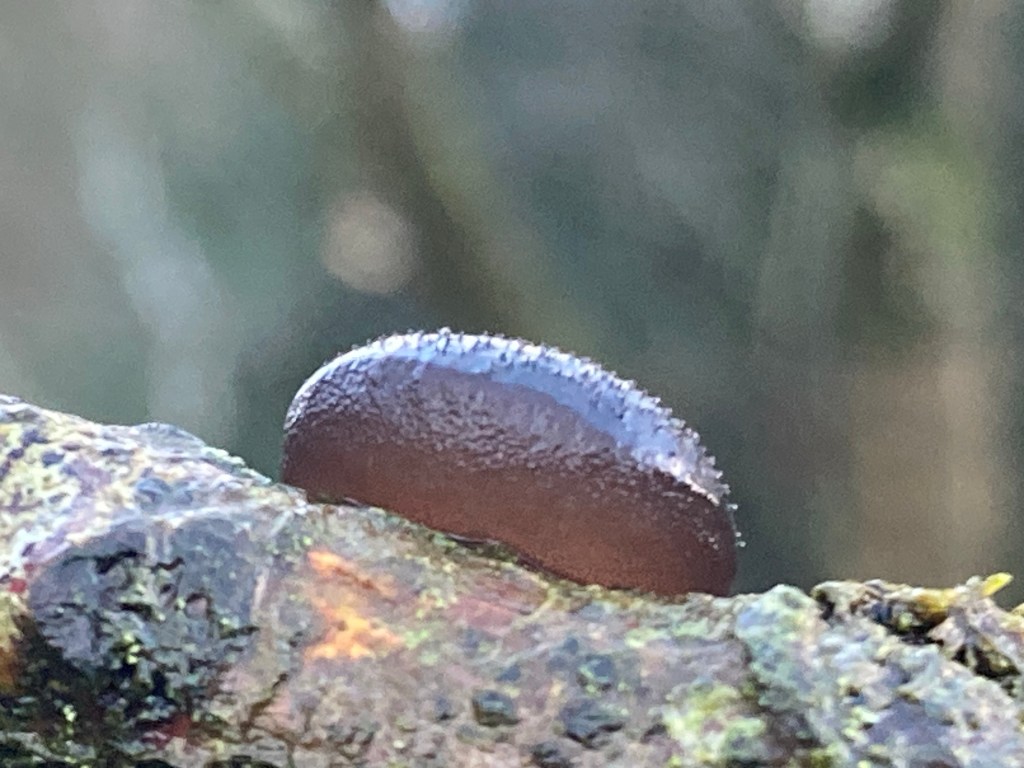
It behaves in an antagonistic manner towards other Xylophagous fungi, in particular Hymenoscyphus fraxineus, which causes ‘Ash Dieback Disease’, so is currently being studied by Dendrologists (tree scientists) in their efforts to find a cure.
They have found that the easiest way to identify the presence of Peniophora is to look for the bright yellow fruiting bodies, the Witches’ butter, which grow upon it, as Peniophora itself is so hard to spot.
Oddly enough, Ash trees are traditionally considered to be protective against witches and their evil curses, and in the North of England were often planted beside farms to this purpose.

* The BMS List of recommended names, created so as to avoid confusion when multiple species share the same common names, records it as Yellow Brain)
A B-H
(Jan 2025)
 Northwest Nature and History
How could you get Yellow Brain fungus so wrong with all the experience you apparently have ? Please use the BMS list of recommended English names for fungi. (Witches Butter is black and is the common name for Exidia glandulosa)
LikeLike
As mentioned in the article itself T. mesenterica is known as witches butter and yellow brain, i preferred to use witches butter in this article because i like the folklore and i don’t think it looks remotely like a brain, however either is correct, a lot of things are called ‘witches butter’ though, even Nostoc which isn’t even a fungus, so I’ll give you that
LikeLike