
The Wolf-moon
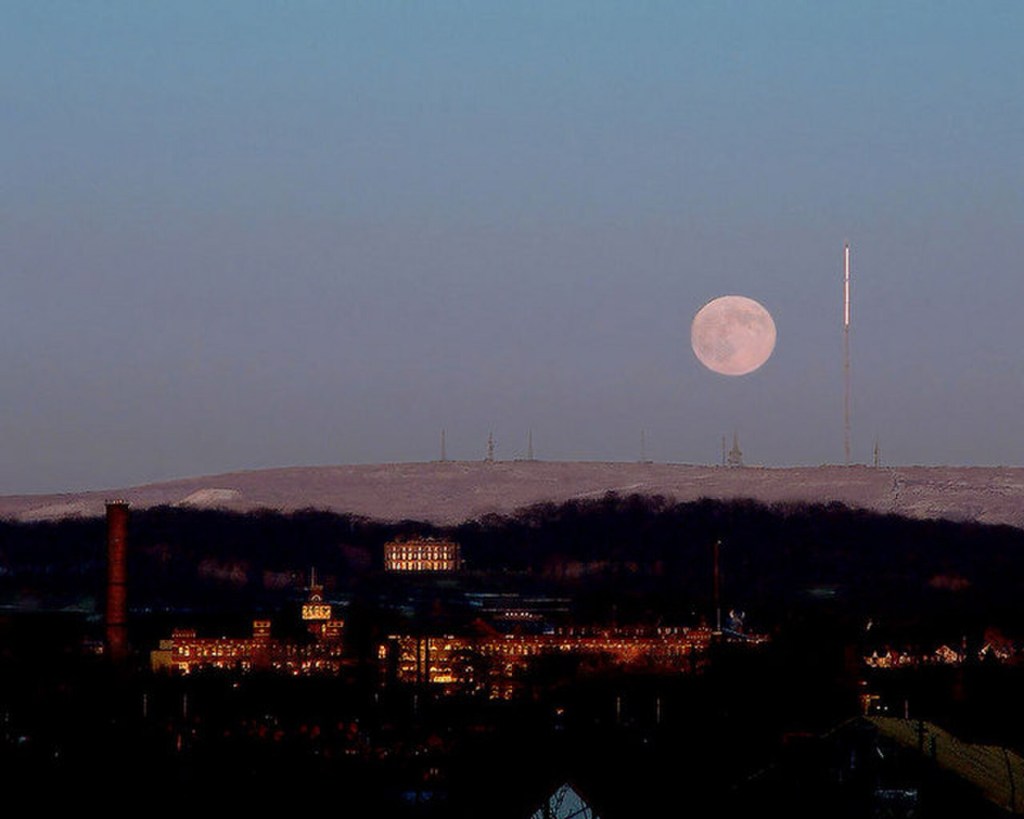
Tonight, given that the weather forecast is cloudy and rainy, there is a slim chance that you might be able see the full beauty of the January full moon, also known as the ‘Wolf moon’ or ‘Old moon’.
The Northwest of England has several dark sky discovery sites in and around it, these being areas largely free from light pollution so perfect places to observe astronomical events such as the rising of the full moon.
The tradition of naming full moons is having a bit of a resurgence at the moment, with each full moon being given a headline-worthy, romantic name. This one is called the ‘wolf moon’ as it supposedly coincides with the howling of wolves in their winter courting.
Wulf-monat
In Richard Verstegan’s ‘The Restitution of Decayed Intelligence’ his treatise on the origins of England published in 1628, he wrote
“our Saxon ancestors originally called this month ‘Wolf-monat’, that is, Wolf-month, because people were wont always in that month to be more in danger to be devoured of wolves than in any season else of the year, for that, through the extremity of cold and snow, those ravenous creat-ures could not find beasts sufficient to feed upon.”’
Wolves, however, have been extinct in the British isles since the 1600s, so you don’t have to worry about being devoured this full moon!
More traditional names in British folklore for the first full moon of the year include the ‘moon after Yule’ for obvious reasons, the ‘frost’ or ‘ice’ moon and the ‘old moon’ as it is the the culmination of the last moon cycle of the previous year, the next new moon being the first of 2025.
Full Moons in 2025
February: 12th
March: 14th (🌕29th)
April: 12th (🌕 27th)
May: 12th (🌕 26th)
June: 11th
July: 10th
August: 9th
September: 7th
October: 6th (🌕 7th)
November: 5th (🌕 5th)
December: 4th (🌕 4th)
There will be also be six ‘supermoons’ in 2025 (supermoons marked above with 🌕)
A supermoon occurs when a full moon coincides with perigee, this being when the moon is closest to the earth in its orbit. When this happens the moon can appear to be up to 30% brighter and 14% larger than a typical full moon.
The first set of three supermoons will fall on March the 29th, April the 27th and May the 26th, the second set will fall on Oct the 7th, Nov the 5th and Dec the 4th.
The sunset embers smolder low,
The Moon climbs over the hill,
The peaks have caught the alpenglow,
The robin’s song is still.
John L. Stoddard (1850–1931)
A B-H
 Northwest Nature and History