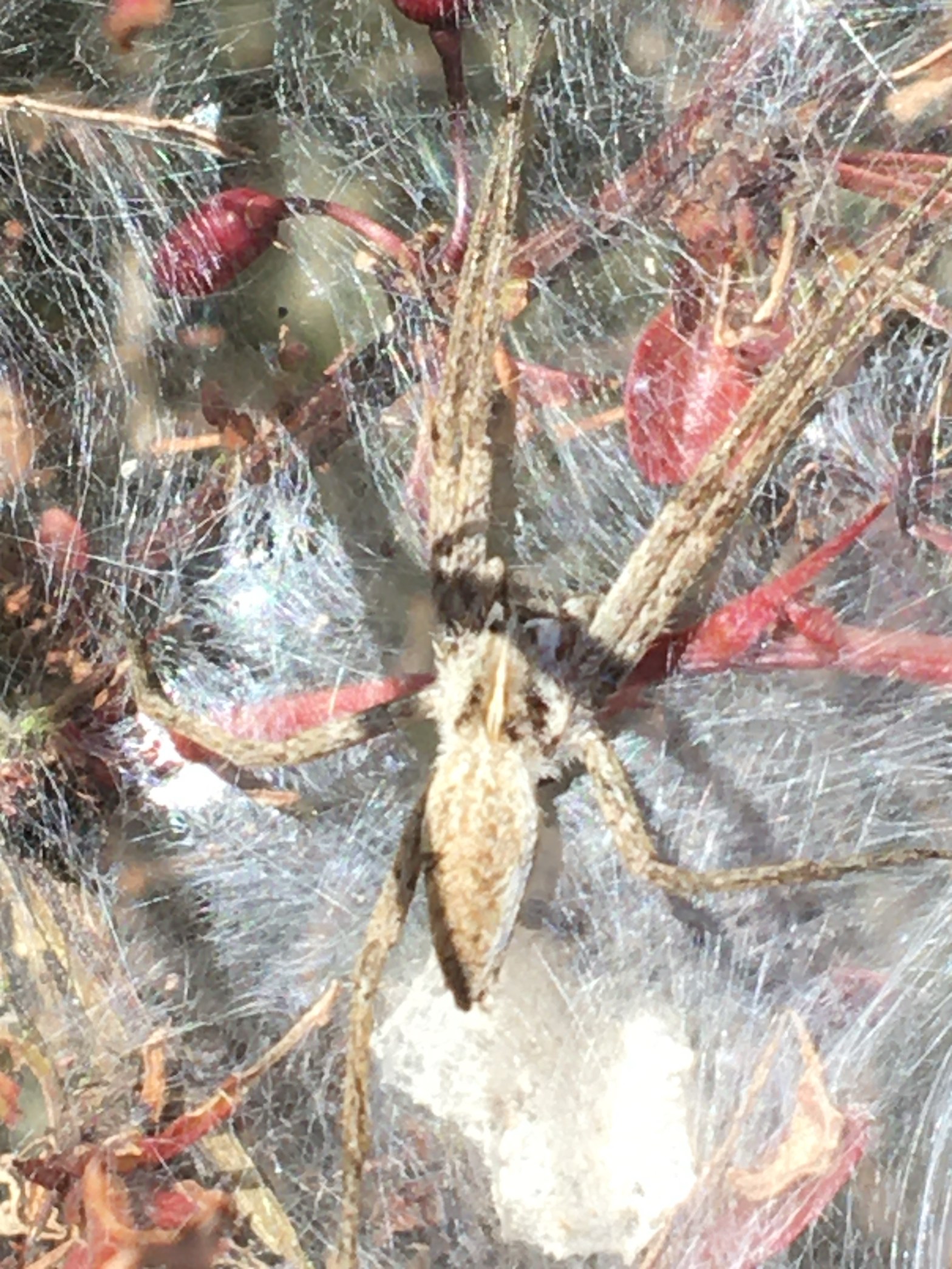

Nursery web spiders are fascinating creatures known for their unique parental care and courting behaviour.
Their scientific name is Pisaura mirabilis and the second half of this, mirabilis (the root of the word miraculous), means ‘admirable’ or ‘remarkable’ and refers to the remarkable parental care the mother gives to her progeny.
Another name commonly used for this species is ‘Tent spider’, after their habit of constructing intricate silken ‘tents’ to safely bring up their children within. These can be seen in long grass and vegetation during the breeding season from mid-June to July, with another smaller season from mid-August to September.
(Andreas Eichler)
Arachnid Appearance
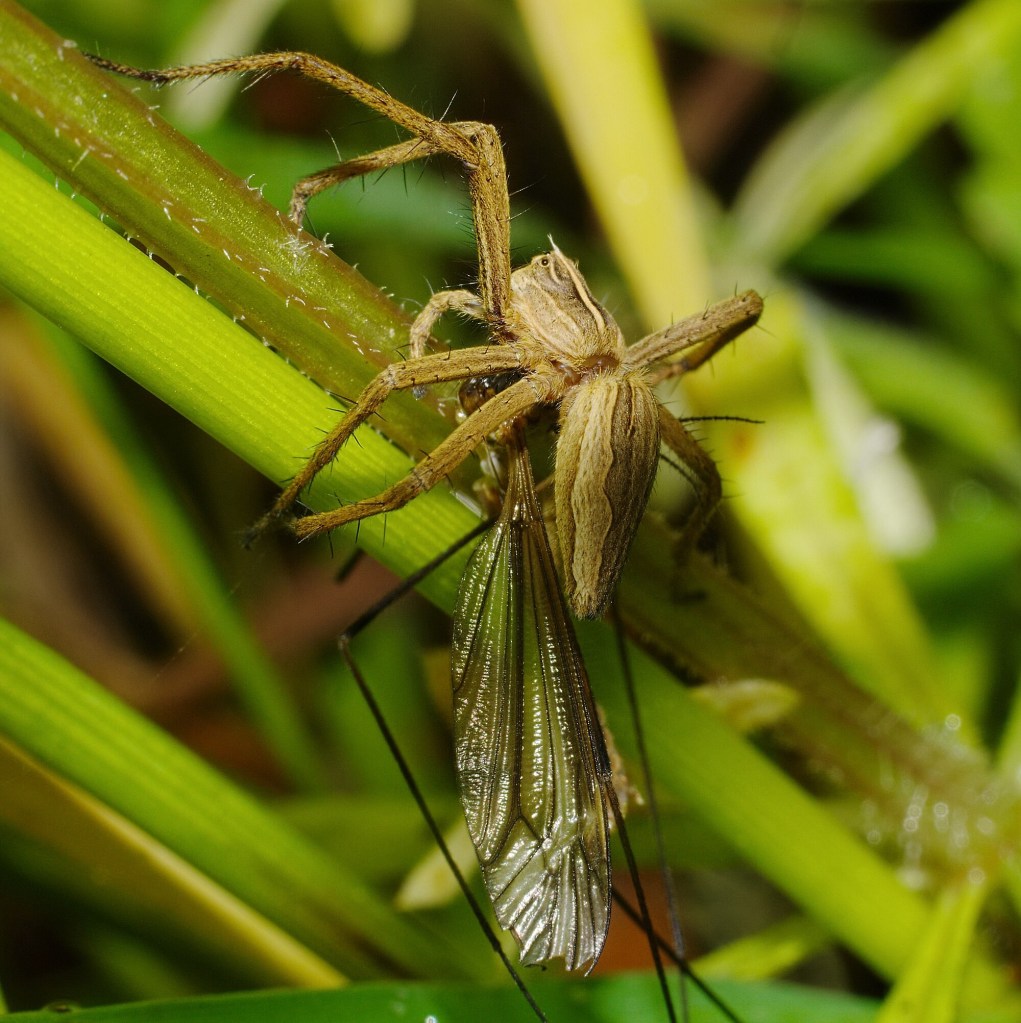
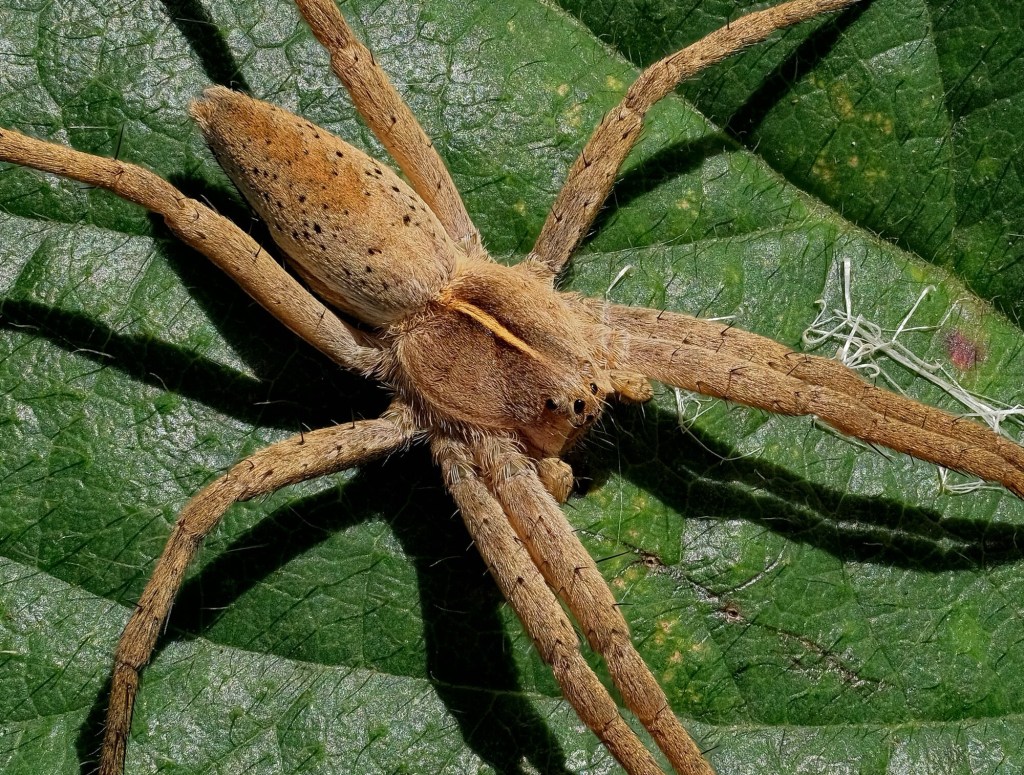
This arachnid can be identified by its slender, cigar-shaped body and long, robust legs. The Adult can vary in appearance from grey, through yellowish/orange, to dark brown, with a pale stripe just behind the head and paler sides on the abdomen.
They can be distinguished from similar species like raft spiders by their size and habitat preferences, with nursery web spiders being notably smaller (the females body being up to 1.5cm in length) and more widespread.
Common throughout much of the British isles, particularly in lowland areas south of a line drawn from North Yorkshire to the southern Lake District, they are also found scattered throughout Scotland. Within this broad range they favour herbaceous vegetation like uncut grassland, nettle-beds and heaths where they can actively hunt for prey.
(Johannes Robalotoff)
Excellent Eyesight
Unlike many of their kind nursery web spiders do not rely on webs to catch their prey, preferring to actively hunt it down instead, using their speed and strength to capture flies and other small insects that come within range.
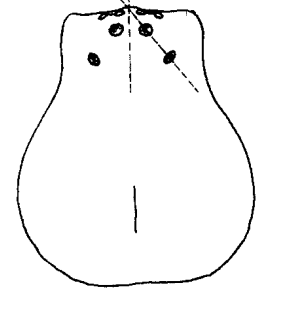
To do this they have evolved excellent eyesight, with eight equally proportioned eyes positioned at the front of its Prosoma, or ‘head’ such as to focus on movement, much in the way other predators, like us humans for example, have theirs.
Whilst they wait to espy their dinner they usually assume a stance with the first two pairs legs joined and protruded ahead. When prey is sighted they will seize it with lightning-sharp reaction speed and pull it to their mouth to deliver the coup de grâce with their powerful jaws.
Often they will rest with both their front and rear pairs of legs together so as to avoid offering a typical 8-legged spider profile to potential predators such as birds.
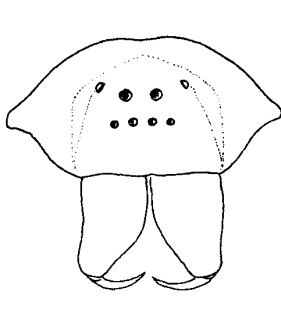
images from Aranaea
Nuptial Gift Giving
The courting behaviour of P. mirabilis is fascinating in its own right and has been the subject of many studies, being a textbook example of ‘nuptial gift giving’, and it proceeds broadly like this;
When ready to court a female the male catches a suitable prey item and wraps it carefully in a silken thread, then he looks for a female to introduces himself to. When he finds a receptive female he keeps his prosoma raised and his anterior limbs apart and vibrating whilst proffering his wedding gift.
If the female deems the gift acceptable she will mate with him, otherwise he will have to go off and find something better and try again with another female.

(Aleksandrs Balodis)
It was long thought that the male offered his nuptial gift in an attempt to avoid being eaten by the female, but research has found that it is rather a case of the male demonstrating his hunting prowess.
The research found only 40% of males without gifts managed to mate, compared to 90% of males with gifts, and that the duration of the mating was proportional to the size of the gift.
Also the percentage of fertilised eggs increased with the duration of the mating and therefore with the dimensions of the gift, although the number and sizes of the newborns were not influenced by the gift.
These experiments proved something else too, which rather surprised the arachnologists involved. They found that deception, lying and general selfishness are not traits exclusive to humans, as the male nursery web spider will sometimes, if he is unable to catch a real gift, wrap up a grass seed or other bit of detritus and proffer that as a fake gift instead, hoping he can get away before she notices!
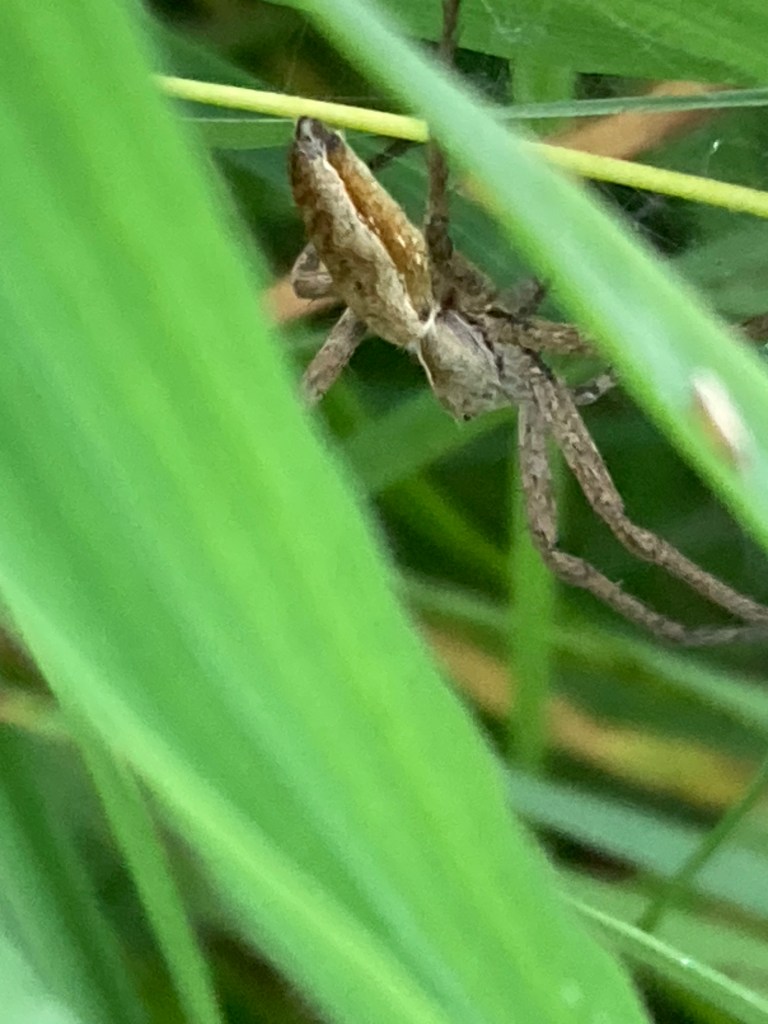
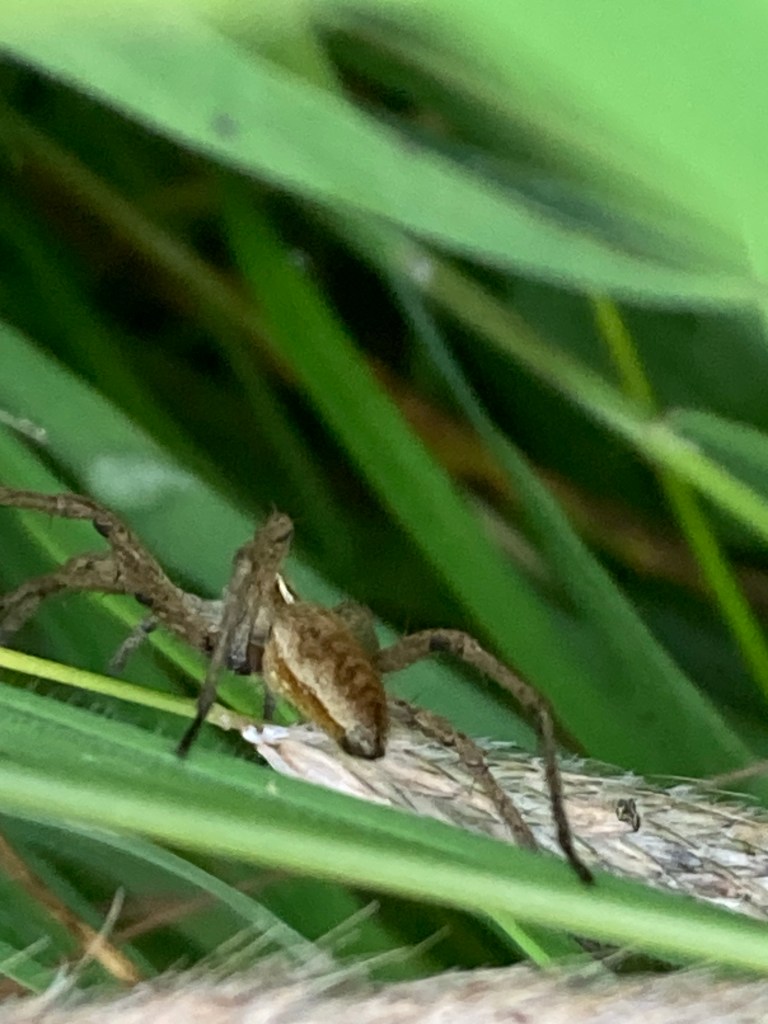
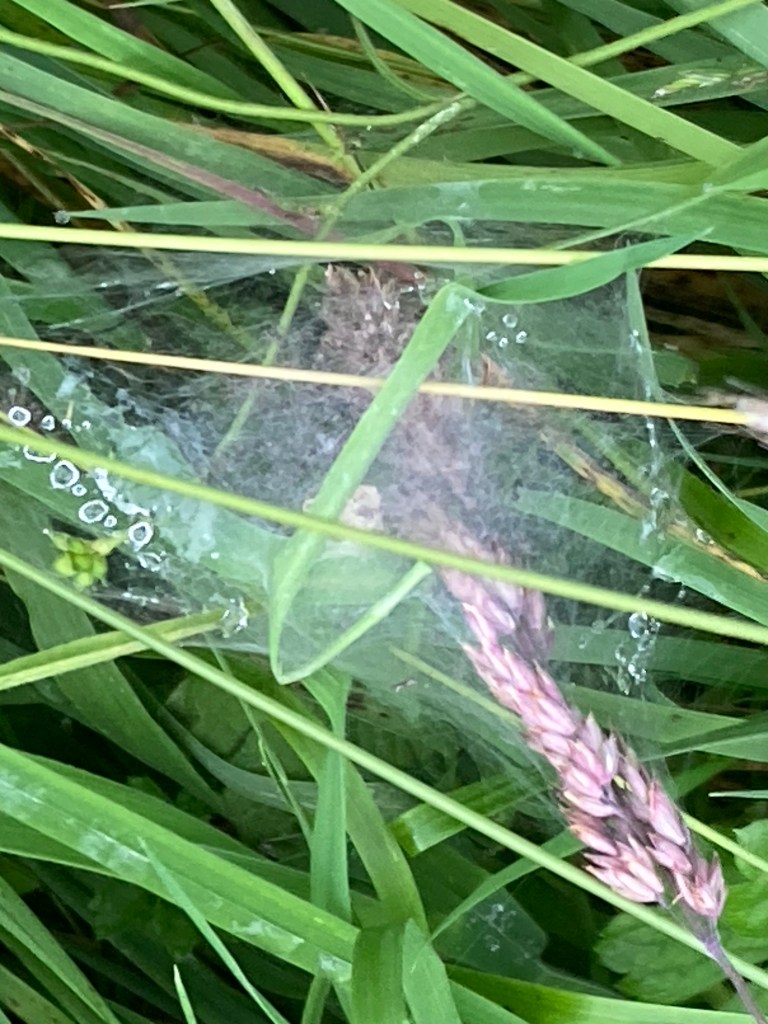
P. mirabilis in grass on the bank of the Leeds/Liverpool canal. Canal banks are a very good place to find them.
Nursing Spiderlings
The most distinctive behavior of nursery web spiders is of course their caring manner of nurturing their young.
After mating, the female spider spins a silk sac to hold her eggs. She then carries this egg sac with her, either in her chelicerae (mouthparts) or attached to the spinnerets at the end of her abdomen, thus protecting the eggs from both predators and environmental hazards.
Just before the eggs are about to hatch the female constructs a nursery web. This is a tent-like structure made of silk, usually positioned in foliage, where the eggs are placed. This nursery provides a safe environment for the spiderlings to hatch in.
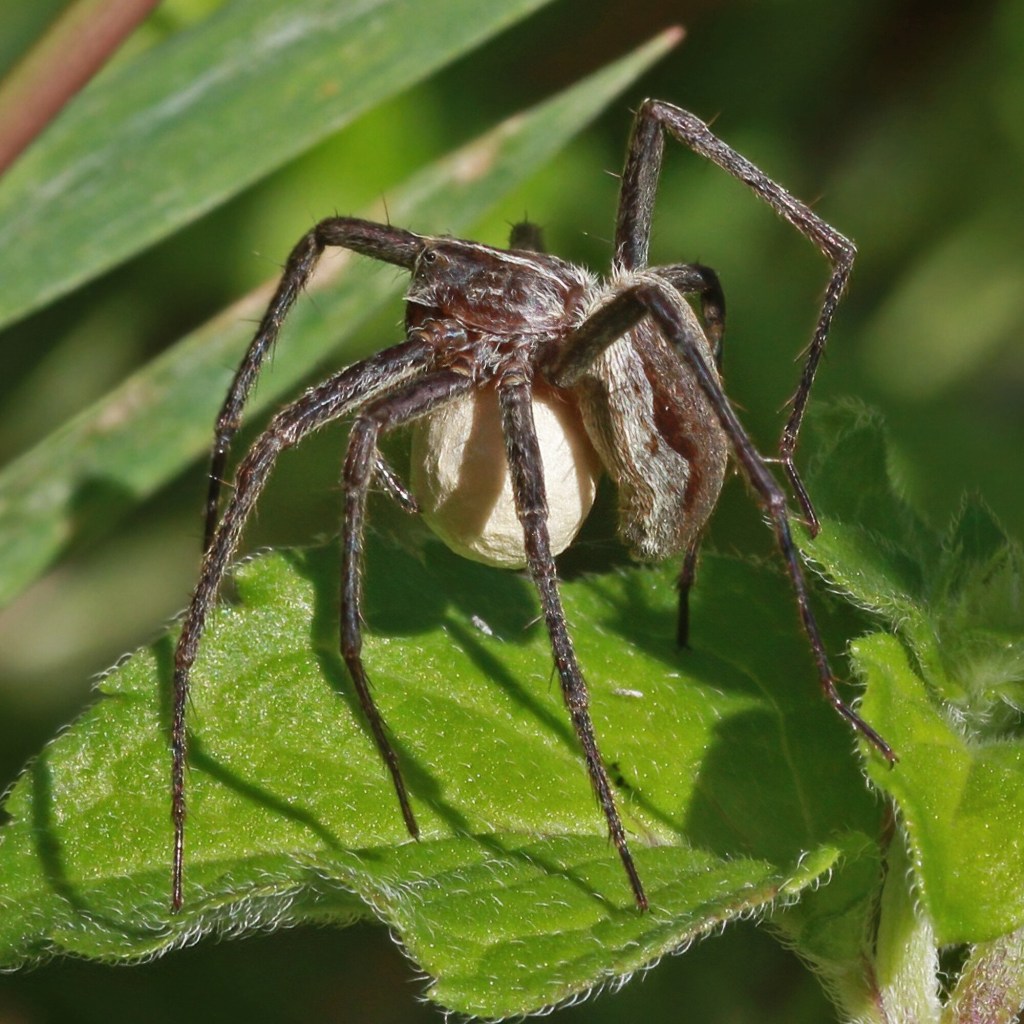
(Charles J Sharp)
The mother spider will guard this nursery web fiercely. She remains close by or even on top of the web, protecting it from predators and parasites. This guarding period can last from one to two weeks, or until the spiderlings are ready to emerge.
Once the spiderlings hatch, they remain in the nursery for a short period, often continuing to be guarded by the mother, and when they are ready, they disperse.
This level of care is relatively rare among arachnids and possibly explains why this species is so common and widespread.
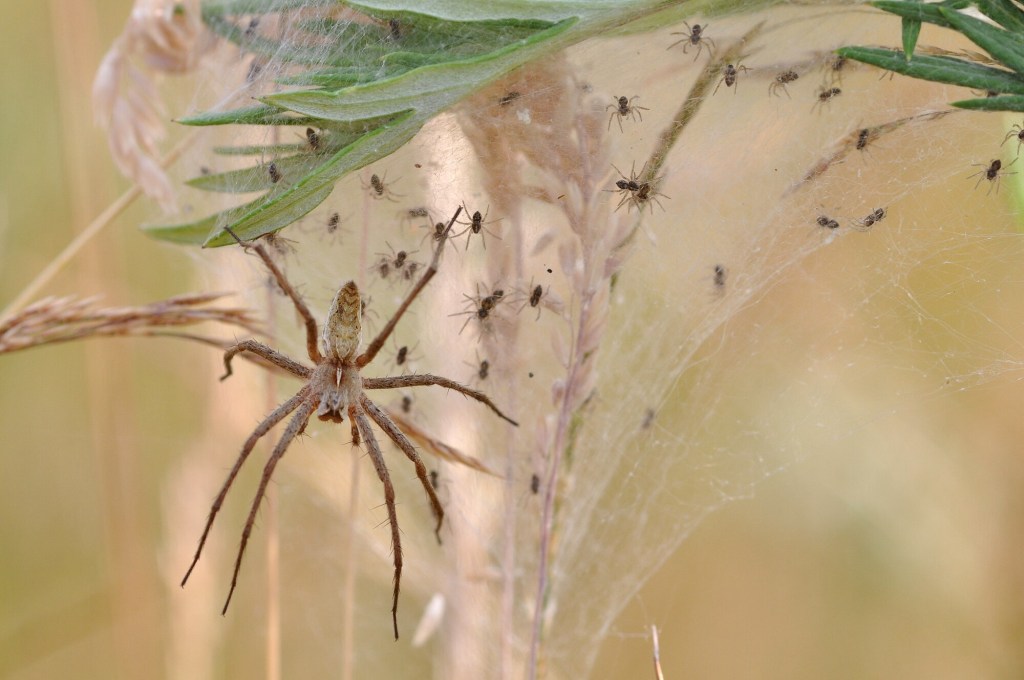
(Aiwok)
The Spider also Loves and Strives
In the dark depths of the bright green leaves, hidden away and out of sight,
Sits a spider, a mother to be, holding her clutch of eggs so tight.
With infinite care and silk so fine, she weaves a cradle to place them in,
And sits upon it keeping guard, with legs so long and eyes so keen.
For within the cradle she holds her future, a precious bundle of life untold,
And this she’ll guard so very fiercely, ‘gainst enemies, rain, wind, heat and cold
With patience and vigil she’ll stay above, ever watchful, a sentinel of paternal love
‘Til they’re ready to leave, her spiderlings, to go and live their own new lives.
For though we may not think it, spiders are very much like us, they also love and fight and strive.
A B-H
1st Feb 2025
N.B: I was partly inspired to write this after looking at some of the artwork Richard Lewington has done for various guidebooks.
 Northwest Nature and History