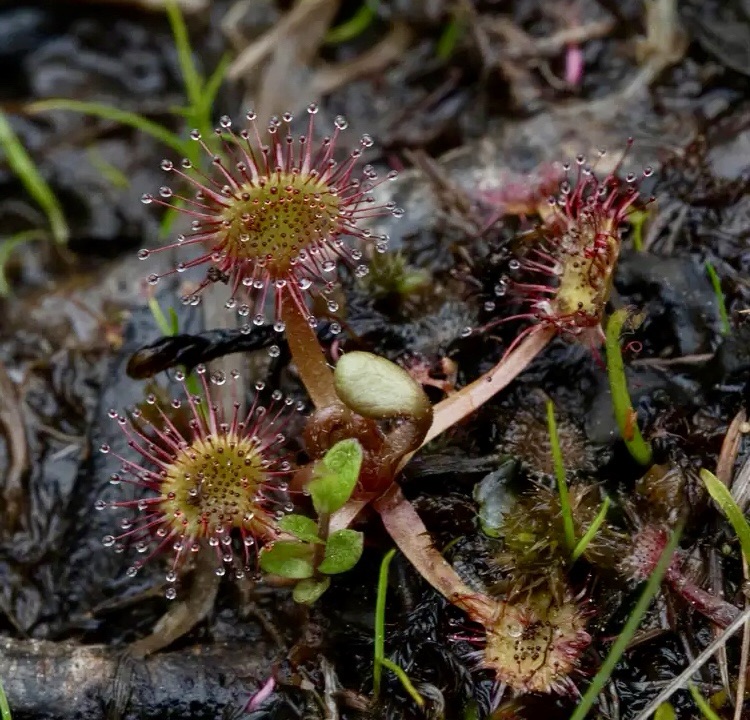
The Round-leaved Sundew, Drosera rotundifolia, (Drosera meaning ‘dewy’ in latin) is a small carnivorous plant found in bogs, it is locally common but hard to find, in England its strongholds are our upland moors, in particular those found in the Northwest.
Insectivorous
A small and peculiar looking plant, with reddish coloured ‘leaves’ covered in sticky hairs, the Round-leaved sundew grows in acid bogs which are sparse in nutrients, which is why it has evolved the ability to catch insects . When an insect alights on one of its leaf-like appendages, it becomes stuck unable to escape, and the plant, sensing this, begins to curl its leaves around the hapless insect to hold it fast.
The sundew then exudes digestive juices and enzymes to get the job done (that link includes instructions for a relatively easy method of finding out which enzymes a carnivorous plant uses). D. rotundifolia utilises an enzyme called nepenthesin which works best in acid conditions, which is one reason it thrives in the acid bogs of our upland moors.
Favoured Habitats
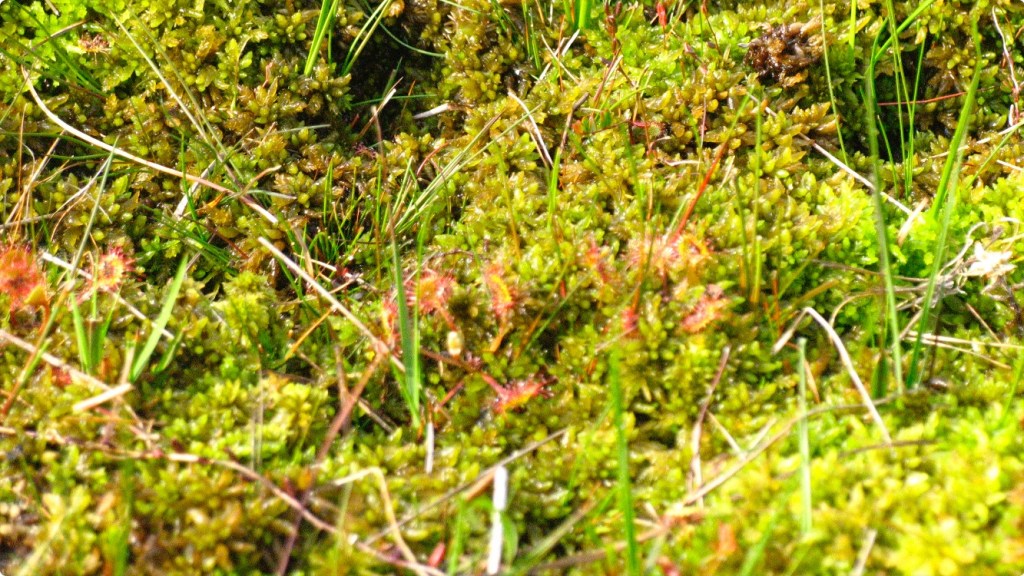
In the North of England there are many sites where the Sundew grows in abundance, I know of several places where it can be found lurking in the mosses, one is at the base of Lamb hill in the Forest of Bowland, where it grows in Sphagnum moss next to a very clear-flowing spring, another is on a blanket bog near Silverdale.
Both places are open and sunlit through most of the day, as the Sundew does photosynthesise even though it ‘cheats’ by eating insects!
It is susceptible to drying out so is rarely found on south-facing slopes where it would roast in a hot summer and is threatened by encroaching woodland in other places, so it is quite vulnerable to habitat loss.
This is something that needs to be considered in any rewilding or woodland regeneration schemes.
Darwin’s Obsession
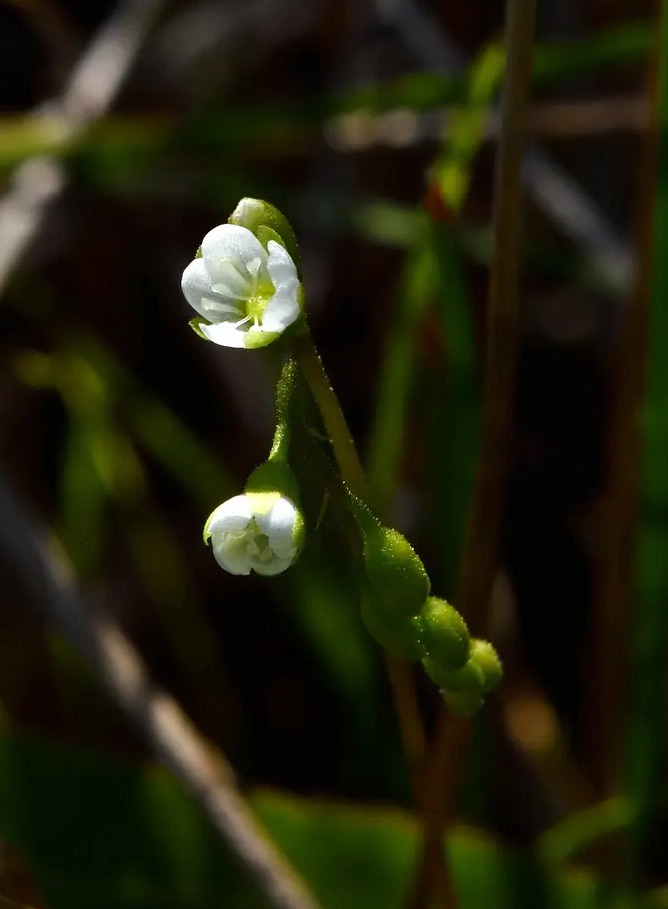
Darwin was famously enamoured with the sundew, famously stating; “I care more about Drosera than the origin of all the species in the world” and his works contain several sketches of the plant, its leaves and its flowers.
In particular he was fascinated with how it evolved into its particular niche and botanists have long had an interest in the plant’s medicinal properties, including its use for treating heart problems.
One of his close friends, E. F Lubbock, mildly amused by Darwin’s obsession with Drosera once penned a humorous ditty From the Insects to their friend, Charles Darwin which included these lines written from a fly’s perspective;
I never trusted Drosera,
Since I went there with a friend,
And saw its horrid tentacles
Beginning all to bend.
I flew away, but he was caught,
I saw him squeezed quite flat—
I don’t go any more to Plants
With habits such as that.

(Cambridge University Library)
Hopefully the sundew can continue to thrive on our peat-bogs as it such a wonder to find and its health reflects that of the rest of the moorland and the bogs it grows in.
The Sundew
By Algernon Charles Swinburne (1837-1909)
A little marsh-plant, yellow green,
And pricked at lip with tender red.
Tread close, and either way you tread
Some faint black water jets between
Lest you should bruise the curious head.
A live thing maybe; who shall know?
The summer knows and suffers it;
For the cool moss is thick and sweet
Each side, and saves the blossom so
That it lives out the long June heat.
The deep scent of the heather burns
About it; breathless though it be,
Bow down and worship; more than we
Is the least flower whose life returns,
Least weed renascent in the sea.
We are vexed and cumbered in earth’s sight
With wants, with many memories;
These see their mother what she is,
Glad-growing, till August leave more bright
The apple-coloured cranberries.
Wind blows and bleaches the strong grass,
Blown all one way to shelter it
From trample of strayed kine, with feet
Felt heavier than the moorhen was,
Strayed up past patches of wild wheat.
You call it sundew: how it grows,
If with its colour it have breath,
If life taste sweet to it, if death
Pain its soft petal, no man knows:
Man has no sight or sense that saith.
My sundew, grown of gentle days,
In these green miles the spring begun
Thy growth ere April had half done
With the soft secret of her ways
Or June made ready for the sun.
O red-lipped mouth of marsh-flower,
I have a secret halved with thee.
The name that is love’s name to me
Thou knowest, and the face of her
Who is my festival to see.
The hard sun, as thy petals knew,
Coloured the heavy moss-water:
Thou wert not worth green midsummer
Nor fit to live to August blue,
O sundew, not remembering her.
If you enjoyed this article please consider showing your appreciation by buying me a coffee, every contribution will go towards researching and writing future articles,
Thank-you for visiting my site,
Alex Burton-Hargreaves
June 2025
 Northwest Nature and History
Nice post
LikeLiked by 1 person
Thank-you 🙂
LikeLike