
Common Honeysuckle, Lonicera periclymenum, also known as Woodbine, is one of those plants that easily goes unnoticed until it bursts into flower, filling the air with a heady, sweet perfume that draws you in as you pass.
Twisting and twining its way through our hedgerows, these tubular blooms shift from creamy white to yellowish-pink through the year, attracting a host of pollinators on warm summer evenings.
A native climber it is a familiar sight throughout the countryside, where it weaves its way through not only our hedgerows but into the very fabric of the landscape itself and, as we’ll find out later, its folklore.
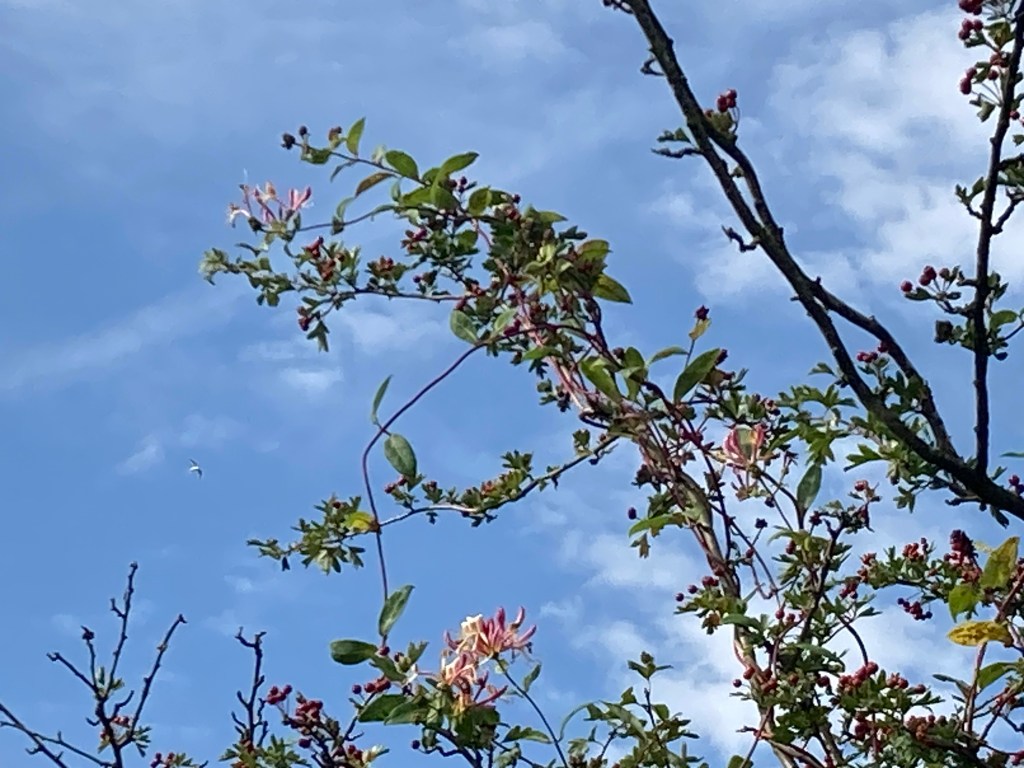
Well-behaved Woodbine
A deciduous or semi-evergreen woody climber, Honeysuckle is capable of reaching heights of up to 7 metres as it twists around supporting trees or shrubs.
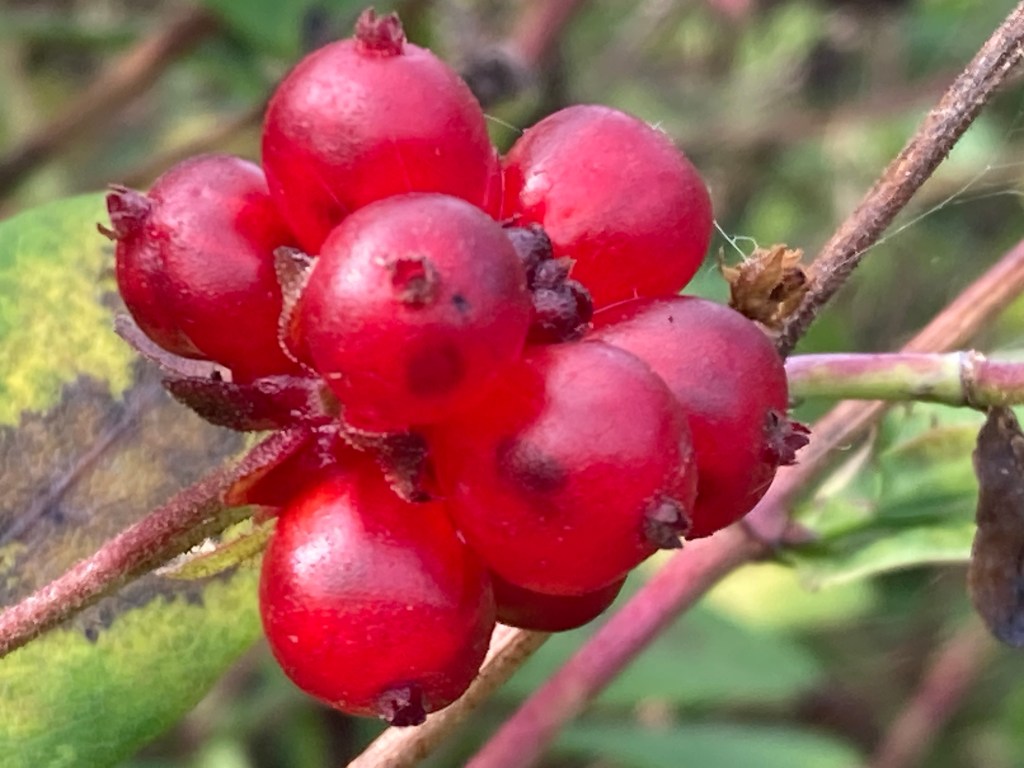
Its leaves are opposite, oval, and dark green, often with a slightly hairy underside and its flowers emerge from June to September, starting white or cream and maturing to a flushed pink or yellow. These are followed by bright red berries in autumn, which, while attractive to birds, are toxic to humans and can cause stomach upsets if ingested.
In the field, it’s easy to spot by its twining habit, always anti-clockwise (I wonder if it grows clockwise in the southern hemisphere?) and the strong, sweet fragrance of its flowers that intensifies at dusk.
Unlike some invasive honeysuckles, such as the Japanese variety, Lonicera japonica, Common Honeysuckle is native and well-behaved, not outcompeting other plants but rather enhancing the biodiversity of its surroundings.
Its scientific name, Lonicera periclymenum, derives from the 16th-century botanist Adam Lonicer and the Greek words peri, περί, meaning ‘around’ and klima κλῆμα, meaning ‘twig,’ ‘branch’ or ‘shoot’, Periclymenus was also one of the Argonauts who possessed the power of shapeshifting.

Isaak Briot 1619
Honeysuckle Habitats
Here in the Northwest of England, Honeysuckle thrives best on our woodland edges and hedgerows, particularly where the soil is moist but well-drained and slightly acidic.
You’ll find it clambering over Hawthorn and Blackthorn in the valleys of the Yorkshire Dales or the gritstone edges of the Pennines, as well as in the damper, lowland woods of Lancashire and Cumbria. It’s very common along rural lanes in areas like the Forest of Bowland or the edges of Morecambe Bay, where it benefits from the mild, oceanic climate that prevents harsh frosts.
This plant is adaptable but prefers semi-shaded spots, avoiding deep woodland interiors or exposed moorlands. In urban fringes, it sometimes appears in overgrown gardens or railway embankments, a reminder of how our native flora can persist, and even flourish, amid human development. Its presence often indicates healthy, undisturbed habitats, as it dislikes heavy pollution or intensive agriculture.

Pollinating Powerhouse
Ecologically, Common Honeysuckle is a pollinating powerhouse. Its nectar-rich flowers are a magnet for flying insects, especially long-tongued bees, butterflies, and moths like the Elephant Hawk-moth, which hover around its flowers at dusk to feed.
The plant’s evening scent is an adaptation to attract nocturnal visitors like this, ensuring pollination under the cover of night, and in turn, the red berries provide vital autumn food for birds such as blackbirds, thrushes, and even Wood mice, aiding seed dispersal.
As a climber, it adds structural diversity to woodlands, creating niches for insects and small mammals. Larvae of certain moths, like the Honeysuckle Moth, feed on its leaves, while aphids and other invertebrates use it as a host, supporting the food web.
In our countryside, where biodiversity can be challenged by habitat fragmentation, Honeysuckle helps connect fragmented woodlands, offering corridors for wildlife. It’s also resilient to browsing by deer, regrowing vigorously if damaged.
Honeysuckle in History
Honeysuckle has woven itself into human history for centuries. In folklore, it’s associated with love and fidelity, its twining stems symbolising unbreakable bonds. Victorian flower language deemed it a token of devoted affection, and in some rural traditions, bringing it indoors was thought to predict a wedding. Shakespeare referenced it in A Midsummer Night’s Dream, evoking its enchanting scent in enchanted woods.
Medicinally, it has a long pedigree. Traditional herbalists used the flowers and leaves for respiratory ailments like coughs and asthma, as well as a diuretic or to treat skin irritations. The berries, though poisonous, were once employed cautiously in poultices. Here in the Northwest, where out infamously damp weather can exacerbate such issues, it may well have been a go-to remedy in rural communities.
Today, it’s valued in gardens for its fragrance and wildlife appeal, and in conservation efforts to restore hedgerows. However, care should be taken not to confuse it with non-native species, like the afore-mentioned L. japonica, that can become invasive.
Common Honeysuckle may not shout for attention like a showy orchid, or possess the stately grandeur of trees like the Oak which it may climb upon, but I find that its subtle charms are more than enough to make it a true gem in the treasure chest of our natural heritage.
Next time you’re wandering a woodland path and catch that intoxicating scent, maybe pause for a while, and appreciate this unassuming climber that’s been part of our landscape for millennia, and thank it for the work it does supporting other members of our natural ensemble.

Come, sit thee down upon this flowery bed,
While I thy amiable cheeks do coy,
And stick musk-roses in thy sleek smooth head,
And kiss thy fair large ears, my gentle joy.
Sleep thou, and I will wind thee in my arms.
Fairies, be gone, and be all ways away.
So doth the woodbine the sweet honeysuckle
Gently entwist; the female ivy so
Enrings the barky fingers of the elm.
O, how I love thee! how I dote on thee!
From A Midsummer Night’s Dream by William Shakespeare, Act 4, Scene 1, spoken by Titania, Queen of the Fairies, as she addresses Bottom,the weaver from Athens and member of the “Rude Mechanicals” troupe. At this stage of the play Bottom’s head has been transformed into that of a Donkey’s by Puck, servant to Oberon, King of the fairies (hence the ‘sleek smooth head’ and ‘fair large ears’).
If you enjoyed this article please consider showing your appreciation by buying me a coffee, every contribution will go towards researching and writing future articles,
Thank-you for visiting,
Alex Burton-Hargreaves
(Aug 2025)
 Northwest Nature and History