
The Wild Carrot, Daucus carota, is a familiar yet often overlooked wildflower gracing verges and wastelands throughout the British Isles.
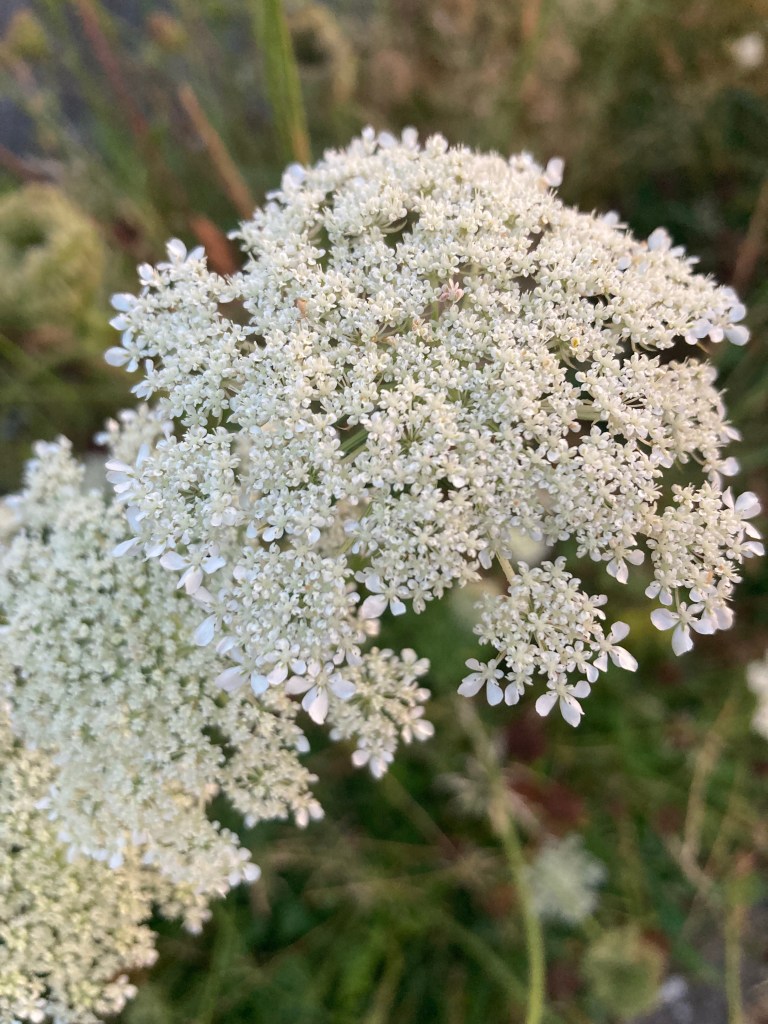
I recently spotted some fine specimens while wandering the edges of a derelict industrial site at the end of our road here in Padiham, its lacy white umbels swaying gently in the summer breeze amidst a tangle of grasses and thistles, photos of which I’ve used to illustrate this article.
The name Daucus comes from the Greek word
daûkos (δαῦκος) which simply means carrot, so the plants binomial name translates as ‘carrot carrot’
Culinary Cousin
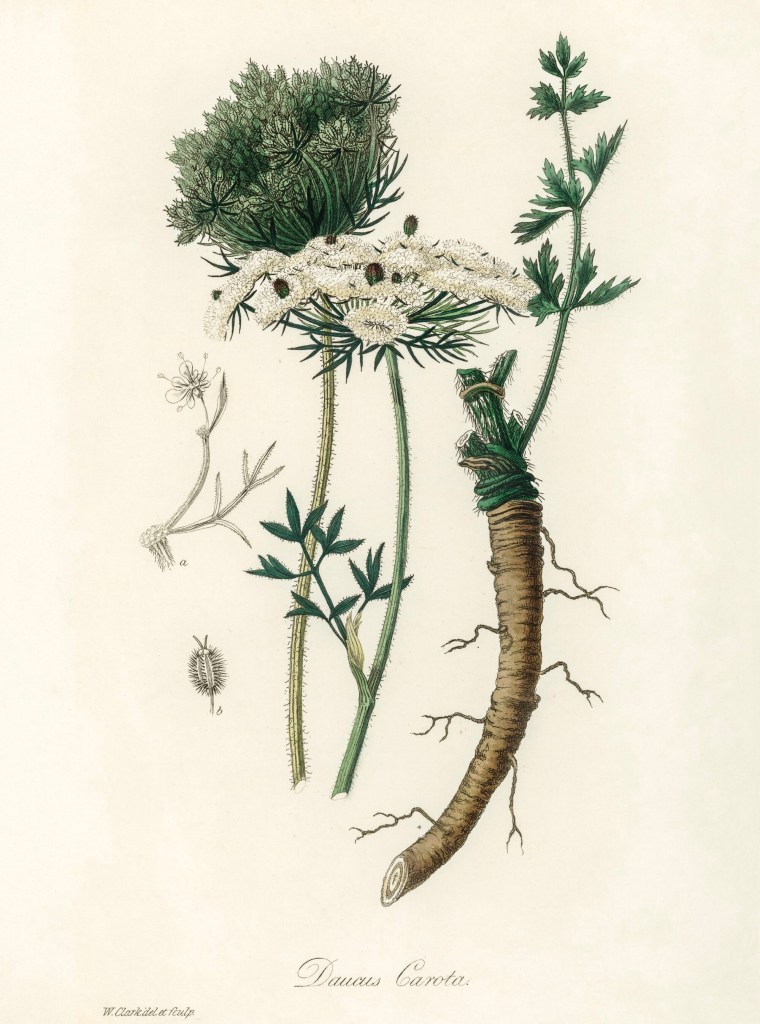
Belonging to the Apiaceae family, which includes familiar herbs like Parsley and Fennel, Wild Carrot is a biennial species. In its first year it forms a low-growing rosette, composed of finely divided, feathery leaves that resemble those of its cultivated culinary cousin, the garden Carrot.
By the second year, it sends up a sturdy, bristly stem that can reach up to a metre in height. Atop this stem blooms a compound umbel, a flat-topped cluster of tiny white flowers arranged in a lace-like pattern, often with a single dark purple floret at the very centre. This central spot, which is infertile, is said to attract pollinators, though its purpose remains a bit of a botanical mystery.
The flowers appear from June to August, curling inwards at night or in poor weather, much like an umbrella folding shut. After flowering, the umbel contracts into a bird’s-nest shape, enclosing the seeds which are covered in hooked bristles for dispersal by animals or clothing.
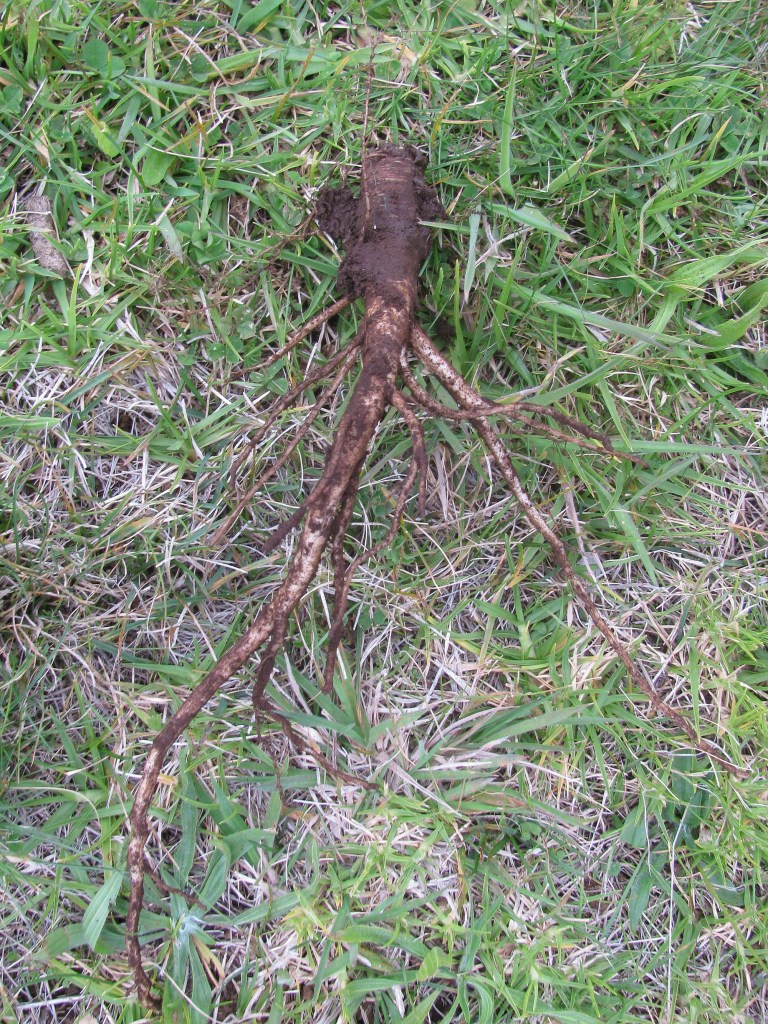
Care must be taken in identification, as the Wild Carrot can be easily confused with poisonous relatives like Hemlock, Conium maculatum, or Fool’s Parsley, Aethusa cynapium. A key distinguishing feature is the carrot-like scent when the leaves or root are crushed, though the root itself is woody and inedible in mature plants.

(Peter O’Connor)
Hardy Herb
This resilient species thrives in a wide variety of habitats, favouring disturbed ground where competition is low. Here in the Northwest you’ll find it along roadside verges, railway embankments, meadows, and coastal dunes, from the sandy soils of Merseyside to the exposed hills of the Yorkshire Dales.
It prefers well-drained, nutrient-poor soils and full sun, often colonising areas recovering from human activity, such as old quarries, abandoned farmland or the scrubby rubble of the former Magnesium works that I found it on.

Wildflower Folklore
Commonly known as Queen Anne’s Lace, the moniker stems from a tale of Queen Anne (1665 to 1714) pricking her finger while lace-making, with a drop of blood falling at the centre, mirroring the plant’s occasional purple floret. Other folk names include Bird’s Nest, due to the seed head’s shape, and Devil’s Plague, perhaps alluding to its weedy persistence?
Historically, the plant is the wild ancestor of the domesticated carrot, which was introduced to Britain by the Romans (one of many Roman imports including Pheasant and Rabbit) and cultivated for its nutritious root. In medieval times, it was used in herbal remedies for everything from kidney stones to snakebites, as noted in old herbals like Culpeper’s Complete Herbal (1653), where he praised it for its diuretic properties.
In folklore, picking the flowers was once thought to bring rain, a superstition that likely stems from the plant’s tendency to close its umbels in damp or overcast conditions, as if anticipating a downpour. Farmhands heading to the fields would avoid cutting the flowers, fearing they’d curse the day’s work with a sudden shower.
This belief persisted into the 19th century, with records from rural Cumbria noting that children were warned not to gather “Bird’s Nest” (another folk name, from the seed-head’s shape) lest they anger the sky.
During festivals like St. John’s Day (June 24th), its lacy flowers were woven into garlands alongside other wildflowers like Meadowsweet and St. John’s wort. These garlands were worn by young women or hung in homes to celebrate the solstice and ensure good fortune for the harvest.
In coastal areas like Morecambe Bay, where the plant thrives on sandy dunes, fishermen’s wives would include it in wreaths to bless boats, believing its delicate beauty carried the favour of sea spirits.
In other parts of the North, it was woven into garlands for midsummer festivals. Its seeds were even used as a spice or contraceptive in ancient times, though such practices are not recommended today.

Vital Vegetation
Ecologically, the Wild Carrot plays a vital role in supporting the biodiversity of marginal habitats. Its nectar-rich flowers are a magnet for a host of pollinators, including beetles, bees, hoverflies, and butterflies such as the Small Copper and Common Blue.
In upland areas like the Pennines, where summers can be fleeting, it provides essential forage during the peak flowering season, the plant’s structure offers shelter for small insects, and its seeds are a food source for seed-eating birds like the Goldfinch in autumn.
As a pioneer species, it helps stabilise soil in disturbed areas, preventing erosion and paving the way for other plants. Interestingly, it can be allelopathic, releasing chemicals that inhibit the growth of nearby competitors, which aids its spread.

Female four-banded longhorn beetle (Leptura quadrifasciata) on the inflorescence of D. carota
(Ivar Leidas)
While the mature root is tough and unpalatable, young Wild Carrot roots can be eaten much like garden carrots, though foraging requires expert identification to avoid toxic lookalikes. The seeds have been used as a flavouring in teas or as a coffee substitute, and the leaves can add a Parsley-like zest to salads.
Medicinally, infusions of the plant have been employed for urinary issues and as a mild antiseptic, but please consult a professional before use, as it can cause skin irritation in some.
In modern times, it’s mainly valued in wildlife gardening for attracting pollinators and is sometimes included in seed mixes for meadows, also crafters appreciate the dried seed heads for floral arrangements
In the words of the poet John Clare (1793 to 1864), from his work The Village Minstrel;
“The wild carrot shakes its white umbel high,
And nods its head to every passer-by.”
If you enjoyed this article please consider showing your appreciation by buying me a coffee, every contribution will go towards researching and writing future articles,
Thank-you for visiting,
Alex Burton-Hargreaves
 Northwest Nature and History
One thought on “Wild Carrot, or Queen Anne’s Lace, a Common Wasteland Wildflower”