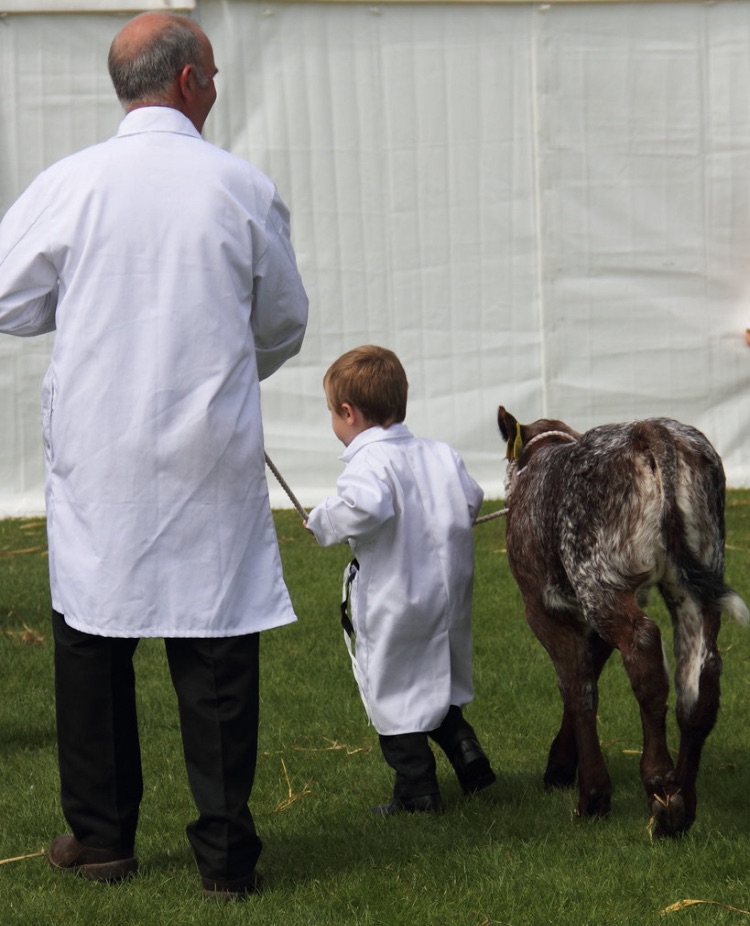
(DebbeeDot)
The United Kingdom’s agricultural sector stands as a pillar of food security, rural economies, and environmental management, yet it faces a generational shift amid rapidly evolving challenges.
With the average farmer’s age around 60, the industry urgently needs fresh talent to ensure its sustainability yet many have abandoned the profession.
For a long while the future looked dark for farming but recent years have witnessed a resurgence in interest among young people, particularly through Young Farmers’ Clubs (YFCs), which are experiencing membership growth and renewed vitality despite massive setbacks and funding cuts.
This revival, coupled with the enormously influential role of social media, paints a hopeful yet complex picture for the next generation.

(@ScotGov)
The Resurgence of Young Farmers’ Clubs
Young Farmers’ Clubs, coordinated by organisations like the National Federation of Young Farmers’ Clubs (NFYFC), have long been an anchor of stability for rural youth, offering opportunities for education, social connections, and skill-building.
After a challenging period where membership halved due to Covid disruptions, there’s been a notable renaissance.
The NFYFC’s 2025-26 membership year kicked off with enthusiasm, seeing the federation organising events like providing free tickets for young farmers at the Cereals 2025 show, a large arable farming conference held in Lincolnshire in June which attracted 20,000 visitors.
YFCs also promoted their dedicated programmes for the development of prospective farmers, such as the Competitions Programme with agricultural, sport, art, and public speaking events, and a Learning and Development programme featuring workshops on topics like farm safety, succession planning, mental health, and e-safety.
Clubs like Suffolk YFC reported a strong rise in membership, from 217 to 240 during 2025, which they attributed to the appeal of hands-on learning and community support in an increasingly isolated rural landscape. The Cumbrian Federation of YFCs boasted of a “fantastic year” with young people returning in droves for competitions, social events, and community work, and awards such as the Northern Farmer Awards’ 2025 Young Farmers’ Club of the Year category celebrated thriving groups.
Surveys reflected how this was valued, with a recent NFYFC poll showing that 93% of members reported improved health and wellbeing through involvement, with 96% feeling welcomed and included.
However, this momentum faces significant hurdles. The Department for Farming and Rural Affair’s (Defra) decision to end a long-standing grant to the NFYFC after 30 years caused dismay, though the department claims it’s providing £30,000 for 2025/26 and denies a full cut. Farmers responded, saying that the clubs play a vital role as a “lifeline” for mental health and skills in isolated areas.
Overall, despite challenges, membership trends show resilience, and many clubs report not only increased numbers of members but more participation in fund-raising events like charity speed shears and tractor runs.

(Instagram)
Navigating the Future; Challenges and Opportunities
The landscape for young people in UK farming is very unstable, with succession issues posing by far the greatest threat.
Last year’s autumn budget proved deadly to family farms, 39% of farms are now potentially unsustainable in five years and 56% are at risk of closure by 2035. This is down to the Inheritance Tax (IHT) changes brought in with the budget, which impose hefty tax bills (£53k yearly on a £34k-profit farm) and have forced many farms to consider the sale of land and assets or closing down entirely.
Industry groups like the National Farmers Union (NFU) have warned of generational damage despite government claims that only 27 to 66% of farms will be affected and that mitigations like 10-year interest-free payments are available.
Negative perceptions persist within the industry, with farming viewed as hard work, isolating, and low-paid, with mental health concerns like high suicide rates further deterring young people. Only 22% of teenagers receive careers information on the sector, though 35% show interest. Economic barriers, high land costs, climate impacts (with some forecasting up to 30% yield drops by 2050), and shifting diets add pressure.
When I asked redditors on the RuralUK community the question; “Do young people see a future in farming?” the responses echoed these sentiments;
“I don’t see much future in it, no. All the farmers I know work very long hours at often unsociable times, and it tends to take over their lives, to where they struggle to take time away from the farm, say to go visit family elsewhere, or go on holiday or anything, they’ve always got to be somewhere near the farm add to that it seems that they get very little pay for the effort”
Said one, adding that it’s “a very tough life for very little reward, respect to those that do it, but I just can’t see the appeal, can’t see why you’d want that life.”
Another answered “Farming is hard work, if it isn’t already in your family you only get into it if you’re romanticising it”
Yet, opportunities abound. Educational pathways at colleges like Capel Manor in London and the College of Agriculture, Food and Rural Enterprise (CAFRE), plus scholarships like those offered by Goodall Agri-Development and Nuffield equip youth with skills in sustainability and technology, land matching schemes in Scotland, Wales, and Northern Ireland facilitate entry, while bursaries target thousands of aspirants.
Success stories also show promise, like that of first-generation Wiltshire farmer Ellie Scovell, inspired by the hit reality show Clarkson’s Farm, who said in the ‘Young Farmer Focus’ feature of the Farmers Guardian; “I am proud to be the first farmer in my family. If it was not for the kindness of farmers who helped to develop my love and passion for this industry, who also gave their time, I would not be where I am today.”

Innovation drives appeal too; precision technology, drones, and regenerative practices attract eco-conscious youth, and training programmes like Resilient & Ready, organised by the agriscience company Corteva, proffer exciting sounding prospectuses that promise ‘immersive, action-packed three-year programmes of training, technical support and mentoring’ to help ‘farmers to introduce sustainable farming and gain the skills and know-how’.
Gender shifts are becoming evident, women now comprise 64% of agricultural students and are increasingly entering farming, taking on leadership roles and reshaping the industry’s culture. According to the Office of National Statistics (ONS) 22% of farms are now run by women, compared to 17% in 2019, though challenges like pay gaps and biases persist, with 60% citing attitudes as barriers, 59% pay inequality and 75% seeing childcare as an obstacle.
Women inheriting farms are more likely to name daughters as successors, making it clear that the traditional male-preference in farm handovers is waning. High-profile women, such as the first female director of the Great Yorkshire Show, Rachel Coates (appointed in 2024) and Britain’s youngest and first female female wool grader, Amy-Jo Barton, (aged 22) are challenging stereotypes and inspiring others to enter the industry.
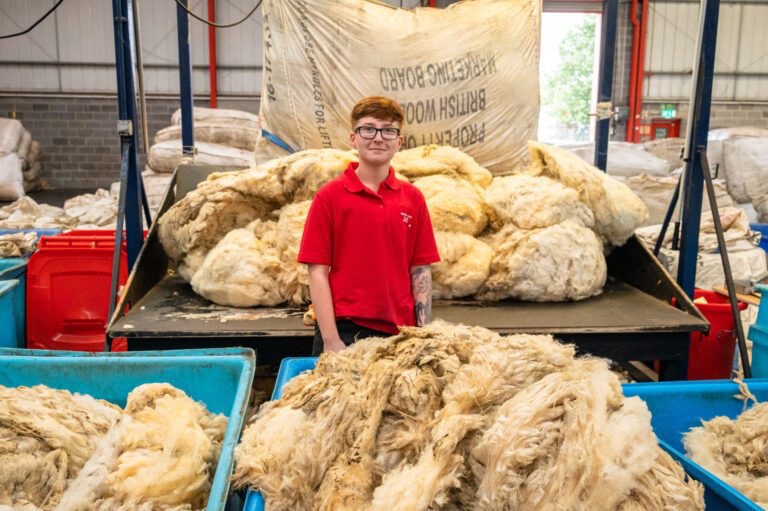
(UK Fashion and Textile Association)
Fresh Digital Fields; Young Farmers’ Interactions with Social Media
Social media has become a transformative tool for young farmers, bridging isolation, amplifying voices, and fostering innovation. Platforms like Instagram and Tik-Tok enable grassroots depictions of farming life, countering stereotypes and promoting positive narratives.
Studies show young farmers use digital curation for self-care, sharing experiences of daily challenges and triumphs, refining notions of the “good farmer,” a concept of farming identity that emphasises ethics, sustainability, community, and stewardship over productivity or profit.
Social networks heavily influence adoption of sustainable practices, and younger farmers, more familiar with social media platforms, use them for marketing and community building. A look at posts using the Hashtag #Farm24 and those by the NFYFC tells us that mentoring, competitions, and wellbeing benefits are main concerns.
Challenges include biased representations and the digital divide, but overall it is abundantly clear that social media is enabling the next generation of farmers.

Sowing Seeds for Tomorrow
The resurgence of YFCs, combined with future-oriented programmes and social media’s connective power, offer what might be the only pathway to revitalise UK farming.
To secure this, the farming industry must enhance agricultural education, combat negative perceptions via digital campaigns, and reverse funding cuts. Young aspirants should also be encouraged to engage with scholarships, networks, and online communities. By supporting these elements, the sector can thrive and address global issues like climate resilience and food security.
The future belongs to empowered youth, let’s ensure they have the tools to cultivate it.

Wem Young Farmers’ Club
Clwb Ffermwyr Ieuanc Wem
Taken in October 1950 by Welsh photographer and photojournalist Geoff Charles
A B-H
(Sep 2025)
 Northwest Nature and History