Notes on the moth species Autographa gamma and its ecology in Northwest England, including a chapter on the phenomenon of Phototaxis
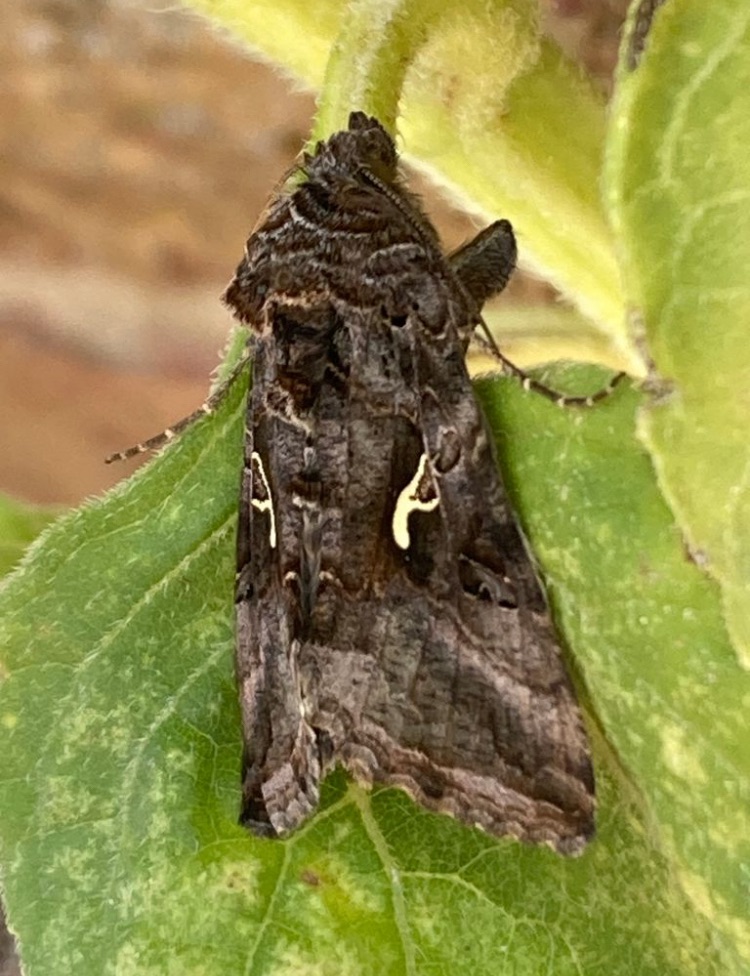
The Silver Y, Autographa gamma, is named for the shimmering, Y-shaped mark on its forewings and belongs to the Noctuidae family, a diverse group of moths often associated with nocturnal habits. Yet, this species defies convention, flitting about in daylight as readily as at dusk.
Its forewings, spanning 35 to 40mm, are a mottled mosaic of earthy browns, greys, and purples, providing perfect camouflage against tree-bark or soil. The silvery ‘Y’, resembling the Greek letter ‘gamma’, (γ) hence its scientific name, stands out like a metallic badge, while the hindwings, paler with a faint pinkish fringe, are tucked neatly under when at rest, making it very easy to identify.
Here in Northwest England, you’re likely to spot Silver Ys from late spring to early autumn, with numbers peaking in July and August in a variety of habitats; coastal grasslands, woodland edges, farmland, and even city parks.
They are found in such a wide range of places due to their adaptability, with the caterpillars feeding on a wide range of plants, from wild species like nettles and bedstraws to crops such as peas, beans, and sugar beet. This broad diet makes them both a vital pollinator and, in some years, a nightmare for crop farmers.

Itinerant Insect
What sets the Silver Y moth apart from others is its extraordinary migratory lifestyle as, unlike many native moths, it doesn’t reliably overwinter in the British Isles.
Each spring, adults arrive from southern Europe and North Africa, carried on warm southerly winds across the Channel. Here in the Northwest coastal areas such as Morecambe Bay or the Wirral are the best spots to witness these influxes, where moth traps can record hundreds in a single night during peak migrations.
Once here, they breed, producing one or two generations over the summer. The caterpillars, green with a white side-stripe and a distinctive looping gait due to their three pairs of prolegs, feed voraciously before pupating in silken cocoons in the soil.
By autumn, many of the new adults embark on a return migration south, though some may perish in our cooler winters. This migratory cycle connects us to distant ecosystems and reminds us of how interlinked mother nature’s networks are.
Historical records, particularly from the 1930s and 1940s, document occasional ‘plague years’ when Silver Y numbers surged, causing significant damage to crops like sugar beet, however these events are increasingly rare today.
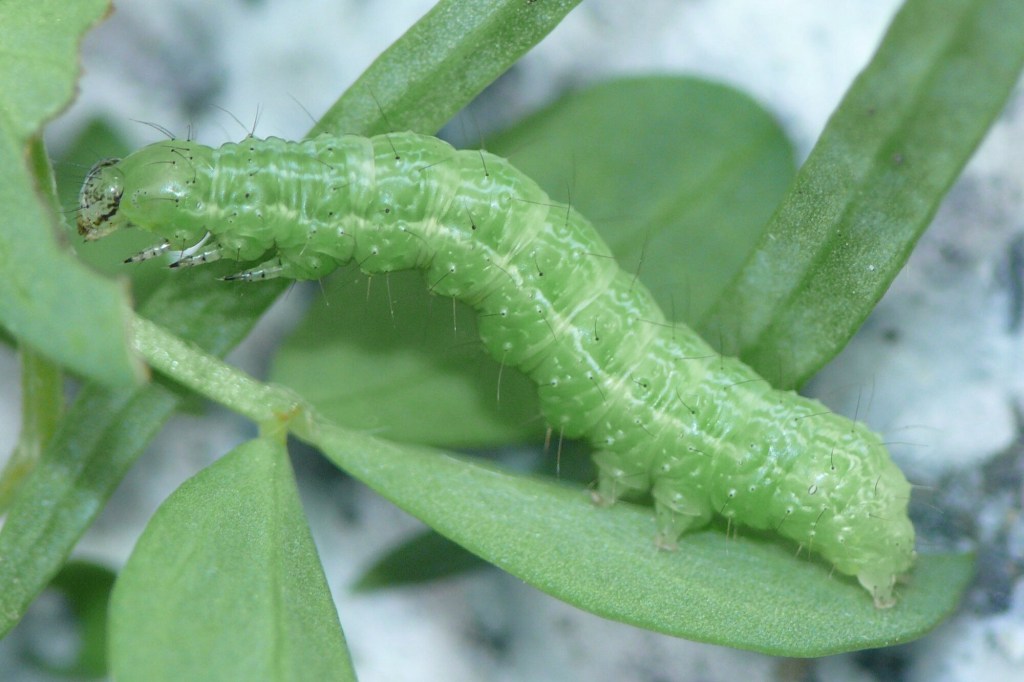
(Harald Süpfle)
Proficient Pollinator
As a pollinator the Silver Y is highly proficient, visiting flowers like Knapweed, Thistles, and Ragwort, supporting plant reproduction in habitats like meadows, brownfield sites, gardens, and agricultural land.
It’s habit of flying during both day and night could even be said to make it doubly more efficient than other pollinators, indeed a recent study by the University of Sussex found that moth species like the Y may be more efficient pollinators than bees or butterflies.
As prey, both moths and caterpillars sustain bats, birds, and parasitic wasps, filling an important niche in the food chain, their cathemeral (active both day and night) tendencies may make them more efficient at being eaten too!
However, their success is not without threats. Habitat loss from intensive farming and urban development, coupled with pesticide use, can reduce available food plants and breeding sites. Our industrial past has left pockets of degraded land, but ongoing restoration projects, such as wetland recovery in the Ribble catchment area and meadow creation in Greater Manchester offer hope for Silver Y populations.
Climate change may be influencing their migration patterns, potentially leading to earlier arrivals or larger influxes as weather patterns shift, although to test this theory lepidopterists require many more years of records and data.
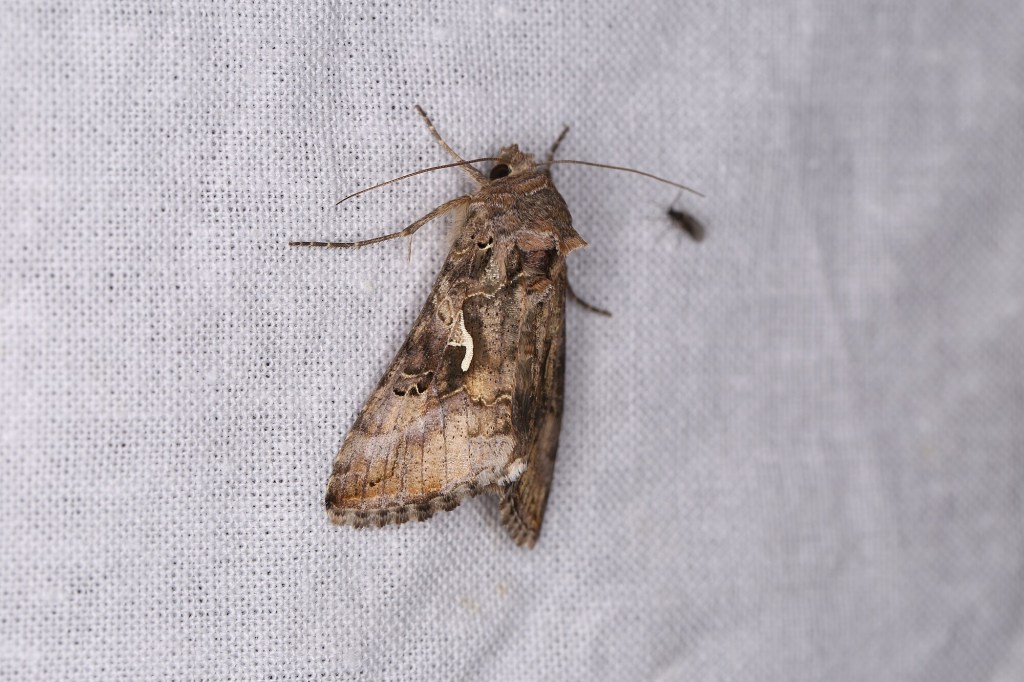
The Peculiar Phenomenon of Phototaxis
As we all know moths are famous for being fatally attracted to light, this phenomenon is known as phototaxis and is used by lepidopterists to great effect in the harmless recording technique known as moth trapping.
Phototaxis is the movement of an organism toward (positive phototaxis) or away from (negative phototaxis) a light source. In moths, positive phototaxis is common, particularly in nocturnal species, which are instinctively drawn to light sources like flames, bulbs, or the moon.
Scientists believe this behavior evolved as a navigation aid, with moths using the moon’s light to maintain a straight flight path by keeping a constant angle to it (transverse orientation).
Artificial lights disrupt this, causing moths to spiral inward, often leading to exhaustion or death (e.g., circling a bulb or burning in a flame). The exact mechanisms are debated, but theories include light overriding other sensory cues or triggering a “dazzle” effect that disorients them.
This behavior is especially pronounced in species like the Silver Y moth, which is strongly attracted to light during its migration.

1 and 2 Silver Y Autograph gramma
3. Ni moth Trichoplusia ni
4, 5. Scarce Silver Y Syngrapha interrogationis
6, 7. Mother Shipton Callistege mi
8, 9. Burnet Companion Euclidia glyphica
The Moth
By Walter de la Mare
Isled in the midnight air,
Musked with the dark’s faint bloom,
Out into glooming and secret haunts
The flame cries, ‘Come!’
Lovely in dye and fan,
A-tremble in shimmering grace,
A moth from her winter swoon
Uplifts her face:
Stares from her glamorous eyes;
Wafts her on plumes like mist;
In ecstasy swirls and sways
To her strange tryst.
If you enjoyed this article please consider showing your appreciation by buying me a coffee, every contribution will go towards researching and writing future articles,
Thank-you for visiting,
Alex Burton-Hargreaves
(Oct 2025)
 Northwest Nature and History