
The climate of the Northwest of England is famously damp and drizzly for most of the year (that is when the weather’s behaving normally), providing perfect growing conditions for fungi, and you may find many of the UK’s estimated 15,000 species growing here in our woods and fields.
Some of these are edible and right now (October as of writing) is the best time to head out and seek them.

Girolles
Among the most sought-after treasures are Chanterelles Cantharellus cibarius, vibrant yellow-orange mushrooms renowned for their delicate, fruity flavor. These gourmet fungi, often called ‘girolles’ in culinary circles (funnily enough ‘girolle’ comes from the latin gȳrus, meaning ‘circle’), thrive in our woods and, being easy to identify and cook, offer an ideal gateway for prospective mushroom pickers looking to get into the hobby for the first time.
Chanterelles belong to the Cantharellaceae family and their scientific name derives from the Greek word kantharos (κάνθαρος) which is a type of cup, describing their distinctive funnel or trumpet-like shape, with cibarius coming from the latin cibus which simply means ‘food’.
Interestingly kantharos is the root of the latin word cantharus or chalice, an epithet more widely used in biology, particularly for sea-snails.

(Holger Krisp)
The ‘cup’ is typically 3 to 8cm wide, starting flat and irregular before forming a wavy, upturned edge. The color ranges from golden yellow to apricot orange, with white flesh inside. Instead of true gills, they feature forked, ridge-like folds that run down the stem, which is solid, tapered, and matches the cap’s hue. Freshly picked specimens emit a pleasant apricot-like aroma, and they produce a pale yellow to cream spore print.
As well as having a uniquely subtle flavour and being visually appealing Chanterelle, like many wild funghi, are highly nutritious, being a rich source of vitamins C and D, potassium, essential amino acids and boasting antioxidant, antibacterial, and antiviral properties. Indeed, as a recent news article in the Express stated, we should eat more mushrooms during the winter months in order to keep illnesses at bay.
Historically, they’ve been prized for these reasons since at least the 16th century, and have come to symbolise luxury in European cuisine due to their inability to be commercially farmed, as they only grow wild.
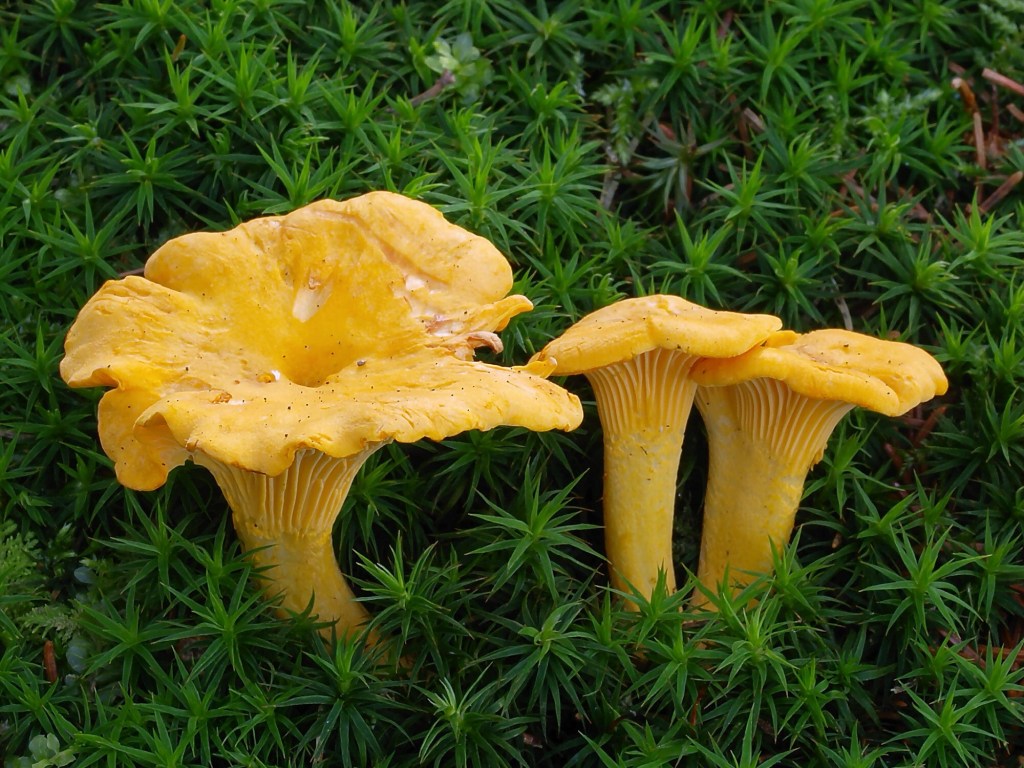
(Image by Andreas Kunze)
Where to Seek Wild Chanterelle
Like many fungi species C. cibarius form mycorrhizal relationships with trees, meaning they grow symbiotically with roots, contributing to forest health while drawing nutrients. They prefer shaded, moist environments in woodlands, and their fruiting bodies are often found in mossy patches or leaf litter.
In the British Isles, they’re usually associated with broadleaved trees like Beech, Birch and Oak, as well as conifers, being more commonly linked to Beech in the south, while Birch dominates in northern areas.
In the Northwest the region’s rainy weather, fed by prevailing westerlies from the Irish sea, make it ideal Chanterelle territory, though they’re less abundant than in Scotland’s Highlands. Prime picking grounds include the mixed woodlands of the Lake District, in particular the woods around Irton Pike in the Eskdale Valley, in Grizedale Forest, and the older woodland on the hills above Windermere.
Further south the Forest of Bowland and Peak District fringes also offer good foraging, especially if you can find mossy glades under Oak or Birch. Look for them in clusters; spot one, and others are likely nearby, camouflaged among fallen leaves.

(NBN (National Biodiversity Network))
When to seek Wild Chanterelle
Timing is crucial for Chanterelle hunting, they typically emerge from July to December, with peaks in September and October when heavy rains alternate with warm spells. The damp climate here extends the season, but the best hauls come after rainfall, which encourage fruiting. Frosty periods are best avoided though, as they signal the end of the mushroom’s growth cycle.
Early summer sightings (May to June) are possible but rarer in cooler northern climes.

Identification Tips and Lookalikes
Accurate identification is essential to avoid risks. Key features include the vase-like shape, decurrent ridges (not true gills), white inner flesh, and fruity scent. Cut one open to confirm the white interior and sniff for that signature apricot note.
Beware of confusions; The False Chanterelle, Hygrophoropsis aurantiaca, is more orange, has true gills that don’t run down the stem, and lacks the fruity smell, it’s often found on decaying conifer wood and can cause stomach upset.
The rarer Jack-o’-lantern, Omphalotus, is poisonous, with true gills and a darker orange tone, it also grows on wood. Always consult a field guide or join a guided forage to build confidence.

(Holger Krisp)

(Jason Hollinger)
Sustainable Foraging
- Foraging in the UK is legal on public land only with permission, please stick to footpaths and rights of way.
- Follow the “leave no trace” ethos, aim to leave only footprints.
- Pick only what you need, cutting mushrooms at the base to preserve the mycelium underground.
- Pick only for personal consumption, unlicensed commercial foraging is environmentally destructive and illegal.
- Avoid over-harvesting, as Chanterelle regenerate slowly.
- Don’t pick in protected areas. Please respect local guidelines to protect ecosystems, these vary widely according to bye-laws and landowner.
- If unsure, photograph and identify later rather than risk consumption.
Culinary Notes
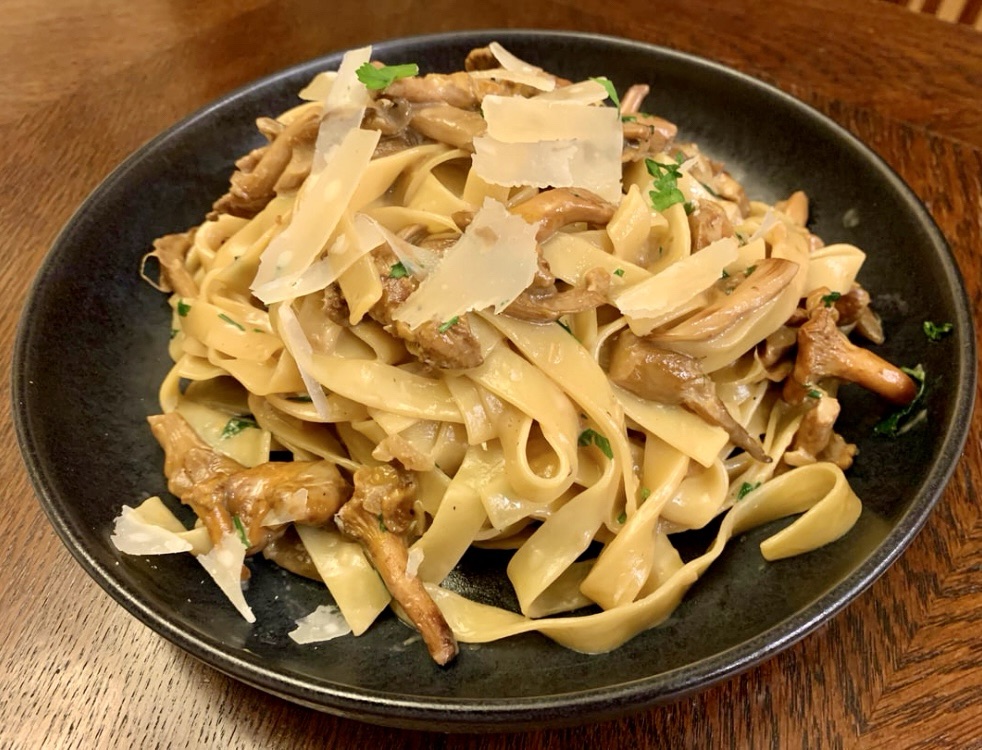
The succulent texture and subtle peppery-apricot taste of Chanterelle make them very versatile in the kitchen. Sauté them simply in butter with garlic and herbs for a side dish, or incorporate into risottos, omelets, or pasta, I’ll publish a favourite recipe of mine at some point.
They pair beautifully with cream, poultry, and seafood dishes. Clean them gently (they absorb water easily) and cook thoroughly to enhance flavor and digestibility. As a high-end ingredient, they’re very rewarding to forage, as fresh ones beat shop-bought every day.
Caution
“All fungi are edible. Some fungi are only edible once” (Terry Pratchett)
While Chanterelle are safe when properly identified, mushroom foraging always carries risks. Never eat anything you’re not 100% sure about, and consider consulting experts or apps for verification. In rare cases, even edible types can cause reactions in sensitive individuals. Start small to build experience.
“Among those vegetable productions which are eaten with risk, I shall, with good reason, include mushrooms; a very dainty food, it is true, but deservedly held in disesteem since the notorious crime committed by Agrippina, who, through their agency, poisoned her husband, the Emperor Claudius”
From Pliny the Elder’s Natural History; Book XXII, Chapter 46: Mushrooms: Peculiarities of Their Growth

Hans Zatzka (Vienna 1859 to 1945)
If you enjoyed this article please consider showing your appreciation by buying me a coffee, every contribution will go towards researching and writing future articles,
Thank-you for visiting,
Alex Burton-hargreaves
(Oct 2025)
 Northwest Nature and History