A Short Guide to Identifying the most Common forms of ‘Mermaid’s Purses’ found on the Coast of North-West England and the Species that Produce them

If you walk along almost any beach from the Mersey to the Solway after winter storms you may find the curious leathery pouches known as “mermaid’s purses” washed up on the tideline.
These are the empty eggcases of sharks, skates and rays (collectively called elasmobranchs) and the North-West coast, washed by the Irish Sea, is one of the best places in Britain to find them because several species breed in Liverpool Bay, the Solway Firth and the eastern Irish Sea.
Here are the species you are most likely to encounter, with tips on how to tell them apart;

A foetus of a small-spotted catshark (Scyliorhinus canicula). The umbilical cord and yolk are clearly visible
(Sander van der wel)
Small-spotted Catshark / Lesser-Spotted Dogfish (Scyliorhinus canicula)
This is the commonest mermaid’s purse on almost every North-West beach.
- Description of adult: The most abundant shark in our coastal waters S. canicula rarely exceeds 80cm in length. A slender, attractively patterned shark with a light sandy-brown body covered in numerous small dark spots and saddle-like markings it spends much of its life on or near the seabed from the shallows down to about 100m, feeding on crabs, prawns, worms, molluscs and small fish.
- Name: Scyliorhinus comes from the Greek skýlion (σκύλιον) meaning ‘a kind of shark’ and rhinus from rhinós (ῥινός) meaning ‘nose’ ergo ‘shark with a dogfish-like nose,’ canicula simply means ‘little dog’.
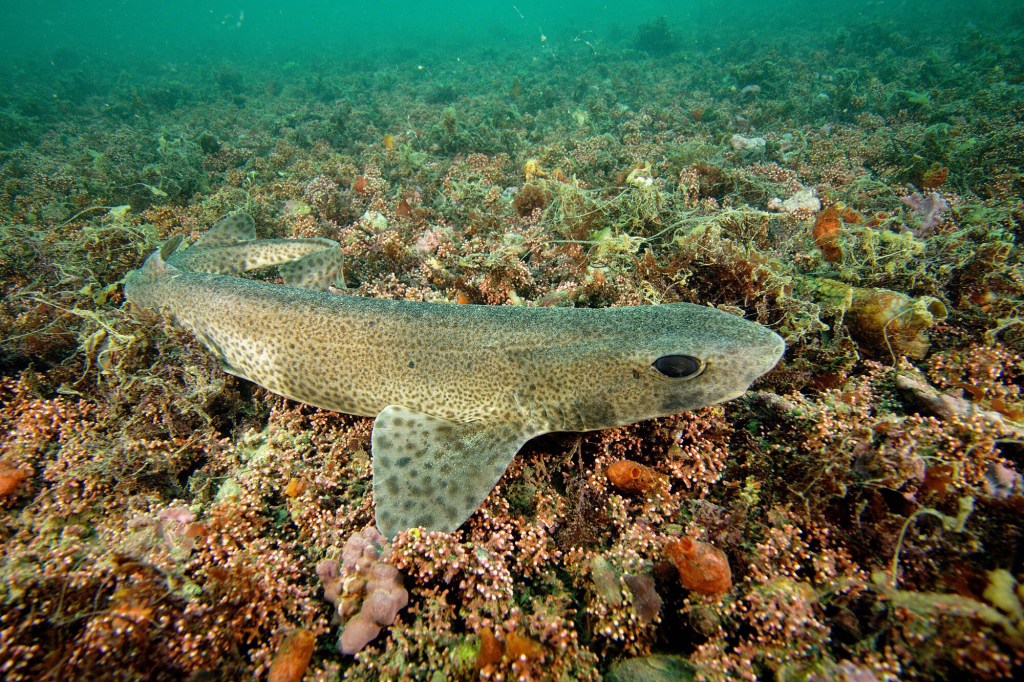
(Olivier dugornay)
- Egg-laying habits: Females deposit eggs year-round with a peak in spring and summer, typically laying two eggs at a time (one from each oviduct) every 10 to 14 days, producing 20 to 60 eggs per year. The embryo takes 7 to 10 months to hatch, depending on water temperature.
- Size of purse: 5 to 7cm long (excluding tendrils), about the size of your little finger
- Shape: A rectangular pouch with four long, curly tendrils (one from each corner)
- Colour when fresh: Golden-brown or yellowish, often with translucent patches
- Where to find: Everywhere, from Formby, Ainsdale, Blackpool, Morecambe, St Bees Head to Silloth
- Notes: Often washed up in huge numbers after storms, empty cases feel stiff and leathery; fresh ones may still contain yolk or even a tiny embryo!

Thornback Ray (Raja clavata)
The second most frequently found purse, especially on Merseyside and Lancashire beaches.
- Description of adult: Adults grow to about 1m long and 60 to 70cm across, though most seen by divers or anglers are considerably smaller. A bottom-dweller that favours sand, mud, and gravel from the shallows down to 300m, it feeds mainly on crabs, shrimps, small fish, and worms.
- Name: Thornbacks are named after the spines and ‘buckles’ found on their backs, Raja comes from raia, the latin name for rays, and clavata means ‘club-shaped’ referring to the shape of the ‘thorns.’
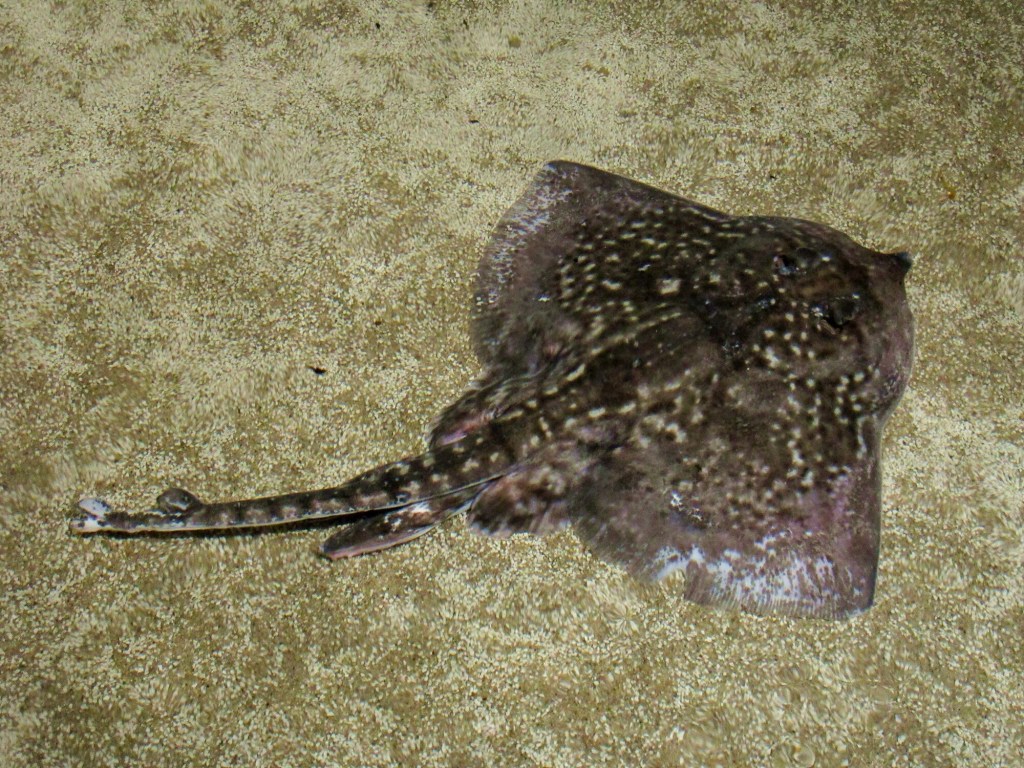
(BJ. Schoenmakers)
- Egg-laying habits: Females lay 50 to 150 eggs annually, with peak deposition between February and September, placing them singly on sandy or muddy seabeds at depths of 10 to 60m. Embryonic development takes 9 to 12 months (longer in colder water), after which the young ray (about 11 to 14cm long) emerges.
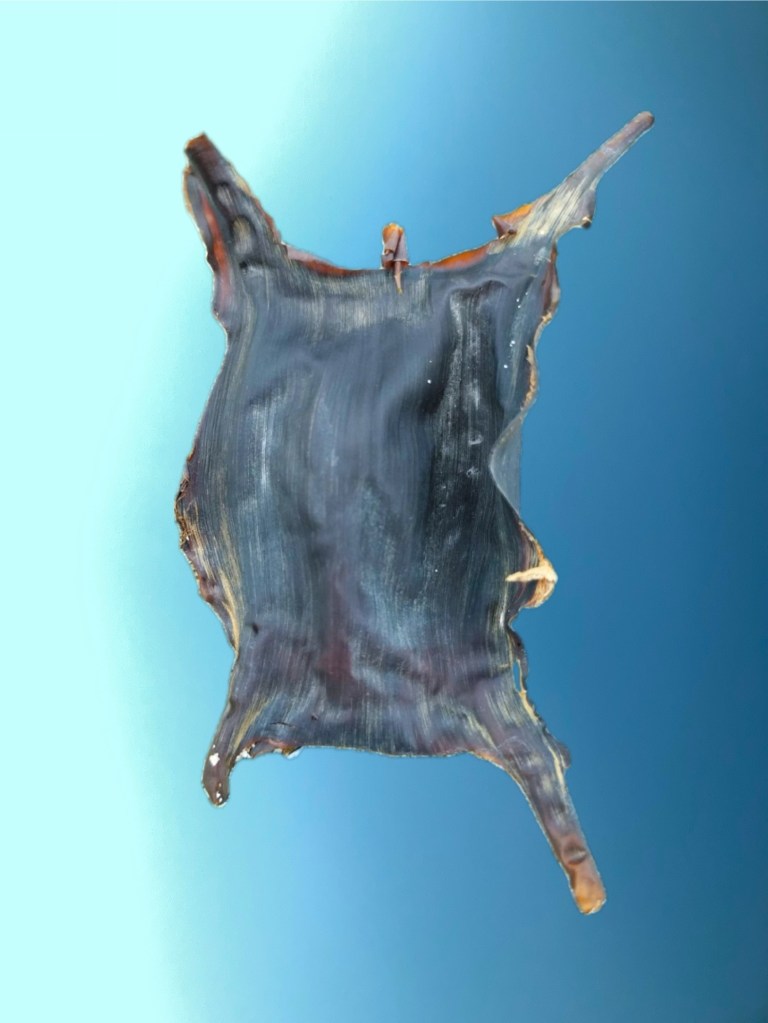
- Size: 7 to 9cm long, up to 5cm wide.
- Shape: A broad, convex pouch with a short, thick horn at each corner (no long tendrils).
- Colour: Dark brown to almost black when old, sometimes with a greenish tinge when fresh.
- Keel: A distinct raised ridge runs along the sides.
- Where found: Very common at Formby, Crosby, Southport, Lytham St Annes and Fleetwood.
- Notes: The horns are often curled or worn. This is the classic ‘skate purse’ shape most people picture.
Spotted Ray (Raja montagui)
Very similar to the Thornback Ray but slightly smaller and more rounded.
- Description of adult: A small to medium-sized skate R. montagui rarely exceeds 80cm in length and is often much smaller. It is easily recognised by its rounded snout and almost circular disc-like shape with scattered dark spots (sometimes ringed with yellow) across a grey-brown or olive background. It feeds mainly on crustaceans, especially brown shrimps and small crabs.
- Name: Montagui honors the English naturalist George Montagu (1753 to 1815) who described several species of ray, he also wrote the first proper field guide to British birds, the Ornithological Dictionary, in 1802, and has several other species named after him, including Montagu’s Harrier and Montagu’s Blenny.
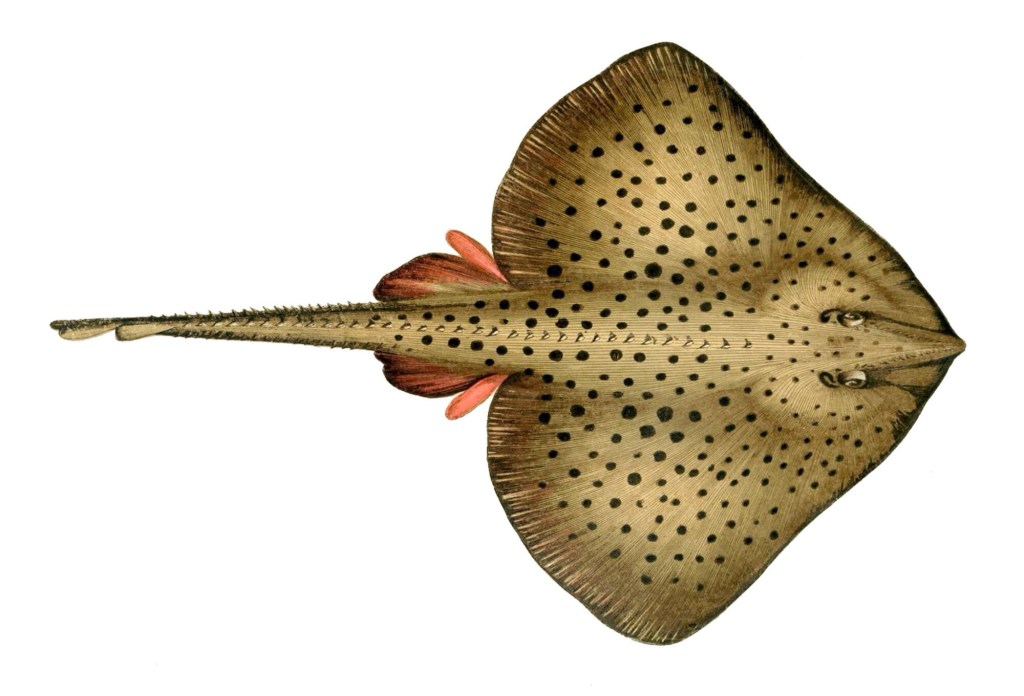
(Gervais et Boulart, 1877)
- Egg-laying habits: Females deposit 40 to 90 eggs per year, mostly from late winter through summer (February to August), placing them on sandy or gravelly ground at depths of 20 to 120m. Incubation lasts around 8 to 10 months.
- Size: 6 to 7.5cm long.
- Shape: More pillow-like and less rectangular than Thornback.
- Horns: Short, stubby horns; the back edge is strongly convex (almost humped).
- Colour: Usually mid to dark brown.
- Where: Increasingly common on Merseyside and North Wales beaches; also found at Ainsdale and Blackpool.
- Tips: Compare the curvature; Spotted Ray cases look “fatter” and more curved on the side where they attach.

Blonde Ray (Raja brachyura)
A larger, chunkier purse that turns up mainly after big westerly gales.
- Description of adult: The largest ray regularly encountered in the inshore waters of North-West England, R, brachyura commonly reaches 1 to 1.2m across and occasionally up to 2m and over 30kg. Its broad, almost rhomboid disc is a striking pale sandy or creamy-brown colour, often with scattered faint darker spots but lacking the bold markings of other rays. The upper surface is mostly smooth in males, while mature females develop a few large thorns along the midline and tail. A true shallow-water species, it is most frequently found over clean sand from the lower shore down to about 150m, feeding heavily on crabs, sandeels and flatfish.
- Name: ‘Blonde’ is self-explanatory, brachyura means ‘short-tailed.’

(Citron)
- Egg-laying habits: Females deposit 60 to 140 eggs per year, mainly from March to August, on clean sand or fine gravel in depths of 30 to 200m (most commonly 50 to 100m). Incubation lasts 8 to 10 months depending on water temperature.
- Size: 10 to 14cm long (excluding horns), up to 8cm wide, much bigger than Thornback.
- Shape: Very broad and rectangular with short, blunt horns.
- Colour: Pale brown or sandy when fresh, often fades to cream.
- Where: Occasional finds at Formby, Ainsdale, West Kirby and Morecambe Bay.
- Note: One of the biggest purses you’ll find.
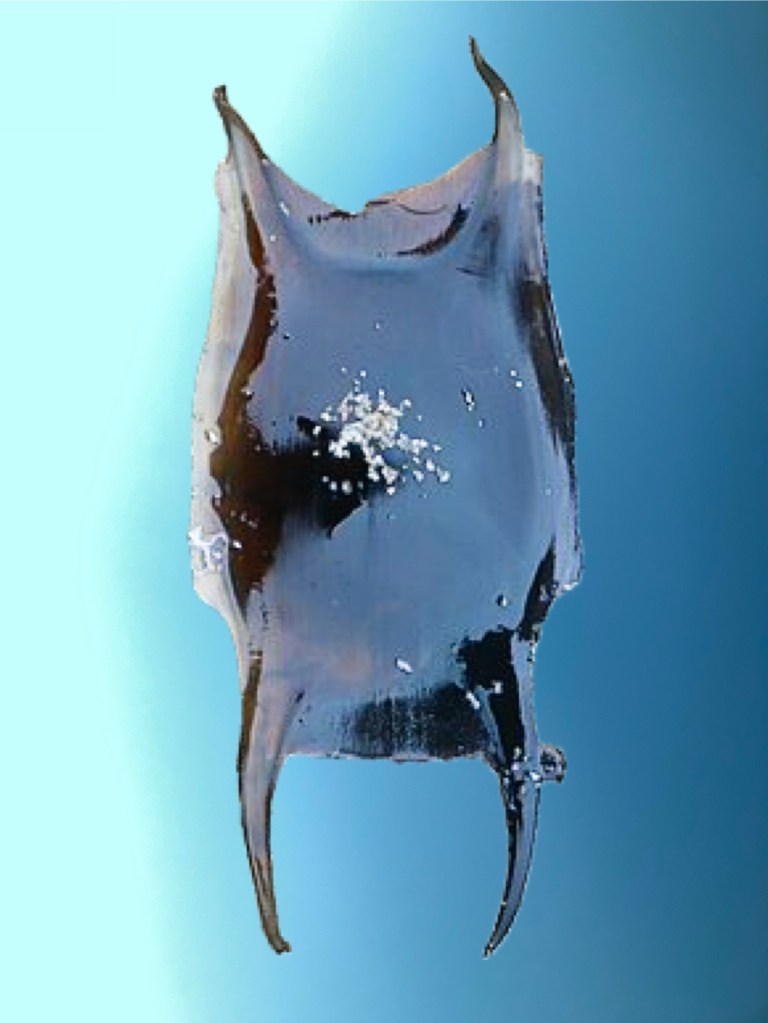
Undulate Ray (Raja undulata)
Perfectly formed purses, rarely found but increasing in Liverpool Bay.
- Description of adult: A strikingly beautiful but scarce visitor to North-West England’s waters R. undulata grows to about 1m across and is instantly recognised by the bold pattern of wavy dark lines and pale spots that run parallel across its sandy-brown disc, giving a marbled or ‘undulating’ effect. The underside is bright white with a broad black margin. Preferring clean sand in shallow bays (often 5 to 50m depth), it feeds mainly on crabs, shrimps and small fish.
- Name: Undulata means ‘wavy,’ as the fish has wavy lines on its back.

(Diego Delso)
- Egg-laying habits: Females lay 50 to 120 eggs per year, with peak deposition from late winter to early summer (February to July), placing them on sandy or muddy-coarse bottoms at depths of 30 to 200m (most often 50 to 120m). Incubation takes 8 to 10 months
- Size: 8 to 10cm long.
- Shape: Similar to the Thornback but with distinctly concave (inward-curving) sides on the attachment edge.
- Horns: Long and straight rather than curled.
- Colour: Dark olive-brown.
- Where: Occasional records from Formby and the Ribble estuary.
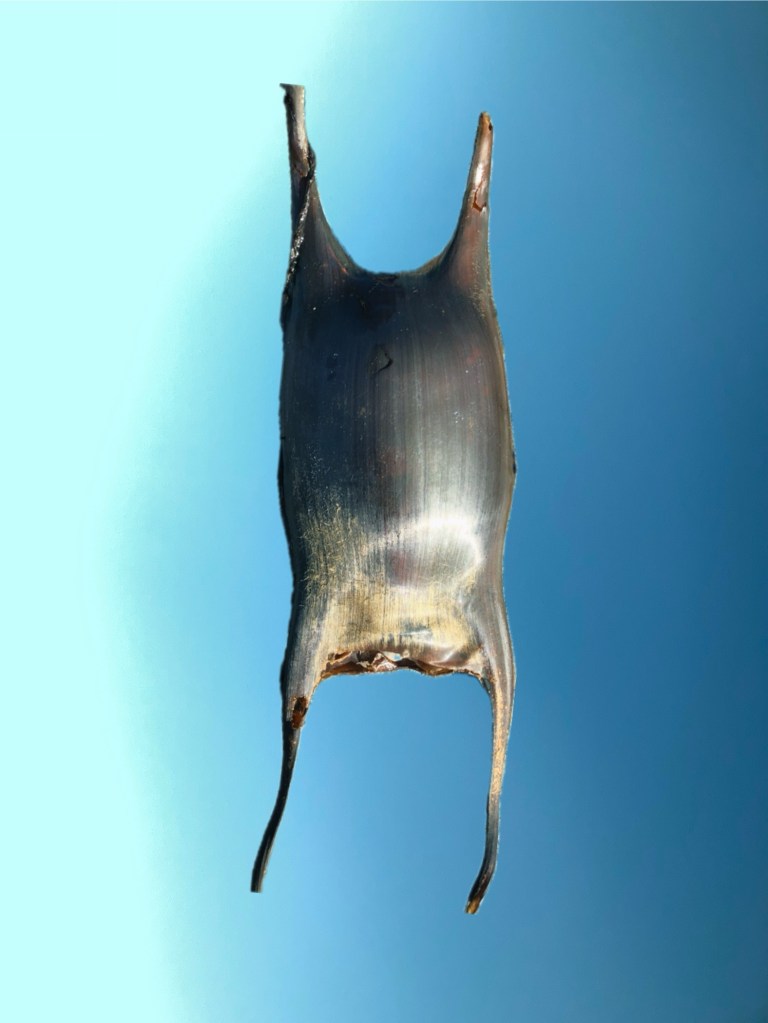
Nursehound / Greater-spotted Catshark (Scyliorhinus stellaris)
Uncommon but exciting when found.
- Description of adult: One of the biggest catsharks in European waters, C. stellaris commonly reaches 1.2 to 1.5m in length and occasionally up to 1.7m. It is instantly recognised by its robust body and striking pattern of 8 to 12 large, dark brown to black spots (often with pale centres) scattered over a sandy-brown or greyish background, giving the ‘starry’ appearance that inspired its scientific name. A prominent saddle-like dark band runs between the eyes, and the nasal flaps are broad and almost meet in the middle. It is a bottom-dwelling species of rocky reefs, kelp forests, and rough ground from shallow water down to about 400m.
- Name: Stellaris means ‘starry,’ referring to the prominent star-like marks on the Shark’s back.

(Gervais et Boulart)
- Egg-laying habits: Females lay only 9 to 28 eggs per year (far fewer than S. canicula), usually two at a time (one from each oviduct), with a pronounced peak from March to October. Eggs are deposited year-round in deeper water (20 to 400 m) on rough ground, and incubation takes 9 to 12 months. Because the cases are so sturdy and the tendrils so effective, they rarely wash ashore intact.
- Size: 10 to 12cm long, noticeably larger than Small-spotted Catshark.
- Shape: Same basic design (pouch with four long curly tendrils) but much more robust.
- Colour: A rich reddish-brown.
- Where: Rare strandings at St Bees Head (Cumbria), Blackpool and the Fylde coast.
- Note: Tendrils are thick and stiff, unmistakable if you’ve seen the smaller cousin (S. canicula).
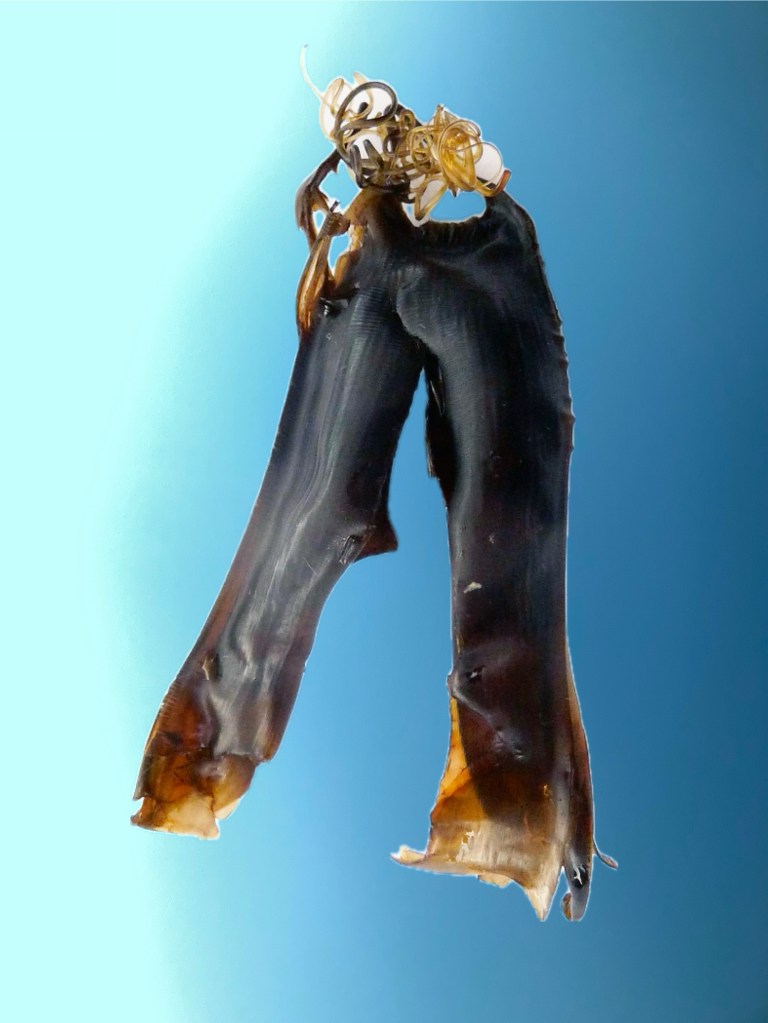
Common Skate / Blue Skate (Dipturus batis)
Very rarely found now, but records exist from the Solway and Morecambe Bay.
- Description of adult: A true giant, reaching 2.3 to 2.85m in total length and well over 100 kg. Their disc is very broad and rhomboid with sharply pointed wing-tips and an extremely long, acutely pointed snout (snout angle <60°). They are grey-brown to bluish-grey on the upper surface (often with scattered pale spots or blotches in juveniles), and a whitish underneath. The tail is relatively short and stout with two small dorsal fins placed far back and usually a single row of 12 to 20 large thorns along the midline of the back and tail (more in younger specimens).
- Name: Dipterus comes from the Greek di (δι) meaning two, pteron meaning ‘wing’ or ‘fin’ and urus, meaning ‘tail’ literally ‘two-winged tail,’ referring to the two small dorsal fins near the tip of the tail. Batis (βατίς) is an Ancient Greek name for ‘rays’ or ‘flat fish’. Sometimes the suffix complex is added as this Skate closely resembles, and is often confused with, a species called the Flapper Skate.
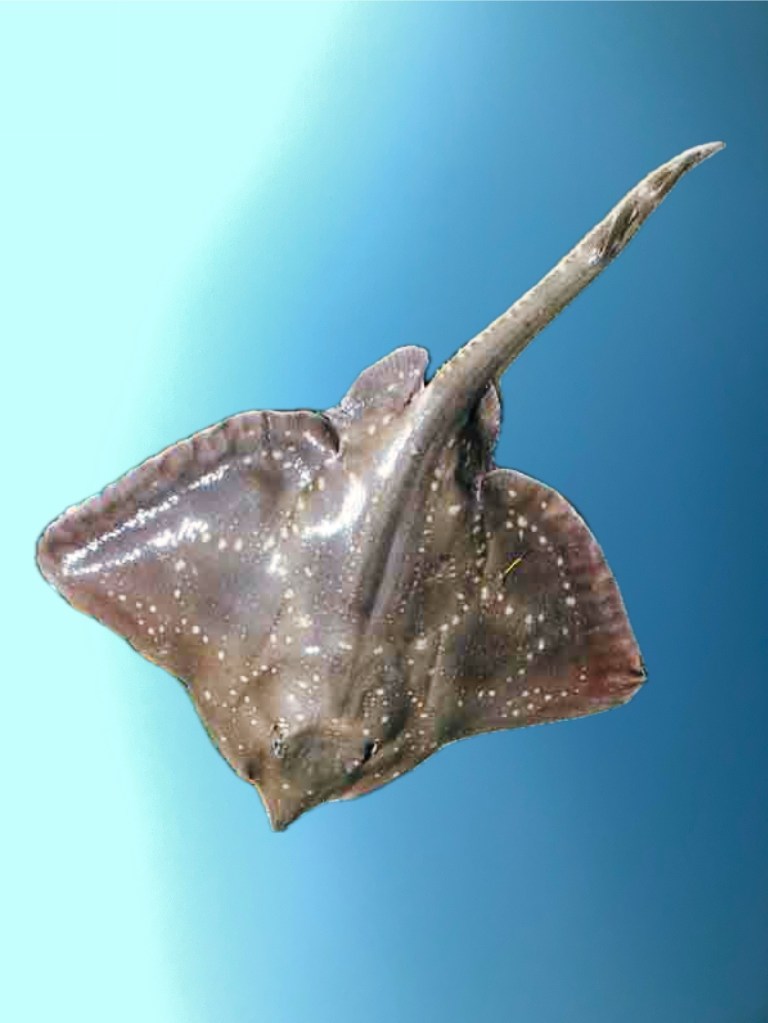
(David Holt)
- Egg-laying habits: Females lay relatively few eggs, typically 20 to 50 per year, with peak deposition from late winter to early summer. Eggs are placed singly on muddy or sandy-mud bottoms at 50 to 200m depth (sometimes deeper). Incubation is long (10 to 15 months), and the newly hatched young are already 20 to 25 cm across the disc.
- Size: Huge, up to 20 to 25cm long.
- Shape: Enormous black purse with very long, straight horns.
- Note: Almost never found complete any more, as the large, tough leathery cases tend to stay on the seabed, but fragments still occasionally wash up.
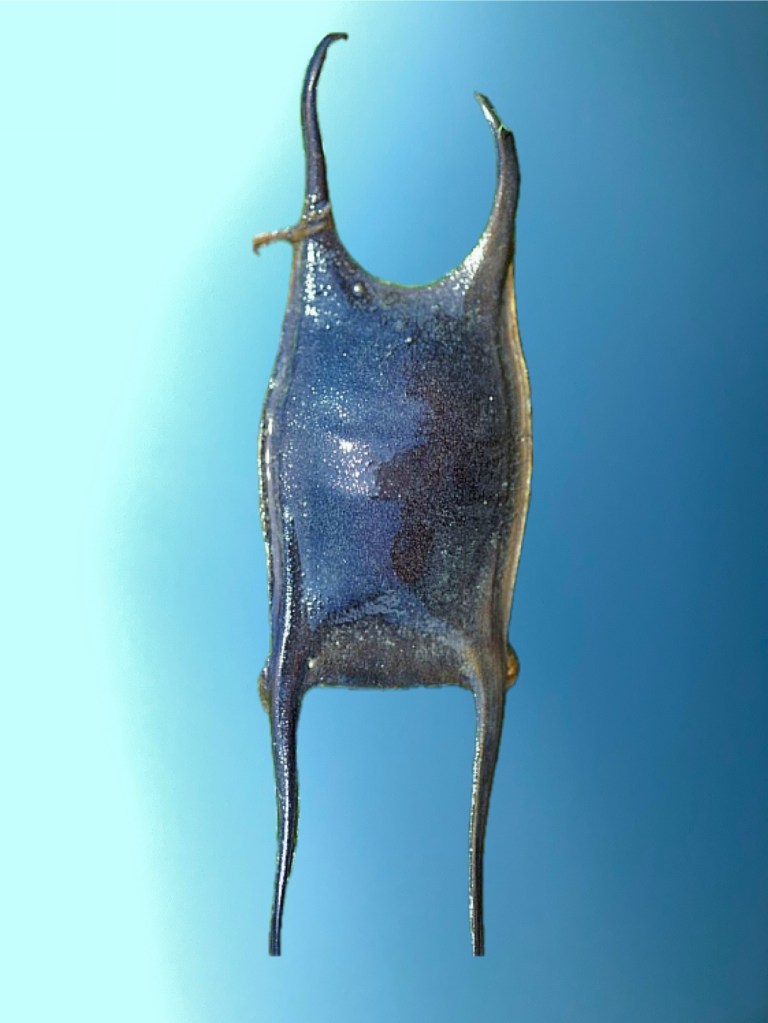
Next time you’re beach-combing on a North-western beach keep an eye out for these strange leathery objects. They’re not seaweed or the plastic litter that is sadly ubiquitous now, they’re the nurseries of the sharks and rays that still swim in our waters, and by holding one you become connected to nature in a way which is increasingly rare nowadays.
The Mermaid’s Purse
By Johnathan Witte
The morning walk
along our stretch
of shore suspended,
my daughter, alight
with curiosity,
holds the hard husk
out to me in her palm.
Obsidian black
and desiccated,
flecked with sand,
the skate egg case is open
at one end, a nascent tear:
a modest aperture to briny,
underwater amplitudes.
I explain that somewhere
out in the Atlantic—today
tinged cerulean blue and green—
a skate is swimming.
Its diamond shape
soars in subaquatic space,
wings through water like a kite.
And from its body
the colour of sand
an invisible thread
unspools for miles,
rising eventually
out of the waves,
enchanted fishing line
into my daughter’s hand.
The Great Eggcase Hunt, run by the Shark Trust, encourages everyone to record finds, your records really do help conservation. Happy hunting!
If you enjoyed this article please consider showing your appreciation by buying me a coffee, every contribution will go towards researching and writing future articles,
Thank-you for visiting,
Alex Burton-Hargreaves
(Nov 2025)
 Northwest Nature and History
Wow, a fabulous, thoroughly researched article. Thanks so much , Julie Anne.
LikeLiked by 1 person
Thank-you! Yes this one was really hard to write!
LikeLike