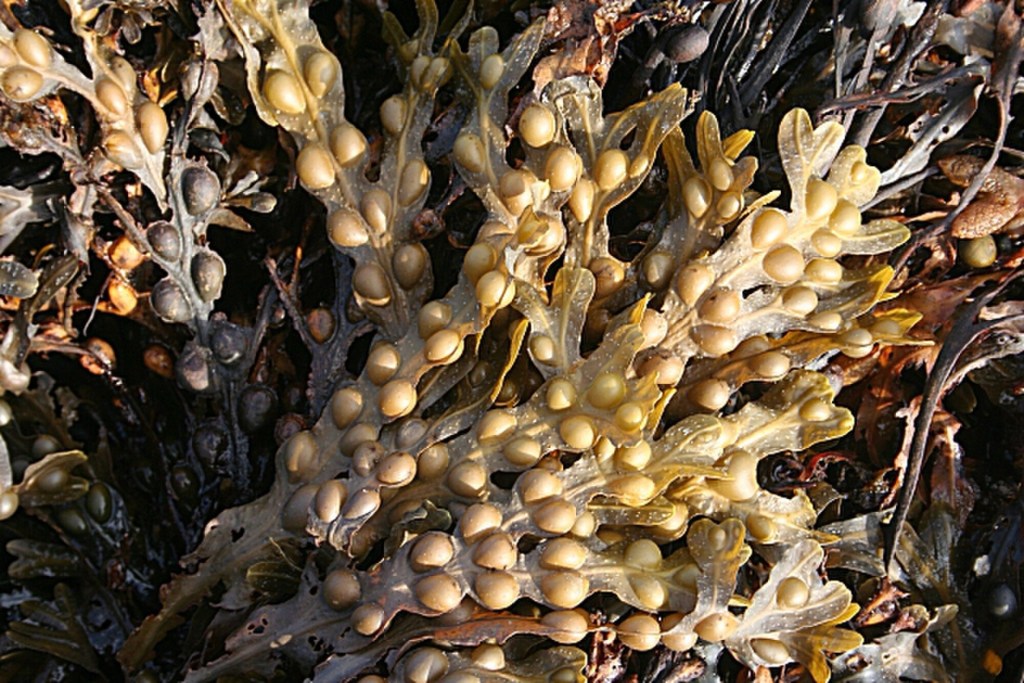
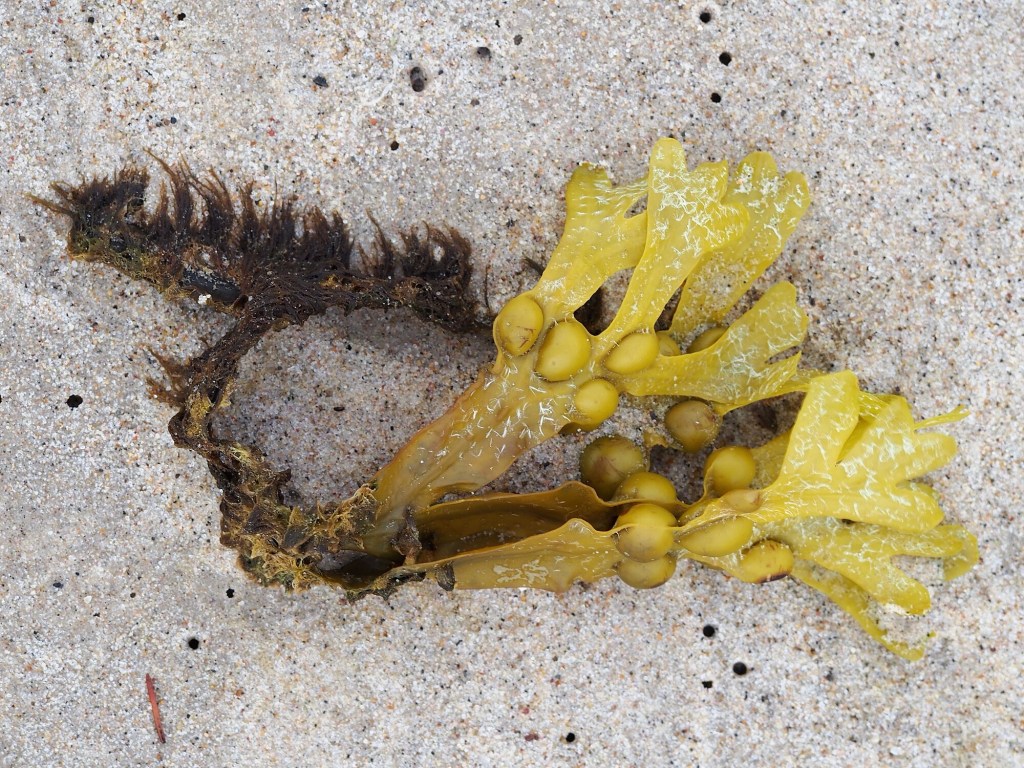
Bladder wrack, Fucus vesiculosus, is a familiar sight to anyone who has wandered our coasts, a member of the brown algae family, it is easily identified by its flattened, leathery fronds that branch repeatedly in a dichotomous pattern, splitting evenly into two like a fork.
These fronds can grow up to a metre in length, though in the exposed conditions of Northwest England’s coasts, they are often shorter, around 30 to 50 cm. The plant’s namesake feature is its paired air bladders, small spherical pods filled with gas that help it float upright in the water, aiding photosynthesis and reproduction. The colour varies from deep olive to brownish-green, depending on exposure to sunlight and water depth, and the tips of the fronds often swell into reproductive structures called receptacles during the breeding season.
Attaching firmly to rocks via a disc-shaped holdfast, Bladderwrack is built to withstand the twice-daily battering of tides. In calmer seas like those of the Mersey and Ribble estuaries, and Morecambe bay, it forms dense mats, while on more exposed shores, like those around the Cumbrian coast, it survives by clinging tenaciously to boulders amid the pounding surf.

Habitat and Ecology
This seaweed thrives in the intertidal zone, specifically the middle shore, where it is submerged during high tide and exposed at low tide. In Northwest England, it’s commonly found alongside other fucoids like Knotted wrack (Ascophyllum nodosum) and Serrated wrack (Fucus serratus), creating layered zones that define the bounds of the coastline. It tolerates a wide range of exposures, from sheltered estuaries to more open coasts but avoids extreme wave action or heavy pollution.
Ecologists regard bladder wrack as a ‘keystone’ species, named after the keystone in the structure of an arch that holds it together, as it has a disproportionately large impact relative to its abundance. Its dense growth provides shelter and food for a myriad of marine life, including periwinkles, limpets, and small crabs that graze on epiphytes (plants that grow on other plants) or hide from predators.
In the warm and nutrient-rich waters of the Irish sea it forms underwater ‘forests’ that stabilise sediments and support biodiversity, much like ancient woodlands do on land. Birds such as Turnstone forage among the wrack at low tide, while fish larvae use it as nursery grounds. However, rising ocean acidity poses a threat; studies suggest increased CO2 levels could enhance its photosynthesis short-term but disrupt the food web by affecting dependent species like snails and crabs.

Historical and Modern Uses
In the 19th century, during the Industrial Revolution, coastal communities harvested Bladderwrack for iodine extraction, a process pioneered in France but adopted here to treat goitre, a common ailment in iodine-deficient inland areas. Burned to produce kelp ash (named after the main species of seaweed used for this process) , it was used in glassmaking and soap production, supporting local industries around ports like Lancaster.
It was already regarded as useful; hung over doorways or windows it was thought to ward off evil spirits. It was usually hung on the inside as the texture of the seaweed, which famously reacts to humidity, would tell its owner if the weather to come would be dry or wet.
Edible when young and tender, it was foraged by fishermen’s families, boiled or pickled as a nutrient-rich supplement during lean times. When I worked at Dundrum Oyster fisheries over in Co Down we used to get the occasional order for Bladderwrack to be used in expensive health supplements for its high iodine, fucoidan, and antioxidant content.
It’s touted for thyroid support and anti-inflammatory benefits, which no doubt made it of great value to hard-working fishermen, but it will bio-accumulate heavy metals in polluted waters, so when we couldn’t pick Oysters, Cockles or Mussels due to a poor water-quality warning, we couldn’t gather seaweed either, yet another sad inditement of modern times.
Flowers of the Ocean
by E.L. Aveline
Call us not weeds—we are flowers of the sea;
For lovely, and bright, and gay-tinted are we,
our blush is as deep as the rose of thy bowers;
Then call us not weeds—we are Ocean’s gay flowers.
Not nursed like the plants of a summer parterre,
when gales are but sighs of an evening air;
Our exquisite, fragile, and delicate forms
are nursed by the ocean, and rocked by its storms.

1 Fucus nodosus = Ascophyllum nodosum 2 Zostera marina
3 Delesseria sanguinea
4 Furcellaria fastigiata = Furcellaria lumbricalis
5 Chondrus crispus
6 Fucus vesiculosus
From The common objects of the sea shore – including hints for an aquarium (1859)
If you enjoyed this you can show your appreciation by buying me a coffee, every contribution will go towards researching and writing future articles,
Thank-you for visiting,
Alex Burton-Hargreaves
(Jan 2026)
 Northwest Nature and History