
Spring is rapidly approaching and it’s the busiest time for our upland farmers. The dairy and cattle farmers will be welcoming the year’s new calves, while lamb farmers will up at all hours helping their ewes deliver lambs.
Our upland moors and pastures have looked the same way for centuries, and this is largely because generations of the same families have managed them using tried and tested methods which have been passed down by grandfather to father to son. However farmers are usually the first to adopt any new inventions or technology that comes along if it promises to make their life easier, think how hard things must have been before tractors and quad bikes!
A lot of these new-fangled contraptions fail to deliver, and end up rusting in the farmyard, but in recent years there have been some very high-tech tools arriving on the scene which really can revolutionise life for the upland farmer.
Webcams and drones
It has become commonplace for farmers to install CCTV and webcams in their cottages so that they (or even you at home!) can keep an eye on a ewe or cow when it goes into labour. On some of the larger and more remote farms they even use drones now to watch over their flocks.
These drones can even be ‘slaved’ which means they can be programmed to fly a set pattern around the fields which the farmer wants to keep a close eye on, saving time and fuel, some can even take the place of sheepdogs with speakers that bark!
Using such technology cuts down on losses at birth as well as ensuring that the farmer can get to any animals in difficulty as fast as possible, otherwise the farmer has to constantly cover all of their fields at once.
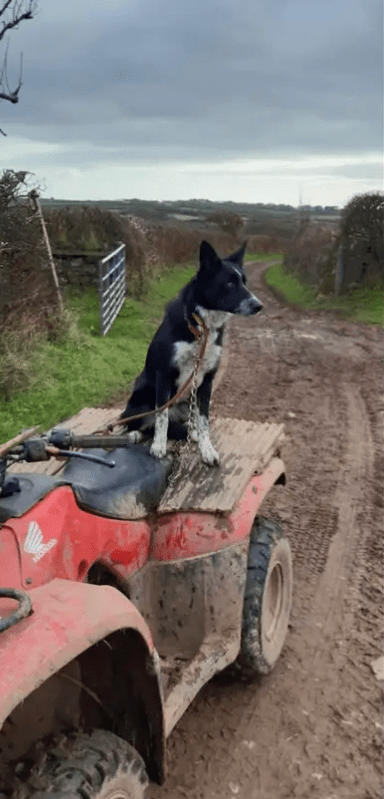
Modern day farmers use quad bikes but in the past this had to be done on foot and, as you can imagine, this would take up a lot of the day in our hilliest countryside, although in some of the really mountainous areas, like the Lake District, the Welsh mountains and the Scottish Highlands some shepherds still have do their rounds by foot to this day.

Calving and lambing
With other advances in modern farming, calving and lambing can be staggered so it doesn’t all happen at once. But generally, most lambs and calves will be born from January/February onwards. In dairy farming, cows are in calf (meaning pregnant as their gestation period is the same as humans; 9 months) from summer, and remain grazing outdoors until October or November depending on the weather.
Cold weather and colostrum
They will be brought in over winter though, which is when they ‘dry off’, meaning they don’t produce milk, while they are waiting for their calves to be born. As soon as the calves are born, the milk will come in again and cows can be let back outdoors to graze, as long as the weather is good enough that is.

Calves and lambs receive their first milk from their mums, called ‘colostrum’ this gives them essential nutrients and antibodies to become healthy adult animals. Sheep are a lot tougher than cows and can lamb outdoors if the weather is not too cold and there isn’t snow on the ground.
Some winters can be very harsh on the open hill farms though and the ewes will have to be brought indoors to lamb. They will be given colostrum to toughen them up and can also be kept warm with electric or gas heaters to give them a fighting chance.
For this reason some sheep farmers still prefer to bring their ewes indoors whatever the weather and also to ensure any problems during labour can be dealt with quickly. Some, if they can afford it, will provide supplementary feed to help bulk the lambs up and prepare them for life outdoors.
Soon enough the weather will warm up so it won’t be long before the baby lambs are playing around in the fields among the spring flowers with their ever tolerant mums keeping one eye on them while they try to catch a break!
A B-H
 Northwest Nature and History
One thought on “Spring on the Upland Farm”