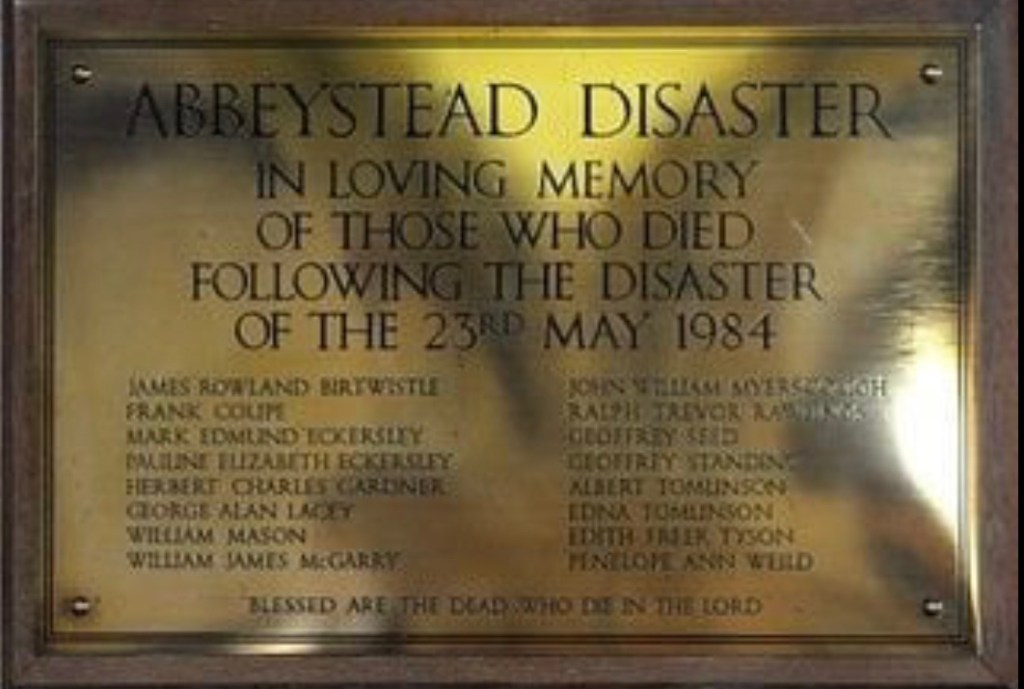
The Abbeystead Disaster
The Abbeystead Disaster happened this day 40 years ago on Wednesday the 23rd of May 1984, in the Upper Wyre valley near the village of Abbeystead.
It was caused by an explosion of Methane gas in a valve house which was being visited by a party of local members of the public, 16 people were killed in the disaster, out of a group of 44, and no one escaped uninjured.
This is how the tragedy unfolded and what is thought to have caused it to happen.
The Valve house
The incident, as documented in detail in this Health and Safety Executive report, occurred on the evening of Wednesday the 23rd of May 1984, at around 7:00 pm, when a group of 44 members of the public were attending a consultation meeting which had been organised to answer the concerns of local residents, mainly from the village of St Michael’s on Wyre, that water pumped into the River Wyre, via the Lune/Wyre River Transfer Link Scheme, may have caused flooding that winter in the lower Wyre Valley.
The meeting was held in a valve house situated on the fell side at the Abbeystead Outfall Station located on the outfall end of the link, and included a demonstration of the pumping station in operation and an explanation of how a weir installed at the site would regulate water flow into the Wyre so as to prevent flooding.
The Abbeystead valve house had been officially opened by Queen Elizabeth II in 1980, and was widely celebrated at the time as an incredible feat of civil engineering, the £60 million scheme, which had been commissioned by the North West Water Authority (NWWA) allowed the water authority to transfer water from the river Lune, about 8 miles north west of Abbeystead, down and under the hills to the river Wyre.
Designed to transfer up to 280 million litres of water a day, the new infrastructure had been designed to cope with a predicted increase in water demand across the south of Lancashire.
It does not bear to think about what could of happened if the explosion had occurred 4 years earlier on the day that her majesty, and a much larger crowd, had been at the valve house to open the Lune/Wyre river transfer link scheme.

The explosion
The visitors were gathered in the Valve house itself to watch a water pump, which would pump water over the weir, being switched on, and a few minutes after the pump had been switched on there was a bright flash, followed straight away by a massive explosion which all but destroyed the valve house and caused 16 of the party to be fatally injured.
The force of the explosion was so severe that the steel-reinforced concrete roof beams of the chamber, which was built partly underground into the hillside, and which weighed 75 tonnes altogether, were forced upwards through the topsoil above them before falling back in when the chamber collapsed in on itself.
Some of the 16 were killed outright by the explosion, some by the collapse of the roof, and some by drowning as the explosion caused the steel mesh floor of the valve house to collapse and they fell into the chambers below, which were full of churning water that had been pumped into them by the turning on of the pumps. Eight further fatalities occurred on the way to hospital or shortly afterwards.
One of the deceased was a twelve year old child that been brought along with his parents, two others were a couple that had postponed a holiday by a day in order to visit the site, one man was flung from the building and crushed to death by a car that had turned over.
The explosion was so loud that it was heard many miles away and many locals presumed there had been a plane crash on the hills.

The cause of the disaster
Afterwards investigators found that the cause of the explosion, as described here in Civil Engineer Richard Balmer’s account of the disaster, was the accidental ignition of Methane gas, which had gathered in the confined space of the valve-house and had originated from coal and shale seams which sit around 1000 to 1500 metres below this part of the Bowland fells.
It is thought that the Methane gas had accumulated in the water pipes themselves, which had been empty of water for 17 days prior to the pump being switched on that day, and had been forced from the pipes into the valve house by the switching on of the pump and the subsequent influx of water.
The source of ignition for the Methane has never been found, electrical equipment was tested and no faults were discovered that could have caused sparks, and evidence of other suspected causes of ignition has not been found either.
However smoking has not been ruled out as a cause as it was not prohibited in the building, this did occur in the eighties after all and it was not thought that a flammable atmosphere could be created in the building anyway.

The aftermath of the tragedy
In the Commons sitting on the 24th of May when the disaster was discussed, it was declared that an immediate inquiry into the disaster would take place and that all similar facilities across the country would be immediately shut to the public and inspected. The emergency services were also praised by everyone present for their swift reaction to the emergency.
It was pointed out though that it was very unusual for there to be members of the public present at all in these kinds of buildings, as Lord Selwyn Gummer, present at the sitting as chairman of the Conservative party put it:
“contrary to the comment that we so often read that people would not have been hurt if they had been there only two minutes later, in this instance an explosion would not, in almost any other circumstance, have led to loss of life. It is very rare for there to be people there, other than those few who visit from time to time, to check operations. Thus, it is particularly serious and sad that the explosion should have happened at that moment. I am told that there are fewer than half a dozen similar installations, and until we know the reason for the disaster they will not admit any visitors”
The inquiries held afterwards didn’t, however, place blame for the tragedy on any one body or organisation and only after a protracted legal battle was any kind of settlement arrived to.
Lancaster Crown Court had apportioned blame mainly on the designers of the system, Binnie and Partners, while also finding the NWWA and the builders of the facility to be liable. After an appeal NWWA and the builders were cleared, and blame was placed on the designers alone, a further appeal failed though and Binnie and Partners finally settled with the survivors in an out of court agreement for a fee which is thought to have been around £2.5 million.
The case is still taught at college and university now as a model of why to avoid gas build up and ventilate such facilities well and when the facility at Abbeystead was rebuilt these factors were taken into consideration. The impact that the disaster had on local communities is still felt to this day and very sorely remembered by all that were affected by it.
A B-H
 Northwest Nature and History