
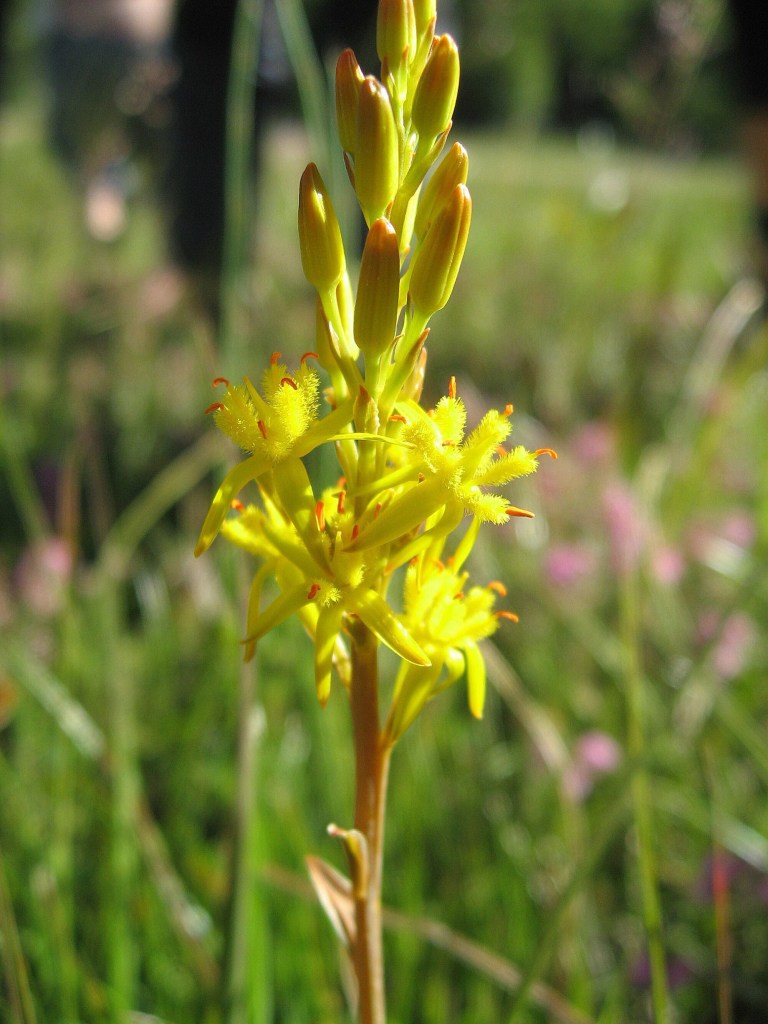
Bog Asphodel, Narthecium ossifragum, also known as ‘Lancashire Asphodel’ or ‘moor gold’ in the north of England, grows in wet patches of bog and is a little orange-coloured plant with flowers that look like a little spike of orange wheat. They flower from July to August and if you look closely you can see that these spikes each hold up to 20 beautiful yellow and orange, star-shaped flowers.
Clever adaptations to harsh environments
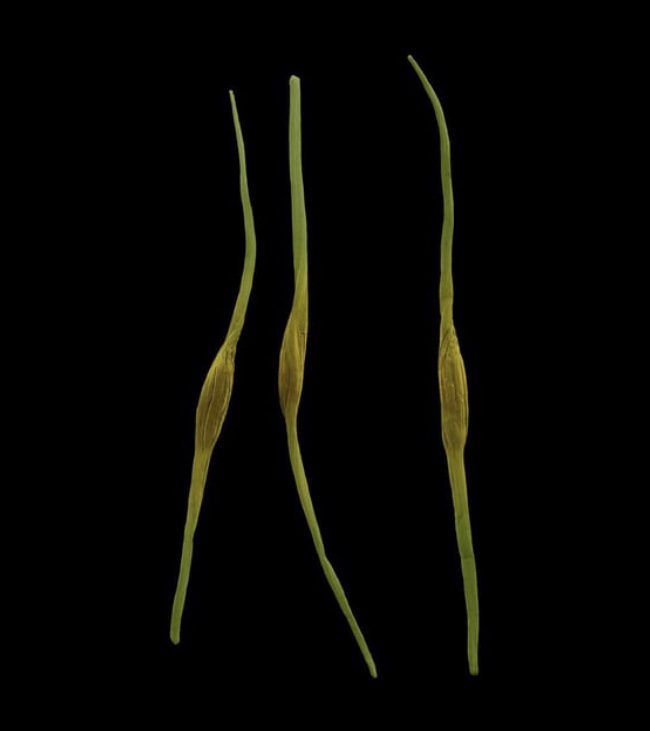
As the whole plant is no more than 30cm tall, it is easy to miss it in summertime, but in autumn these spikes turn to seed with red/orange, nut shaped fruits and become a wonderfully rich orange colour which makes them much more noticeable, these seed cases contain tiny seeds with a tiny ‘tail’ at each end which helps them float in times of flooding.
While most plants rely on insects, such as Bumblebees, or the wind to pollinate their flowers, Bog Asphodel also makes use of raindrops to help knock or wash its pollen onto other flowers on the stalk. This is a clever adaptation in the hills when the higher rainfall can mean fewer chances for insects to visit during wet weather!
The leaves of Bog Asphodel are bright green and sword-shaped and emerge around March and April, at the end of summer they too turn an orange colour before they die. The Bog Asphodel stores all the nutrients these leaves have generated in bulbs along underground rhizomes, or stems, from which new leaves will grow in spring. This is another clever adaptation the plant has evolved to cope with life on the hills and helps it to conserve nutrients on the otherwise nutrient poor bogs.
Its preferred habitat is in Sphagnum Moss along the edges of bog pools which have some movement of water, it also can’t tolerate shade very well. It’s scientific name ossifragum means ‘fragile bone’ or ‘bone breaking’, and is said to have originated from the observation that sheep and cattle grazing in the bogs where the asphodel thrives often seemed to suffer more from broken legs and foot rot compared to other areas of the fells.

Research backs up ancient wisdom
Recent research has backed up what farmers and shepherds have long known as it has been discovered that the fruit of Bog Asphodel contains chemicals which have an adverse effect on Kidney cells.
This toxicity may be side effect of the plant’s response to a fungal infection and a compound, Hydroxy-3(3methylbut-2enyl)benzaldehyde is produced by this which is responsible for causing renal rickets, a condition in which the kidney cells die or become unable to synthesise vitamin D, which is needed to enable mammals to absorb calcium from their diet to make bones.
As upland bogs are so nutrient poor this meant that grazing sheep and cattle which were already struggling to get enough essential elements, such as calcium, in their diet to begin with, ended up with weakened bones and other symptoms from ingesting just a small amount of Bog Asphodel.

its uses past, present and future
One common name for this plant which has long fallen out of general use was ‘Maiden Hair’, this was because the yellow flowers were used to dye hair, they would also be used to dye cloth, producing a unique, saffron yellow colour. Parts of the plant were also used in traditional medicine to treat various conditions such as coughs, hernias, spasms and ulcers. The plant also contains compounds which may be useful in treating childhood leukaemia and for this reason it is protected by an act of Congress in the U.S.
It is not a protected species in the U.K. although its range in the British isles has shrunk over the decades due to drainage of moors and commercial tree planting, however its importance for pollinating insects and as a means of monitoring the health of bog ecosystems has been realised recently, so it is being recorded.
Hopefully some of the various peatland restoration and ‘rewetting’ projects being carried out now on our uplands and heathlands should guarantee this striking and interesting plant a healthy future and its possible medicinal uses should also make people realise just how valuable our native fauna is.
A B-H
 Northwest Nature and History
One thought on “Bog, or Lancashire Asphodel, an example of how modern science can back up ancient wisdom”