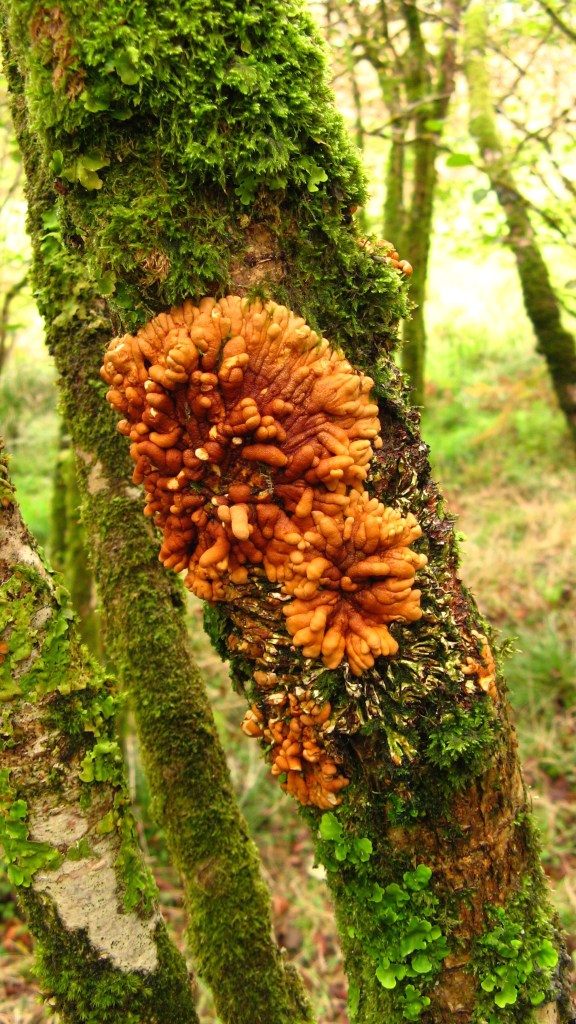
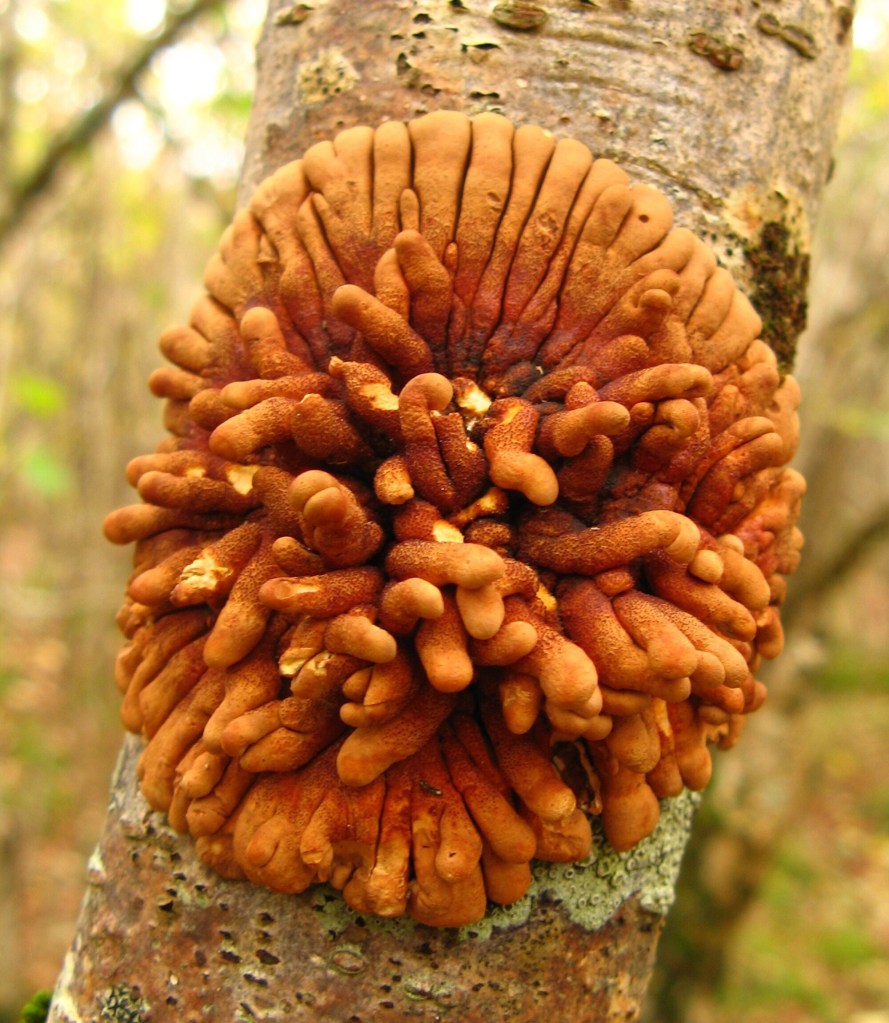
The Hazel Glove fungus Hypocreopsis rhododendri, is a member of the ascomycete genus of funghi, which derives its name from the ancient Greek word ‘ascus’, which means sac. On this species the the openings of these sacs are visible as black dots on the surface of the funguses orange fingers.
This fungus is found fruiting throughout winter from about August to April and old fruiting bodies can be seen as dried up black and white scraps. It is only found at a few sites around the British isles, including the West coasts of Ireland and Scotland, in Devon, and in Northern England.
Found mainly on Hazel
This fungus, as its name suggests, is found mainly on Hazel, growing on the stems of the tree and reaching up to 8cm across, although it has been found on other trees too. The scientific name of the fungus Hypocreopsis rhododendri, is a bit misleading as it leads you to think it is a fungus of the Rhododendron, however this is only as when it was first classified and named it was found growing on Rhododendron maximum in Northern America, but it isn’t recorded growing on Rhododendron in this country.
Hazel glove is indicative of clean, humid air, and most frequently found in our temperate rainforests on the western fringe of the British isles, where they receive a plentiful supply of wet, fresh air. It appears as a peculiar looking, orange-coloured growth which seems to clutch onto the stems of Hazel trees like a glove with way too many fingers, hence its common name, and it does look like it is choking and otherwise harming the Hazel.

Parasite of glue fungus
Hazel gloves does not live directly on Hazel but upon another equally interesting fungus, one called ‘glue’ fungus. Glue fungus, as its name suggests, glues Hazel stems, both dead and dying, into the canopy of the tree and the presence of this fungus indicates that Hazel gloves may also be present.
It is thought that the reason the two are found together is that Hazel gloves parasitises Glue fungus, Hymenochaete corrugata, which is a fungus of the basidiomycete genus which lives on decaying wood and forms a brownish/purple crust, usually on the underside of branches. This fungus gets its name from the tough, black coloured ‘glue pads’ it develops which bind together branches and help it spread from tree to tree.

Priority species
As with many other species which are are found in our temperate rainforests the Hazel glove fungus is as rare the habitat it relies upon, it is categorised as a priority species on the UK Biodiversity Action Plan. As it is found on Hazels which have reached the end of their lifespan and are dying it is also threatened by coppicing and grazing, although Hazel will happily regenerate when cut back entirely, which is the basis of the practice of coppicing. This leaves only new growths, with none of the decaying wood which the glue fungus, and hence the Hazel glove, need to survive, therefore if all of the old Hazel from a wood is cleared out this can lead to the two species becoming locally extinct.
Proper woodland management doesn’t only mean planting trees, as maintaining a balance between new, mature and dying trees is essential in order to keep a balance between all of the habitat types a biome like temperate rainforest can hold, it is only through maintaining this balance that we can keep hold of, and even encourage, important species such the Hazel gloves.
A B-H


NICE POST 💖💓💚💯🙏🫂
LikeLiked by 1 person
Thank you 🙂
LikeLike