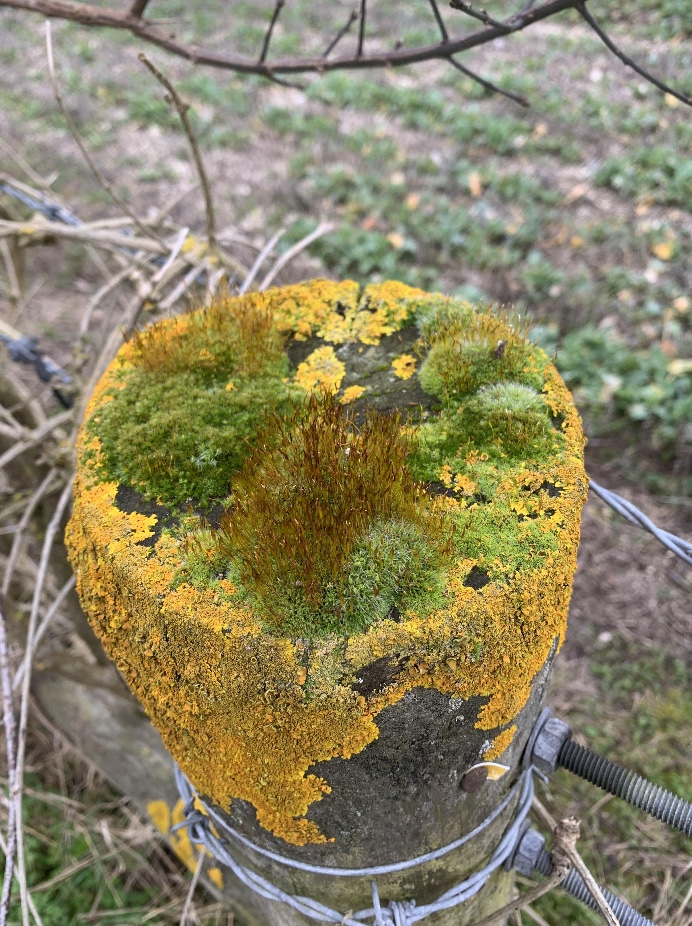
Sunburst Lichen
In the world of Lichenology the Sunburst Lichen, Xanthoria parietina is considered a bit of a weed, growing rapidly and spreading to take over, sometimes literally growing over neighbouring, slower-growing or more delicate species of lichens, its scientific name comes from ‘xanthos’, a greek word meaning yellow, and parietina comes from the same root as patina and means ‘of walls’.
Pollution tolerant
It is one of our most common lichens and can be found throughout the British Isles, growing on branches, twigs and tree trunks, very often being the dominant species of lichen in these places. It is also an interesting species in that it dispels two commonly held myths about lichens; these being that they always grow very slowly and cannot tolerate any pollution.
Conversely X. parietina is very tolerant of Sulphur Dioxide pollution that can kill off other species, and positively thrives on excess nitrates in the environment. In parts of the country that are predominately arable farmed and therefore artificially high in Nitrates due to waterborne and wind-blown fertilisers, X. parietina is often abundant, so is considered by biologists to be a great indicator of these pollutants.
(For more about Lichens and air pollution please see this article;)
Identification and habitat
The best places to find Sunburst Lichens are on trees, such as Ash, Elder, Hawthorn, Sycamores or Willow, they also grow well on exposed rock such as sea cliffs and drystone walls, where they can be found growing alongside another common lichen, Palmeria saxilitis. They usually appear large, leafy, wrinkly, and bright orange, although they can be a greyish/green when they are in shade.
As they tend to do really well in habitats with high amounts of nitrates they are also common on the tops of fence posts and on roofs underneath chimneys or tv aerials where lots of bird droppings are deposited, guano being one of the best sources of nitrates out there.
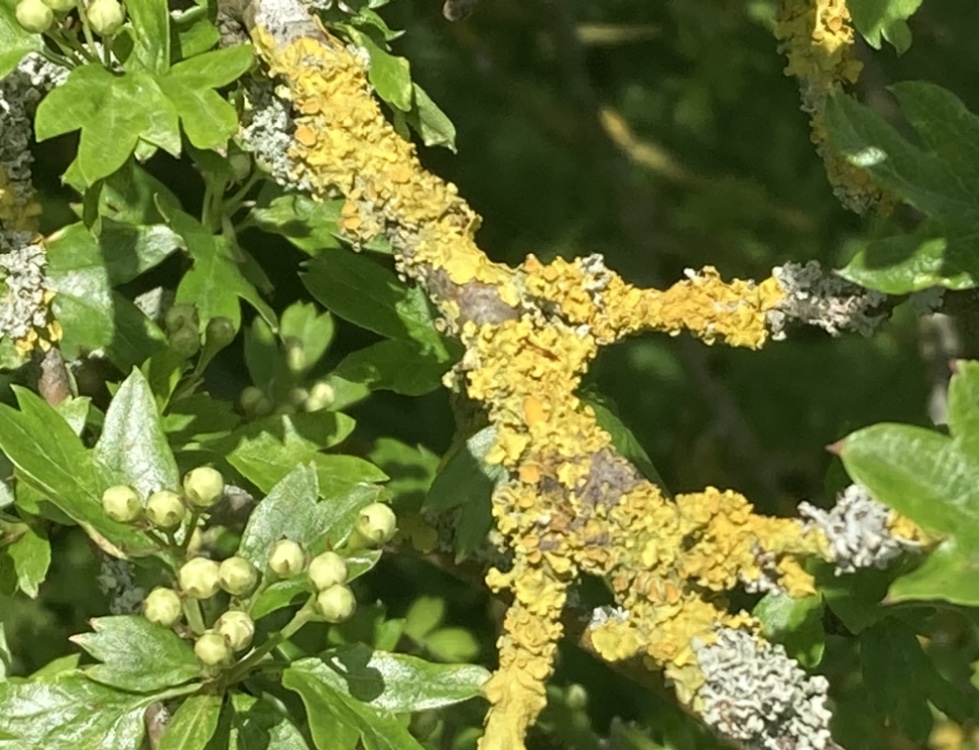
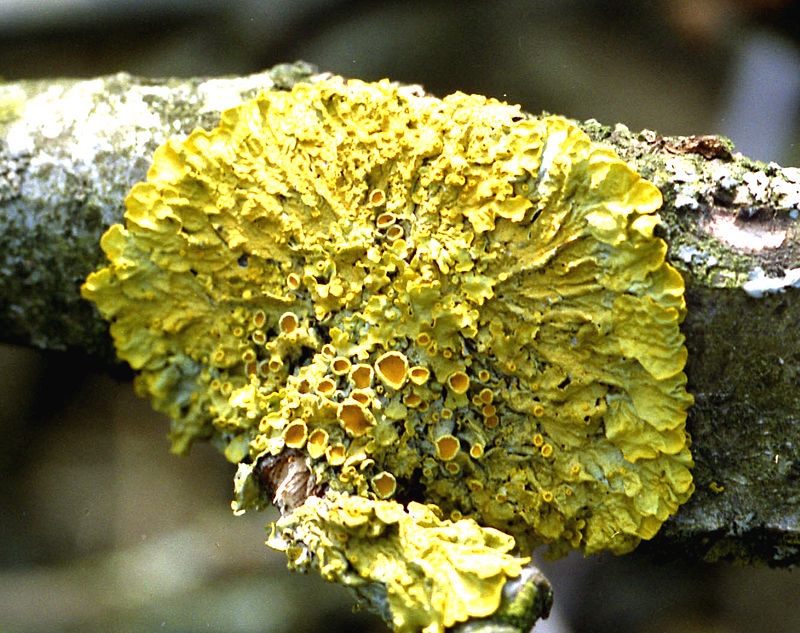
They are classed as a ‘foliose’ lichen, which means ‘leafy’, and form large round patches up to 10cm across, with lots of tiny yellow/orange discs in the centre, although in older specimens the centre will start to die out and turn grey, these discs, which you might need a magnifying glass to see, are called Apothecia.
Lichens are peculiar organisms, each being a partnership of a fungus and an algae, in species like X. parietina the fungal part reproduces by means of spores which are produced in the apothecia. If these spores land on a suitable surface a new lichen may be formed, but only if the correct species of algae is present, exactly how the fungus and algae seek each other out and form these partnerships, and quite how they evolved in the first place, is one of the great unsolved mysteries of science!
Xanthorin
The Orange/yellow colour which gives the sunburst lichen its common and scientific names is due to the presence of a chemical called xanthorin and is thought to be produced as a defence against Ultra Violet radiation, acting as a form of sunscreen to protect the algal cells within the lichen.
This chemical compound can be extracted for use as a fabric dye and was once thought to be a cure for jaundice due to its yellow colour. When the lichen is growing in shade however, the photosynthesising algae need all of the light they can get and protection from UV isn’t needed so the lichen will appear greener instead.
This variation in colour, and the fact that the fungal part of the lichen turns a translucent grey when soaked by rain, can make this lichen difficult to identify sometimes.
Even parasites have parasites
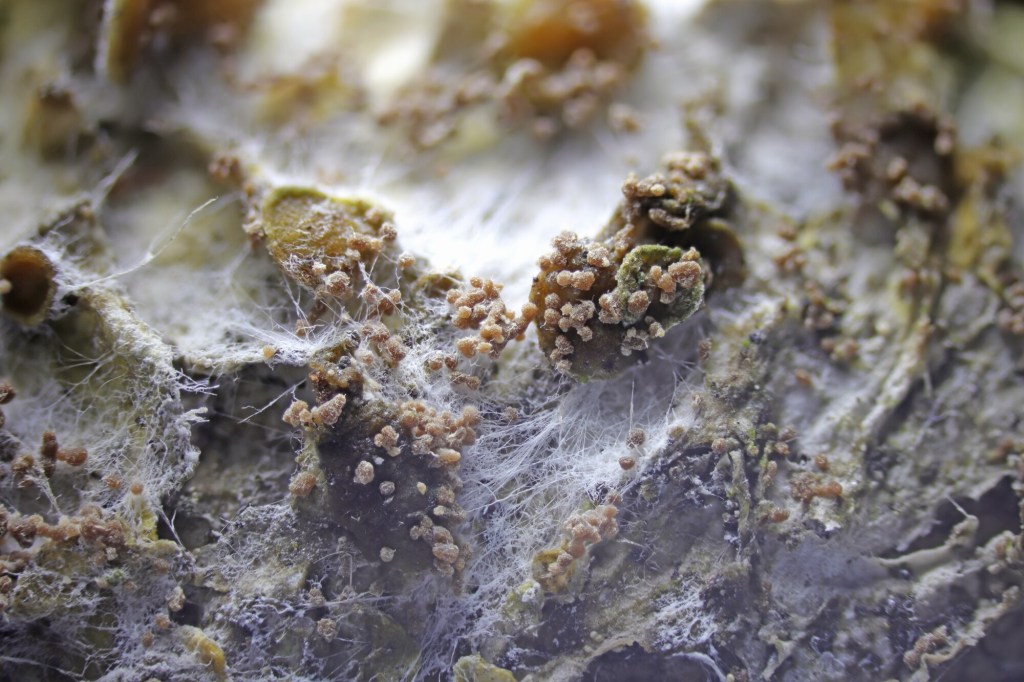
Lichens, although they can be considered somewhat parasitical, are vulnerable to parasites themselves, which often change their appearance, with Sunburst Lichen being particularly vulnerable to an aggressive fungal pathogen called ‘Cobweb Duster’ Athelia arachnoidea. This causes large areas of damage which can be spotted from a distance, with the damaged areas appearing white and covered in a growth which looks a bit like cobwebs, hence its scientific name arachnoidea.
It is a very fast moving parasite, relatively speaking, and moves through an area wiping out many different species of lichens, outbreaks are thought to be connected to pollution, this goes to show that even hardy, supposedly pollution-proof species like the Sunburst Lichen are still at risk from manmade environmental stresses.
A B-H

