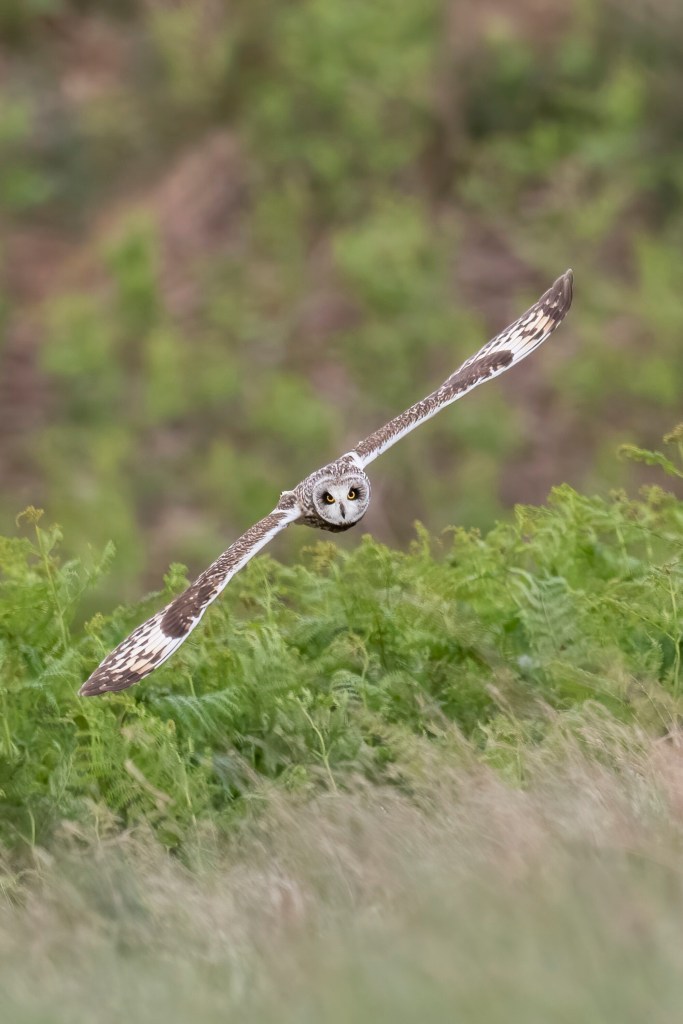
The Short-eared owl, Asio flammeus, translating as ‘flame-coloured owl’, also known as the Strigid owl, is a medium-sized owl commonly found on the heaths and moors of the British isles.
It is a day flying owl, a little bit bigger than a Barn owl, with longer wings and a blunter face, its plumage is a speckled light tan with a light coloured front to disguise it against the sky when it hunts, in a similar way to how a fighter plane is camouflaged above yet light coloured underneath.
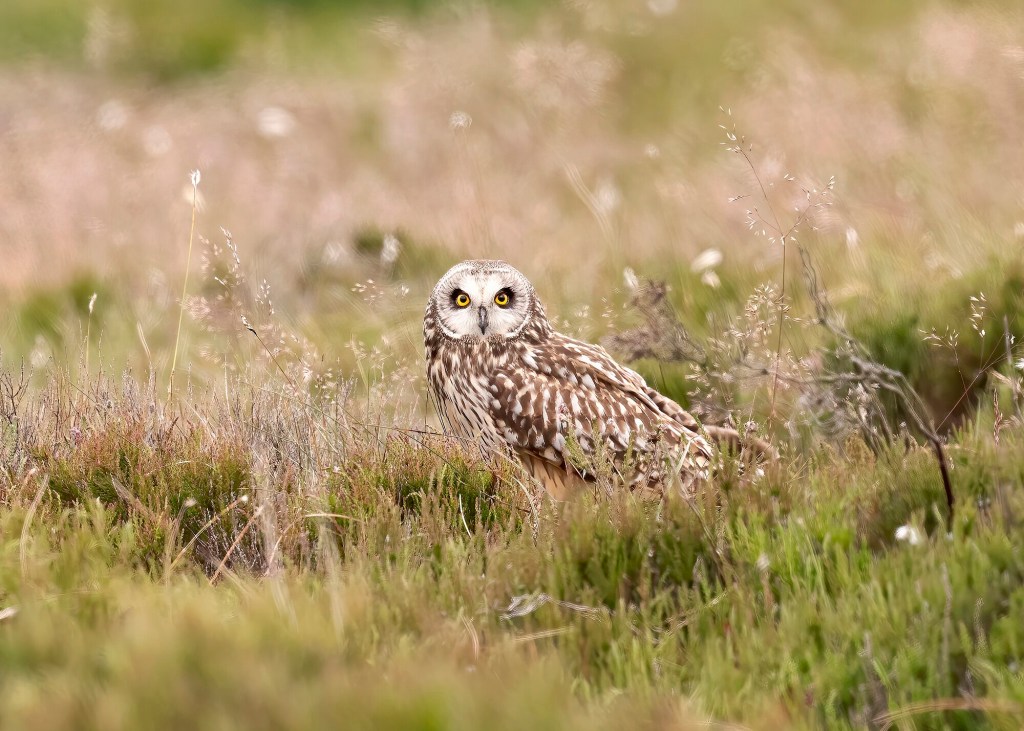
The most striking feature of the Short-eared owl, the one which sets it apart from other owls like the Barn owl, is its huge golden-coloured eyes, shadowed with black like kohl eyeshadow to prevent light-glare and forward facing, giving it a fierce and fiery looking stare, hence it’s Latin name: flammeus.

Sharp-eyed and Keen-eared
Like most owls the Short-eared owl hunts by sight and sound, like its eyes its ears are also front facing and its face is shaped like a radar dish, so that any sounds it picks up are focused, despite its name the ‘short ears’ it appears to have on the side of its head are just tufts of feathers, kept flat to the head when hunting.
They prey on small birds and small rodents, voles and mice being their main food, and quarter over the grassy fells its prey prefers, slowing gliding and constantly peering at the ground for any sign of movement or sound, occasionally they will hover in a way similar to, but not as efficiently as, the kestrel.
Although they often hunt in daylight they are mainly crepuscular, hunting at dawn and dusk, when their acute vision is best suited for picking out their prey.

Ultraviolet Vision
Researchers have recently found that many birds of prey like the Short-eared owl can see ultraviolet light, which is a useful ability as the urine that mice and voles constantly mark their territories with reflects ultraviolet light and gives away their presence to the kestrel, owl or hawk overhead.
In the British isles the Short-eared owl is found in the north of England and in Scotland, where it can be seen hunting over the moors and fells, it is seen more often in winter and in a particularly cold year migrants from Scandinavia, Iceland and Russia may join our native owls and very bad weather will drive them down to the lowlands and coast where they will gather together. Some of our coast’s saltmarshes and estuaries will already host a small resident population of Short-eared owls though so this can sometimes cause conflict.

Breeding behaviour
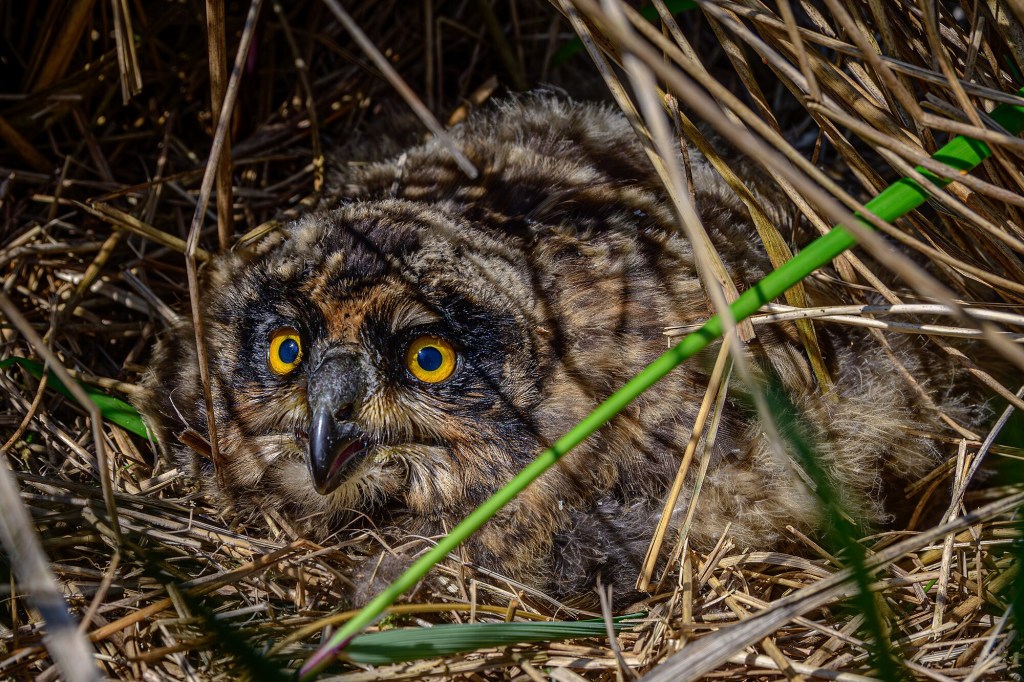
Breeding season is in spring and the young are usually fledged by June, the female will build a basic nest out of dried grass in a scrape or hollow and line it with feathers plucked from her own breast, some birds develop downy feathers especially for this. The clutch is usually around 5 to 6 eggs which hatch after about a month and the young will fledge a month after this.
Once incubating eggs they are very secretive birds and hardly seen but the courting process is anything but discreet! Male Short-eared owls displaying over their territory with strong flaps over their long wings interspersed with sudden dives where they clap their wings together quite loudly, the whole thing intended to be heard and seen by a potential mate over a wide distance. Male owls are highly territorial too, having particular roosts and perches from which they will spot and violently repel any intruding males.
Current Status
The resident population of pairs of Short-eared owls is in decline at the moment, currently estimated at up to 2000 pairs, the species is classed as ‘amber’ meaning that it is under threat. In recent years organisations as the BTO (British Trust for Ornithology) and the GWCT (Game and Wildlife Conservation Trust) have been carrying out counts and researching the possible reasons for its decline and how it can be remedied.
As it is so dependent on the availability of its prey it can be a very nomadic species, following the fortunes of the local vole populations, this nomadic nature and the fact that migrant owls will sometimes bolster British numbers makes it very hard to estimate the numbers of resident pairs. Its tendency to vacate the uplands entirely at the first sign of bad weather and not show itself at all during the breeding season also doesn’t help conservationists!
Status in Northwest England
In the Northwest of England the Short-eared owl does very well on the ‘keepered’ moors; the big estates owned by United Utilities and Duchy estates and managed as Grouse moors by gamekeepers. The habitat here is open which suits them and as they are a ground nesting species, hugely susceptible to predation during the breeding season, predator control carried out by the keepers to protect their grouse also benefits them.
Conversely they seem to be quite common on a couple of unkeepered moors too, I have often seen them hunting on Waddington fell and nearby Birkett fell in the Ribble valley, despite these areas not being intensively managed for Grouse, I’ve seen breeding Hen Harriers on those moors too, these are areas rarely frequented by tourists, gamekeepers or birdwatchers so perhaps the lack of disturbance by humans is what they like?
As they are very susceptible to disturbance and our uplands are becoming more and more popular with tourists, this could become a severe problem in the near future.

Conclusion
I pose a question to birdwatchers, conservationists and keepers alike; is the amount of disturbance caused through monitoring and counting of the Short-eared owl more damaging to them than anything else, (a birdwatcher’s camo can be top-notch but a bird which can see a vole at a hundred yards in the dusk will still spot you hiding a mile off!)
Would they do better if they were given a respectfully wide berth?
A human being, even one trying to be quiet, is still the noisiest animal you can expect to find on the moors!
A B-H
 Northwest Nature and History
Nice 👌
LikeLiked by 1 person
hey
cool blog 🙂 will give it a follow and a like !
https://jackrussellterriers.info/
LikeLiked by 1 person
hey
cool blog 🙂 will give it a follow and a like !
LikeLiked by 1 person