
The Spotted Flycatcher, Muscicapa striata, is found throughout the British isles and is a summer visitor to these shores, arriving in May and departing for Southern Africa around September. Although it is a small bird, only reaching up to 15cm in length at the most, which is about the same size as a sparrow, it is quite stocky in build, which makes it appear to be quite larger.
Specialist predator
As it’s common name suggests, the Spotted Flycatcher is a specialist in the art of hunting flying insects, perching on a lookout post such as a bare branch, telegraph pole/wire or gable end and darting out to grab its prey when it passes, and then returning to its chosen lookout tower until it espies its next snack. It’s bill, like that of other birds which hunt flying insects such as the Swallow and Swift, is broad at the base and surrounded by bristles which act to both channel insects into it’s maw and prevent them from escaping.

(NPPGrandMeadow)
Appearance and calls
In appearance the Spotted Flycatcher is a sharply dressed but rather dull looking bird, a light brown above and paler in colour below, with a finely-streaked, or striated, breast, hence the striata in its scientific name. Its song is inconspicuous too although it is one of the most high-pitched to be heard in the countryside, and older listeners may have trouble hearing it at all, it is composed mainly of high-pitched ‘tseep’, notes that sounds a bit like a squeaky wheel.

Habitat and population
The habitats the Spotted Flycatcher can be found in are varied, as long as there are flying insects, perches, and mature deciduous trees to nest in it seems to be happy in a wide spectrum of places, though it seems to prefer large, open gardens and parks in particular.
Historically it was considered a relatively common bird, but since the 1960s the population has been seen to fall at an alarming rate, with estimates by the British Trust for Ornithology putting this decline at 89% between 1967 and 2010.
The reasons for this are not fully clear at the moment but several factors are thought to be responsible, including drought in its African wintering grounds, a major decrease in the number of insects here in Europe and predation by predators, with Grey Squirrels thought to be largely responsible for the failure of nests in some regions.
Breeding
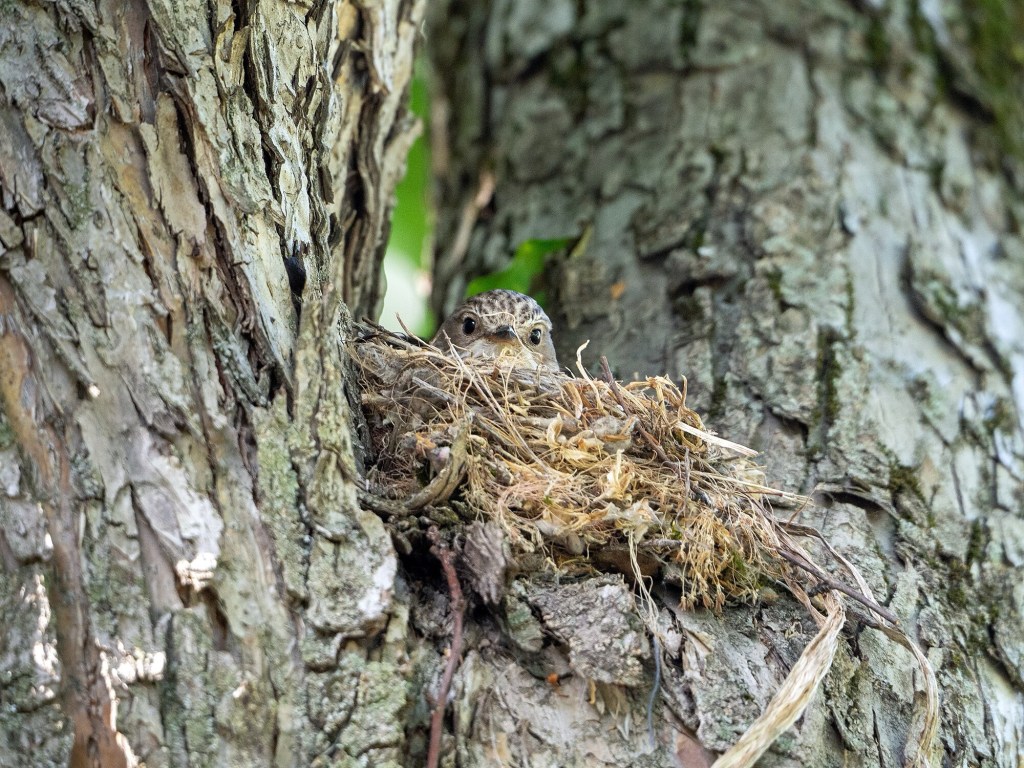
The Spotted Flycatcher breeds in open woodland, farmland, large parks and wooded gardens and builds its nest close against a tree trunk. The nest is a traditional bowl-shape and both birds help to construct it, (notice the male feeding the busy female at around 0.10 in the video!) using materials such as dry grass and moss, lichen, small twigs, and spiders’ webs, and they carefully line it as they go with feathers and hair.
They will nest in open-fronted nest boxes and occasionally old outbuildings and barns. In this nest the female will lay around 4 smooth, glossy white eggs which have reddish blotches on the shell, these are about 2cm by 1.5cm in size, only the female sits on the eggs but the young, which fledge about 13 to 16 days later, are fed by both parents.

(Roger Culos)
If you would like to see Spotted Flycatchers in the Northwest I recommend visiting the Forest of Bowland, which holds some excellent Flycatcher habitat full of all of the rolling cattle-pastures, parkland and mature deciduous trees that this bird likes so much. I’ve spotted them here on Knowlmere Estate near Dunsop Bridge, at Browsholme Hall, from the Trough road and I’ve even seen a pair hunting in the beer-garden of the Bounty at Slaidburn!
The Spotted Flycatcher
Gray on gray post, this silent little bird
Swoops on its prey—prey neither seen nor heard!
A click of bill; a flicker; and, back again!
Sighs Nature an Alas? Or merely, Amen?
Walter de la Mare (1873-1958)
A B-H
(July 2024)
 Northwest Nature and History

The third image feels like its yawning… eventhough its not the picture says.
LikeLiked by 1 person