
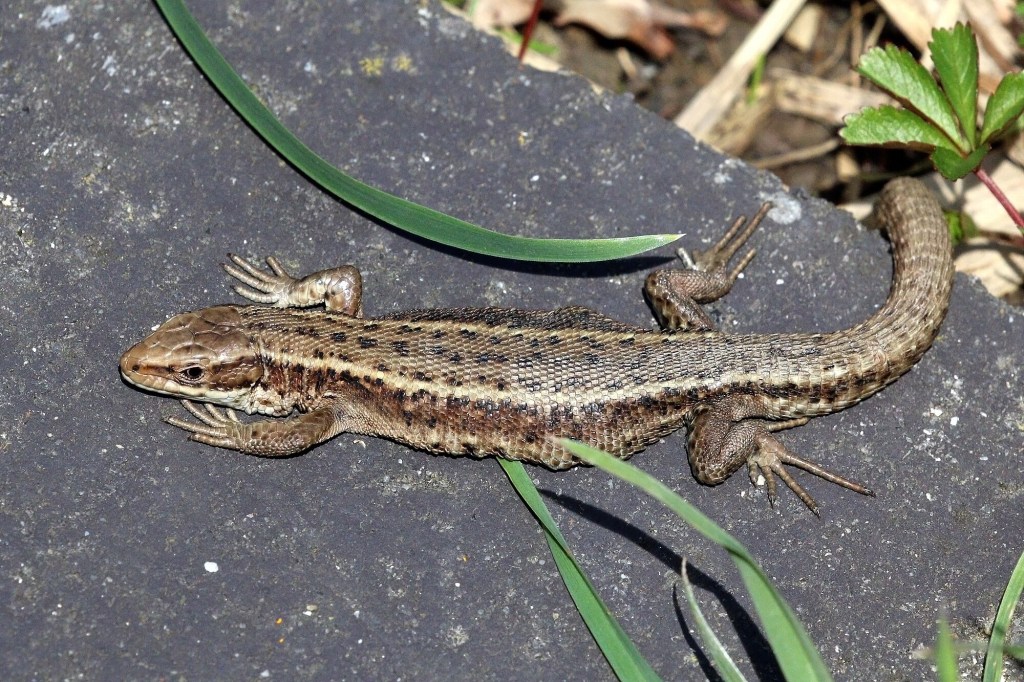
The Common or Viviparous Lizard Zootoca vivipara, (Zootoca from the Greek ‘to give birth’, and vivipara meaning ‘live birth’, as opposed to ovipara, meaning ‘egg birth’) is one of the most common reptiles in the British isles and can be found throughout the country in a wide variety of habitats, even on the cold, damp fells of the Northwest where you might not expect to find such exotic creatures, seemingly more suited to warmer climes.
Cold and damp-proof
The success of the Common Lizard here is due to the fact that, unlike the vast majority of reptiles, it is perfectly at home in damp habitats, as the humidity actually has a positive effect on its growth rate and activity. Ideal habitats for the Common Lizard are similar to other native species of reptiles, like the Common Adder, with a preference for south-facing locations; heathland, sand dunes, scrubby hillsides and forest glades and rides are favourite haunts. However, as it can tolerate damper habitats it can also be found in boggy locations such as peat bogs and the damper corners of the countryside which other reptiles shun.
We had one living in front of our old house for years, where we were surrounded by trees and the lawn was so damp it was all but un-mowable, and had long since reverted to moss anyway, yet the abundance of insects and the few hours of sun that warmed the walls in the mornings for a few days of the year seemed to be enough to sustain it.
This particular lizard wasn’t very shy and this seems to be representative of the species as a whole, which is equally very happy in man-made habitats such as railway embankments, parks, and of course gardens (and ours was a very busy, noisy household!)
Another ability that Common Lizards have which allows them to thrive in our temperate isles is that, as well as being tolerant of damp, they are also able to survive sub-zero temperatures. They can remain in a supercooled state at -3°C for at least three weeks and can stand having up to half of their body water frozen as ice for 24 consecutive hours.

Habitat and Hibernation
As reptiles are ectothermic, meaning cold blooded, they rely on external heat sources to increase their body temperature, Common Lizards are both heliothermic, meaning they can derive their heat from the sun, and thigmothermic; from contact with warm surfaces. They are also diurnal, basking in the sunshine to raise their body temperature and then hiding in the shade if they need to cool down.
Sites with flat rocks, sun-dappled logs and dry, sandy patches with proximity to cover from predators are their preferred basking spots , and they will flatten their body out whilst basking to absorb heat over a greater surface area. When dusk approaches they hide away in nooks and crannies, and their body temperature drops over the course of the night, but in the morning they need to bask in a warm, sunny spot to bring it back up, this means that very early morning is often the best time to spot them, very little is known about these night time refuges although they must certainly be snug, dry and frost-proof.

(Alun Williams)
Breeding Cycle
Common Lizards hibernate over winter from about October to March and begin the courting process as soon as they emerge in spring. The male lizards first establish a territory which they vigorously defend against rivals, and after sloughing their old winter beaten coat off to reveal their shiny new lizard skin jacket underneath they will begin to court females.
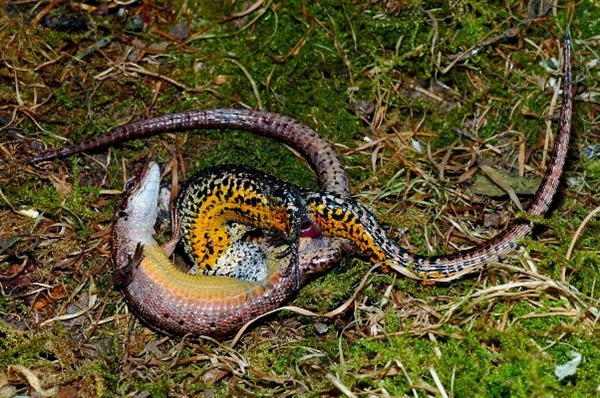
A male might mate with several females and the mating process itself is quite rough, with the male biting the neck of the female to restrain her. The females gestate for about three months, during which they spend most of their time basking, and give birth to between 3 and 12 ‘neonates’ or live young, this is what gives the species it’s scientific name vivipara, ‘live birth’.
The ability to give birth to their young already hatched and ready for life, for this is what the lizards do, holding the eggs inside the oviduct until hatched, is another adaptation which enables this species to survive in the cold north, and the young lizards are completely independent and self reliant from birth, moving straight out to find their own homes.

(Charles J Sharp)
Appearance
The adult Common Lizard usually comes in a variation of colours on the theme of brown and green and the male can be differentiated from the female by his longer stature and shorter head. Males also have more pronounced ‘ocelli’, which are dark spots incorporated into the patterns of their camouflage, whereas females have more obvious stripes along their backs, the females also have plain and pale bellies compared to the males more colourful undersides.
Common lizards can grow surprisingly big, with males reaching up to 20cm in length including the tail, which makes up most of their overall length, however their bodies alone are only 6 to 8 cm on average and they are very light in weight, at about 5 grammes. Male lizards will reach maturity at about 2 years and females 3 and they live for up to 5 years in the wild.

Predator and Prey
The diet of the common lizard consists of small invertebrates; beetles, spiders, worms, grubs, moths, slugs and snails and the lizard hunts by sound, smell and sight. Once a lizard has seized a prey item in its jaws it will shake its head violently to stun the prey, before swallowing it whole, although they will remove the wings from larger insects first, using their 5-fingered paws. Surprisingly they will even swim to chase after prey, using their long tail to power across the surface of the water.
Naturally Common Lizards are prey animals themselves and are hunted by a wide array of larger creatures, including Badgers, Buzzards, Cats, Corvids, such as Crows and Magpies, Foxes, Hedgehogs, Hen Harriers, Merlin, Herons, Hobbys, Kestrels, Stoats, Weasels and many others, who find their wriggling form irresistible.
Although Common Lizards, like other lizards, have a neat, if slightly gruesome, trick up their sleeves to aid escape; they can shed their tails. This ability is called ‘autonomy’, abd is intended to distract the predator and allow the lizard to quickly exit stage left and survive another day, they can regenerate their tails in a relatively short time too, which is something that scientists, especially military doctors, have been trying to replicate in humans for decades.

The Lizard
Thomas Hardy (1840-1928)
If on any warm day when you ramble around
Among moss and dead leaves, you should happen to see
A quick trembling thing dart and hide on the ground,
And you search in the leaves, you would uncover me.
A B-H
(Aug 2024)


Well, as a southerner exiled in the north I had no idea reptiles could survive here! 🙂 Fascinating – thank you for that.
LikeLiked by 1 person
There’s some fairly big adders in the hills too, i know a couple of spots where you’re almost guaranteed to see one on a sunny summer morning but like a lot of things they are missed by most people because they are just too noisy and heavy-footed, the lizard we had living in the wall of our cottage years ago was a surprise to me too as i always thought they were creatures of warmer climates, but since then I’ve seen them in south-west scotland so it must be warm enough for them here, even if we don’t think it is!
LikeLike