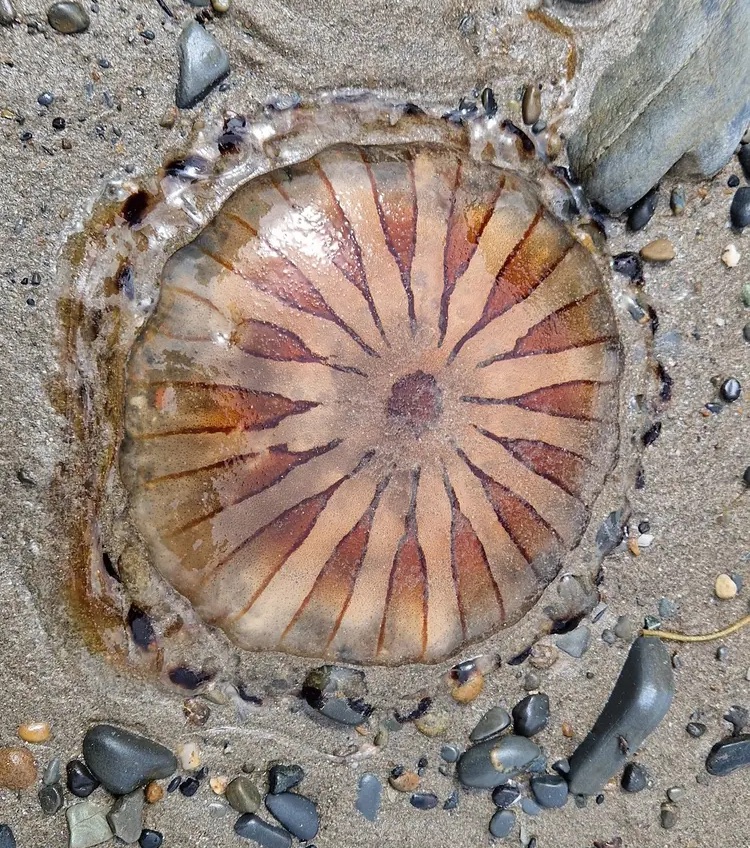
The scientific name of the Compass jellyfish is Chrysaora hysoscella, Chrysaor being the son of the Sea God Poseidon and Snake-headed Gorgon Medusa.
This is very apt as being a true member of the jellyfish family they follow the typical ‘medusae’ body-plan when in their adult stage, with a round bell-shaped body below which long tentacles trail.

Compass by Name but not by Nature
The common name of the Compass jellyfish comes from the symmetrical radial patterns they display on the top of their ‘bodies’. It’s an attractive looking marking composed of chestnut or maroon lines and it’s easy to see how the jellyfish got this name, but you would be ill-advised to use C. hysoscella to navigate as, being jellyfish, they are brainless with very little clue of where they are going and, by their very nature, at the whim of tide and current.
Many people will recognise this species from specimens washed up on beaches, where they have stumbled upon their saucer-like forms stranded on the sand. These peculiar gelatinous blobs give those of us who haven’t seen them in their mundus normalis, their normal world of the water, only a vague sense of how they should appear and go about their life.
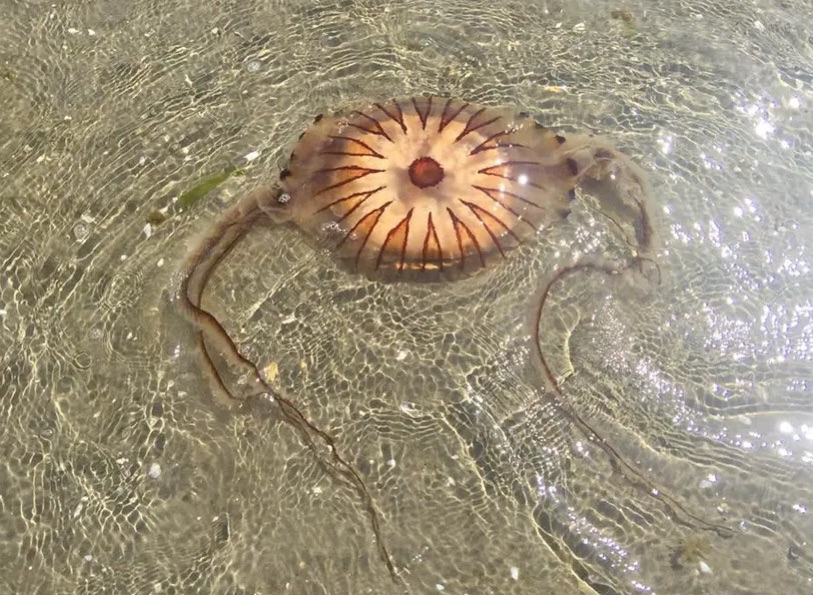
When in the water they are composed of a flattened, bell-shaped body, ranging from 4 to 40cm across, this plays an important role in swimming and constantly opens and closes as the medusae moves through the water. Trailing after this will be the creatures tentacles, arranged in eight groups of three making a total of twenty-four tentacles.
These tentacles are extendable and retractable and bear stinging cells (called nematocysts) for capturing prey, in between each group of tentacles a basic sense organ, which can detect light and olfactory stimuli, is located. As well as these there are four arms surrounding the mouth which are longer than the diameter of the jellyfish.
These oral arms, tentacles or both are often missing from the stranded jellyfish which has led biologists to hypothesise that they have often died before washing ashore.

Coastal Casualties
Such mass strandings usually occur from June to August and it has been estimated that 95% of the total medusae will end their lives in this way, the exact reason for them doing this is unknown but a current theory is that the mature medusae die shortly after gamete (sperm or egg) release and the dying bodies drift ashore with the tide.
This theory is supported by the fact that they are a coastal species, staying relatively close to the shores of the continental shelves, predominantly within the latitudes of 50° to 52° North and in waters of 4°C to 28°C. In these zones they will breed in shallower water, leading to their bodies being washed ashore in very localised areas. Indeed I have found them washed ashore in their hundreds on one stretch of the sands of Dundrum bay in Co Down, Northern Ireland but none at all just half a mile down the beach. (I’ll be writing a series of memoirs about my time Up in Down soon)
Distribution
The Irish Sea is one of their strongholds as well as the North Sea and the Atlantic coasts of Scotland and Ireland, here they occupy the top 30 metres of the epipelagic zone, the well-lit topmost layer of the sea and rarely stray any deeper, although they will descend to escape the rough waters of storms or if they feel threatened by predators, their chief ones being larger fish such as Mackerel and Sunfish, Leatherback Sea Turtles and Seabirds.
They prey upon small fish, planktonic animals, such as Arrowworms (Sagitta), Comb Jellies (Ctenophores) and young Polychaetes, such as Tomopteris, using their tentacles to draw the captured creatures up into their mouths. In some years their sheer numbers can massively affect local populations of these prey species and as our increasingly warmer waters have led to increasingly larger populations of jellyfish, this has repercussions that marine biologists are only beginning to understand.

(Pan-european Species Directory)
Explosions in Jellyfish populations
Warming ocean temperatures, combined with overfishing and pollution by sediments, sewage and fertilizer has caused periodical explosions in jellyfish numbers, and as they fill a very broad trophic level (position in the food chain) this can have huge knock-on effects for other marine creatures, and therefore us.
Large numbers can wipe-out local populations of plankton, mollusc and crustacean larvae, tunicates (sea-squirts etc) and worms, reducing the availability of food for species further up the food chain and limiting their reproductive and growth success. They also feed on the eggs and larvae of commercial species, and can swamp fishermen’s nets, making them useless for catching fish.

must have been its last meal
Complex Life-cycle
The solutions to the jellyfish problem (apart from the immediately obvious ones such as reducing use of fertilisers) aren’t clear as there are so many gaps in our knowledge about them, in particular their complex lifecycle.
With Compass jellyfish it is known that they gradually change from male to female over the course of their lifespan, with the female stage being larger than the male. After mating the adult females release larvae called ‘planulae’ which swim freely for a few days before settling on a suitable surface and becoming a benthic polyp, called a ‘scyphistoma’, (benthic means living on the sea-bed).
These scyphistoma reproduce asexually by releasing an immature stage of jellyfish called ‘ephyrae’, this is done during the summer months and maturation of the ephyra adult medusae can take weeks to months depending on sea conditions. When young these immature jellyfish can revert back to polyps but mostly they mature into males, mating later in the year with most of them meeting an unfortunate end on our beaches, only to be poked by curious children or pecked at by seagulls.

What to do if you get stung
The sting of the Compass jellyfish is often compared to that of a Nettle or Bee so it’s best to avoid poking one, they detach their tentacles too, which keep stinging even when not attached.
I’ve found that if you do get stung scraping the sting clean or removing the tentacles with tweezers, followed by washing with warm water seems to work well, the received wisdom is to then apply a mild acid like vinegar to prevent stinging cells on the skin from firing, but i can’t vouch for this personally and the NHS advise against it as a treatment anyway.
I wouldn’t, however, recommend getting someone to pee on you, it’s an urban myth, it’s just gross and it will actually make the sting more painful, so unless you’re into that kind of thing it’s best to follow medical advice, here is a link to the official NHS page on what to do if you get stung by a jellyfish.
Jellyfish Poem, by Sebastian Seal
When swimming in the North Sea,
I was stung by a jellyfish.
He charged me 95p,
For a porcelain welly dish.
He told me it was Royal Dunlop,
He said it was very rare,
All the way from far Cathay,
And rubbery with French flair.
A pottery expert I came upon,
He said it was a worthless shell.
He told me I had been truly done,
And for a trick I had fell.
A B-H
(Aug 2024)
 Northwest Nature and History
Love the poem. 🪼
LikeLiked by 1 person
Thanks, i wanted an upbeat, silly kind of poem to balance the tone of the article but most jellyfish poems are rather sad, this one seemed to work quite well!
LikeLiked by 1 person