Rainforest, but not as we know it
Lofty green trees clad in lianas and vines, broad waxy leaves dripping with rainwater, howling and screeching monkeys and birds, the whine of flying insects and unbearable humidity, for most people the images these words conjure up are of the archetypal tropical rainforests, those vast, mysterious jungles of the Amazon and Congo, teeming with exotic life yet threatened by man’s bulldozers and chainsaws.
Few however will have realised that we have rainforests right here on our own front doorstep, and very rarely does their fate come up for discussion.
Even so, since mankind first started chopping down trees tens of thousands of years ago we have destroyed more of the world’s temperate rainforests than any other type, although many patches and corners of it still hang on.

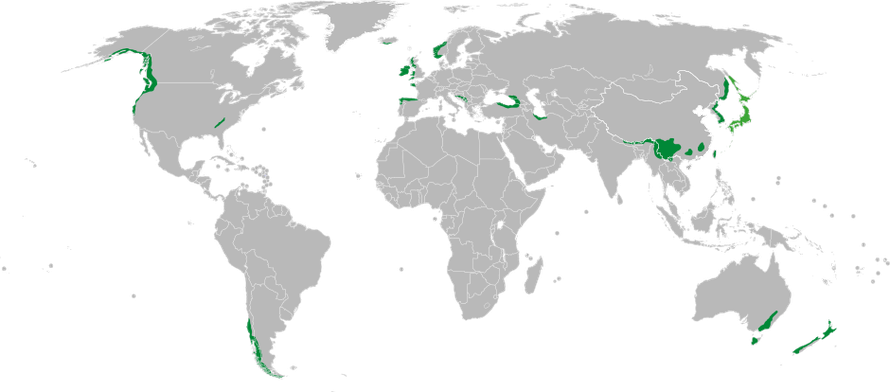
Temperate rainforests around the world
There are bits-and-bats of this type of biome all around the world, in the Southern Hemisphere there are the sylvanian forests of New Zealand which burglar Bilbo and his company trekked through in the film trilogy, also in Australasia the rainforests of Tasmania.
The Southernmost tip of South Africa, funnily enough also a source of inspiration to Tolkein, has its own temperate rainforests, as does Chile, which has a thin slice running down the country’s western coast.
This strip of coastal rainforest is also duplicated in the northern hemisphere, where, at roughly the same latitudes, can be found coastal temperate rainforests which run from Northern California, up through Washington State, to Alaska, and contain one of the most diverse ecosystems in the whole world, home to some of the oldest organisms too, with some of the Giant Sequoias dated at over 3000 yrs old.
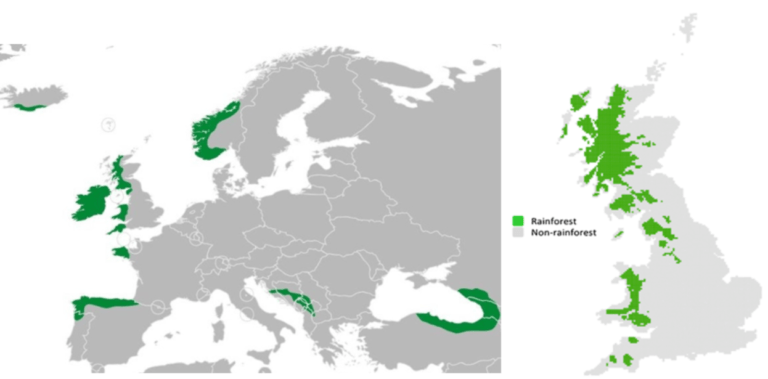
Temperate rainforests can be found on the other side of the world, in Japan and northeast China, and also on the eastern side of the Black Sea, and in Europe small pockets exist in Norway and the British isles. Here it is called Atlantic, or Celtic, forest and these are remnants of much bigger forests that existed from the period between the retreat of the last ice sheets and the Neolithic period, when clearance of the forest first began.
British rainforests
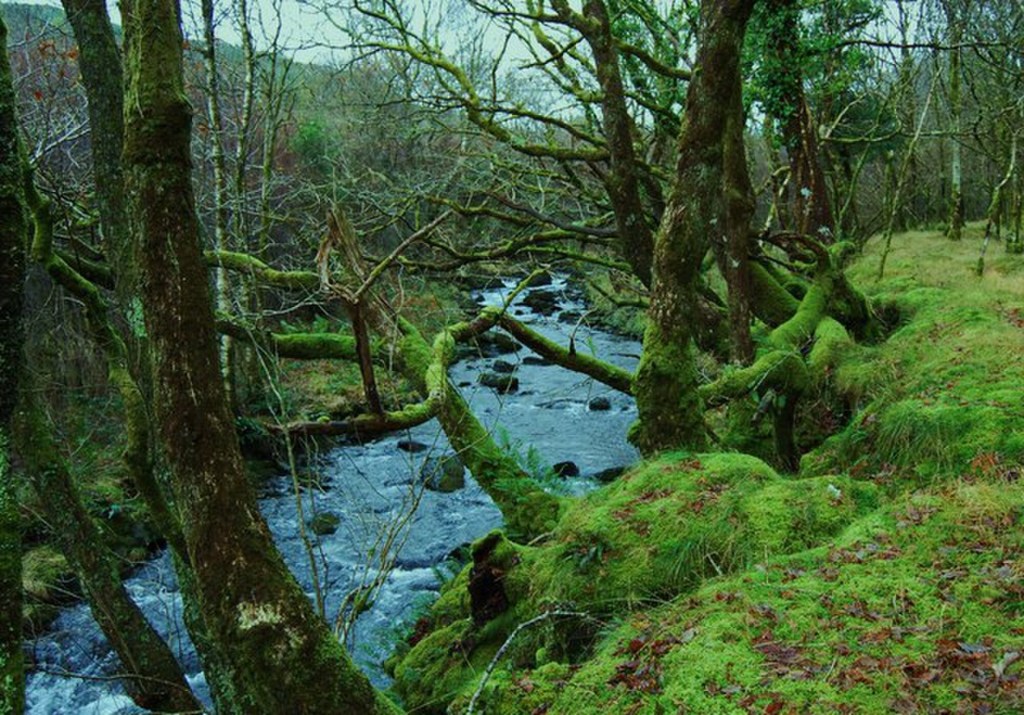
One of the reasons these forested areas are called ‘Atlantic’ or ‘Celtic’ forests is that they are found on the western fringes of the British isles, where the oceanic climate, quite often boosted by branches of the Gulf Stream, brings heavy rainfall. The high humidity and warmer climate allows species such as the Hart’s Tongue and the Polypody Fern, liverworts, mosses, lichens and rare funghi such as the Hazel Gloves to thrive on the trunks and branches of the trees, which are characteristically stunted, and predominantly Oak.

These can by surprisingly ancient trees too, as their dwarf-like stature historically made them of little use for constructing timbers and beams for buildings and ships, so they were left alone.
Agriculturally however, these areas can have very fertile soils, so any areas that could be cleared for grazing or crops, were, this literally pushed these fringes of temperate rainforest into the more inaccessible parts, such as steep or rocky hillsides and dark valleys, (called Cloughs in the northwest of england).
To find these corners of ancient wild wood now you have to head to places such as the Atlantic seaboard and Western isles of Scotland, the far Southwest; Bodmin, Dartmoor and Exmoor, Pembrokeshire and the North of Wales, and here in the Northwest; Cumbria, Yorkshire and the Forest of Bowland.
In my Temperate Rainforest Collection I’ll look at some of the various species of flora and fauna that can be found in these rainforest remnants, as well as uncovering some of the ancient lore that surrounds them.
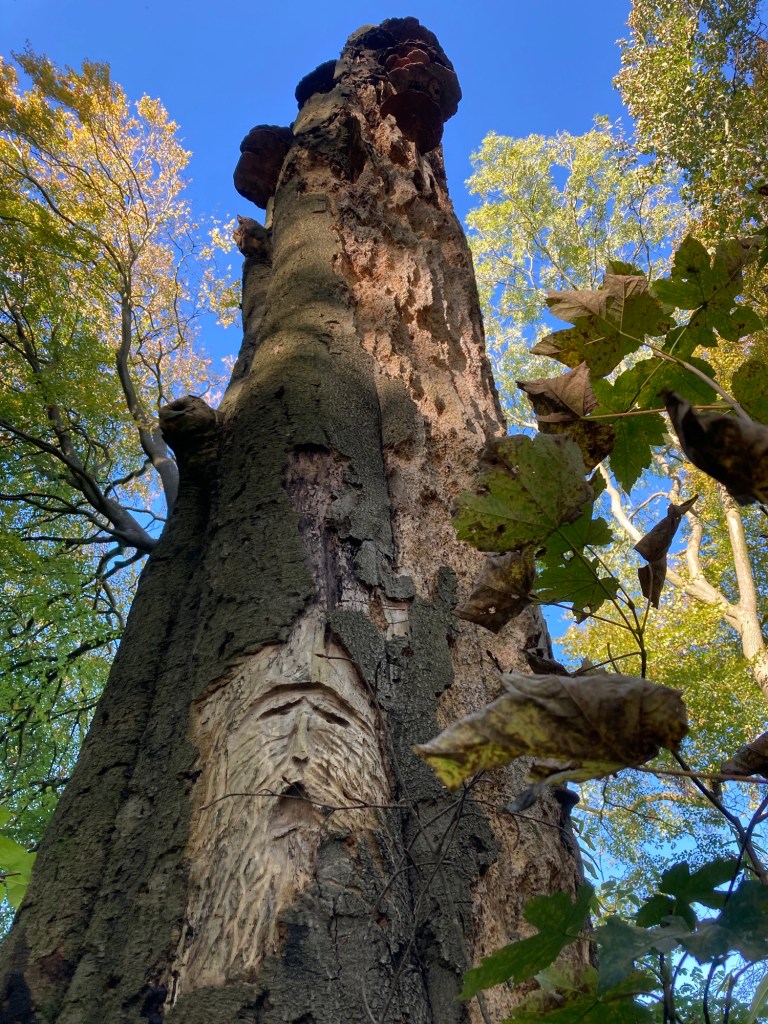
Green Man in the Garden
Charles Causley (1917-2003)
Green man in the garden
Staring from the tree,
Why do you look so long and hard
Through the pane at me?
Your eyes are dark as holly
Of sycamore your thorns,
Your bones are made of elder branch,
Your teeth are made of thorns.
Your hat is made of ivy-leaf
Of bark your dancing shoes,
And evergreen and green and green
Your jacket and shirt and trews.
Leave your house and leave your land
And throw away the key,
And never look behind, he creaked
And come and live with me.
I bolted up the window,
I bolted up the door,
I drew the blind that I should find
The green man never more.
But when I softly turned the stair
As I went up to bed,
I saw the green man standing there.
Sleep well, my friend, he said.
A B-H
(Aug 2024)
 Northwest Nature and History