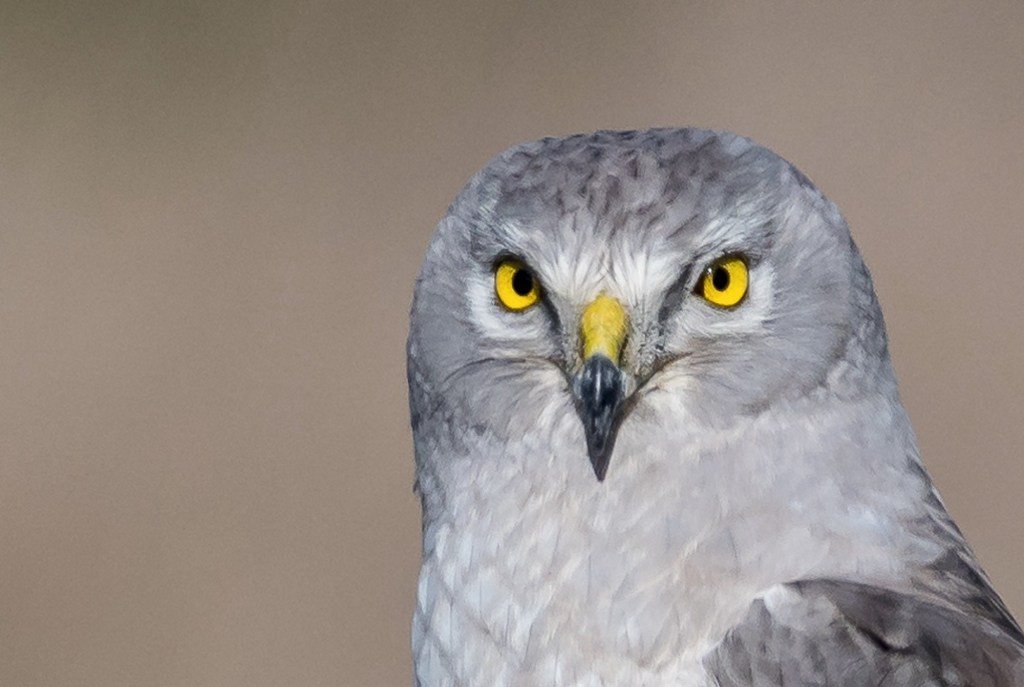
The Hen Harrier, Circus cyaneus, is a medium-sized bird of prey, found throughout Europe and resident in the UK.
Its scientific name aptly describes the appearance of the bird, with circus, the Latin for ‘circle’ or ‘ring’, referring to the propensity of the female and juvenile birds to have white rings around their tails, (which lends them another common-name of ‘Ringtail’,) and cyaneus being Ancient Greek for cyan, which is the attractive dark-blue/grey colour of the male’s plumage.
The most commonly used name, Hen Harrier, has Old English origins and is earned by their age-old habit of ‘harrying’, or harassing any and all ground dwelling birds, which have historically fallen under the catch-all name of ‘hens’, such as ‘marsh-hens’, which generalises coots, rails etc, and ‘moor-hens’ which refers to either Pheasant or Red-grouse.
It is their predilection for hunting the latter that has got them into a lot of bother over the centuries and which has made them the centre of so much controversy today.

(Gail Hampshire)
Creatures of the open Country
Hen Harriers are creatures of the open country, frequenting moorland, farmland and estuaries, here are 3 descriptions of some of my encounters in the hope that it will give you a better feel of the kind of habitats they haunt.
(I’ve avoided being too specific with locations for reasons which will become clear later in this article)
1: A female hunting on the Wyre estuary
The river Wyre begins its short course in the Bowland fells and ends on the Fylde plains where it spreads and forms a meandering estuary. This estuary holds a lot of very sticky and muddy salt-marsh bisected by treacherously steep-sided creeks, for this reason very few people visit the area except for wildfowlers and birdwatchers.
The estuary’s extensive mud-flats and reed-beds attract many bird species and it is here, whilst watching a pair of Reed-warblers, that I observed a female Hen Harrier languidly flapping 2 or 3 feet over the reeds, she noticed the warblers with a brief turn of her head, but seemingly didn’t care much about them as she just silently continued on with her day.

(John S Turner)
2: Male on farmland in the Ribble valley
Once when passing a particularly open and flat field of several acres in the Ribble valley, on which dairy cows are grazed, I happened to notice a male Harrier hunched up surprisingly close to the road in the short grass amongst the various gulls which regularly visit this field.
It was a wet and cold day of driving winds and rain so I presume he was just waiting it out, this was in spring so he could have been migrating like some of the other birds present, very often bird species of quite disparate tribes will gather together if the weather is inclement.

3: On the Bowland fells
The Bowland fells are one of the Hen Harrier’s main strongholds in England, they breed on the open grouse moors and hunt the sides of the area’s many valleys and cloughs.
It is here that I’ve watched and learnt so much about this fascinating raptor, having seen them quartering the heather whilst I’ve been working up there or one of the many days I’ve just been sat out with a pair of binoculars, twice I’ve even been fortunate enough to have witnessed them successfully hunting and killing Grouse, which are probably their main prey here.
On one of these occasions a male, which was quietly quartering the heather in that ghostlike manner they have, must have spied a Grouse below as he circled back around the same spot twice peering below him. On the third circle he descended very low behind a peat hag and then sped around it very fast and disappeared into the heather at that spot, from where a few white feathers then drifted away in the breeze.
I deduced that he must have used the peat hag as cover to make a strike and as later on that day when I revisited that spot I found there to be quite a few white breast feathers and a couple of broken primaries it was obviously a successful one, what a clever bird I thought!
Much of this series is based on these and other observations of them on the Bowland fells.

Caroline Legg,
he does not put on this blue and white plumage until he is a year old
Hunting and Harrying
Hen Harriers hunt in a very determined and systematic manner, flying at a height of only a few feet they quarter the ground as regularly as a pointer, crossing the terrain in every direction, they don’t waste time hunting over useless ground either, passing quickly over more open areas where they thinks prey is less likely to be found.
The moment one sees a bird it will climb rapidly to a height of about 10 to 20 feet, hover for a moment to take a fix on its prey, and then come down with unerring aim, striking its victim dead with a single blow and a puff of feathers. The strength they show is not to be expected from such a light frame and although razor sharp their talons are surprisingly slender.
Through this technique they are fully capable of bringing down birds as big as an adult Mallard, let alone a grouse, but they subsist on smaller birds such as larks and pipits.
If a grouse moor develops a high density of breeding pairs of birds of prey due to the abundance of grouse, these numbers may have a detrimental effect on these smaller birds as well as they will hunt everything. If the grouse numbers are low one season, like they have been this year (2024) this means the birds of prey will not have any prey at all so will move on elsewhere, leaving the moor bereft of bird life.

(Stephan Sprinz)
Territorial Behaviour and Wing Tags
The scale of territory a breeding pair of Hen Harriers need, in terms of square miles, is huge, and a pair will protect it vigorously, against other birds of prey as well as other Harriers, if there’s a nesting pair of Peregrine present they will actively fight a pair of Harriers for room.
There is evidence that Peregrine will predate upon Harriers too, the female peregrine being a much larger and agile bird, analysis of the prey remains taken from 37 Peregrine nests in the Basque region of Spain in 2009, identifying 3127 prey items representing 132 bird species, found the remains of 4 Hen Harriers and 2 Montagu’s Harrier.
Due to the presence of wing tags on prey remains this study argues that wingtags attract predation by Peregrine and that further studies should be carried out into this. Personally I dislike the practice of tagging Hen Harriers for several reasons including this, although I understand the necessity of monitoring them, and having seen a pair of Harrier and a pair of Peregrine spinning around in battle over a Peregrine’s nesting spot I have seen first hand just how aggresive they can be towards each other.

green : breeding
blue : winter
Predation and Persecution
A Harrier will quarter its huge territory constantly for prey and will not tolerate any disturbance from large mammals, humans included, that they spot in this area, they may attempt to chase off intruders, and in the case of sheep or deer this will work, but human intruders are perhaps more ignorant.
In the 1800s when the bird suffered a great deal of persecution from keepers it was quite common for a Harrier to accompany people who were on the fells and bring down any Grouse, Partridge or other birds that they flushed, but this habit made them easy to be shot so perhaps they learnt to dislike and avoid people through this experience.
On the Bowland fells there may be a long distance between paths or roads, and few walkers, ramblers or other land users about, so they perhaps suffer less disturbance then on other moors, also most farmers, keepers etc here know to leave them alone in the breeding season. But unlike most other raptors they are ground-nesting, so this poses some unique problems for them.

A pair of harriers will build a basic nest out of heather twigs, grasses or rushes in a patch of heather or ling, usually next to a stream on the south side of a fell or in a sheltered spot, which rather restricts their suitable habitats. Once a pair have established a breeding territory other prospective pairs will not set up a breeding territory immediately adjacent.
They may be discreet when going to-and-fro this nest but, like other raptors, they occasionally leave the remains of prey near their nest, which can make them vulnerable to ground predators. Indeed 9 Hen Harriers, including 7 newly-fledged chicks, succumbed to predation by foxes in Bowland during the 2020 breeding season and Foxes were believed to have destroyed the nest of the first successful breeding pair of Hen Harriers in the Yorkshire Dales in 2017 for 10 years.

Forest of Bowland Moorland Group
Owners and keepers of grouse moors naturally use this fact to justify predator control, which some conservationists are reluctant to admit is necessary to maintain a healthy breeding population, although it is important to note that they are vulnerable to avian predators too.
These include the afore-mentioned Peregrine, in 2023 on the neighbouring moors of the Yorkshire Dales a passing Golden Eagle checked out a Hen Harrier nest, Bowland’s large colonies of Lesser Black-backed gulls are a particular threat to their nestlings and at least one occasion an Eagle Owl, a pair of which nested in the Whitendale valley in Bowland in 2010, destroyed a Hen Harrier nest. (I was lucky enough to see this huge predator myself, not much stands a chance if they are present!)

Hen Harriers start breeding in April, when the female lays 4 to 8 eggs, these hatch in 29 to 39 days and the chicks leave the nest after about 37 to 42 days, they are very vulnerable and remain dependent on their mother for several weeks after fledging
(Image by Gordon Yates)
Fate and Fortunes on the Fells
The fates and fortunes of Hen Harriers in England have been mixed, they have been persecuted by gamekeepers for centuries, considered a pest since before driven grouse shooting really took off in the 1800s (in some parts of Europe decrees were issued for their destruction and they were even caught by other birds of prey in falconry!) and were nearly made extinct as a breeding species in the British isles.
In the last few years concerted conservation efforts mean that numbers have climbed back up again and there are now more hen harriers in England since they were lost as a breeding species around 200 years ago.

In this series of articles I’ll look at this recovery, focusing on Bowland’s population, in chronological order beginning with this year;
2024
This year there have been good numbers of Hen Harrier but low breeding success, with 10 nests recorded by the RSPB on United Utilities land, out of these 9 of the nests were successful and 22 chicks fledged, making an average of 2.4, an additional nest was recorded on private land. The wet and cold summer is thought to affected Hen Harriers as it has with many other species in the UK.
Natural England’s brood management trial, which ‘involves taking the eggs or chicks of some Hen Harriers nesting on grouse moors into captivity, rearing them to fledging age, and releasing them back into the wild’ was put on hold as they are ‘currently reviewing and analysing the data’ of the trial.
This trial, of which I’ll write more about in the future, has led to 58 chicks being taken, safely reared and released back into the wild since 2019 with a near 100% fledging rate and 44% survival rate, compared to 24% for wild birds, so Natural England are considering whether to roll the scheme out as an annual conservation licence scheme.
In April the satellite-tracked tag of a male Hen harrier called ‘Ken’ (Tag ID 213849a) stopped transmitting high on the fells near the source of the river Hodder, his fate is unknown. (Source: Natural England’s August update)

2023
In 2023 a total of 54 breeding attempts by 50 territorial pairs were recorded in England, a massive increase from a few years ago with 141 Hen Harrier chicks fledged and an average of 3.9 chicks, including 24 brood-managed chicks taken from 6 nests.
In Bowland 8 females made 9 attempts to nest, all on the United Utilities Estate, sadly 1 nest failed as the eggs were predated by a Stoat, this female did build a new nest and laid a replacement clutch but her second breeding attempt also failed. This means that 7 nests were successful and a total of 32 young fledged, an abundance of voles and fine weather during the hatching and early chick rearing period in May is thought to be behind this success.
Data from Natural England and the RSPB found that 32 satellite-tagged Hen Harriers had vanished or were confirmed as illegally killed in England in 2023, which is the highest recorded number of Hen Harriers killed or suspiciously disappeared in one year since recording began.
Two of the tagged birds went missing in Bowland; Rush, an adult male, who was last tracked on the 4th May in the Mallowdale valley, and Wayland, who vanished in the Clapham area of North Yorkshire on the 17th of May, just over the border from Bowland.
RSPB Senior Investigation Officer Howard Jones had this to say about the disappearances;
“To have two more Hen Harriers disappear this spring is a huge blow for a struggling species where every nest counts. These latest disappearances are being treated as suspicious by the police. From Wayland’s tag data, it appears that the tag stopped mid-transmission – cutting out abruptly as it was sending data through to us – which strongly suggests human interference”
2022
This year was the first time in over 100 years that more than 100 hen harriers were added to the English population, with a total of 119 chicks fledged. 49 nests were recorded, 18 in Bowland, 10 in the Yorkshire Dales, 9 in Northumberland, 7 in the North Pennines and 5 in the Peak District.
Satellite tags were attached to 18 fledglings to learn about their movements, these included 12 tags that were attached to brood-managed birds funded by the Moorland Association and 6 fitted to chicks from wild nests that were named Jenny, Bernie, Craig, Reuben, Penelope and Nicola. 5 adults which had previously been reared through the brood-management trial went on to produce 10 chicks between them this year, which was a great result for the trial.
In Bowland 14 nesting attempts by 13 females on United Utilities land led to 39 young fledging, these came from 11 successful nests, 2 nests were predated though and 1 female sadly died of natural causes just as she had begun laying.
Along with 3 females that nested elsewhere in Bowland a total of 16 nesting attempts were made by 15 females.
One Hen Harrier called ‘Amelia’ that hatched in Bowland in 2021, gave her last known tag fix in Bowland on 26th January 2022.

Part Two
In part two I’ll look further back into the history of this magical moorland bird, consider the pros and cons of the brood-management trial and discuss what the future may hold for our ‘skydancers’ and the hills they call home.
Hen Harrier Defiance
bolt from the blue ahead of the storm
she rises across my path, a challenging cross
blunt-headed, wings spread black against the sun
a warning sign she’s keeping her passion warm
her hover shuddering in sudden emotion
whilst a surge spreads beyond under her curse
panics of grouse scoom just before they lift
away over the heather, rocketing so low at first
peregrine might be deterred; they get height because of harrier
dwindle into distance, their disturbance heat wave
un-nerves; I am not brave as she is brave!
Colin Simms 1969
A B-H
(Oct 2024)
 Northwest Nature and History
6 thoughts on “Hen Harriers, Fates and Fortunes, Part One”