
At the moment you might be lucky enough to see Salmon running on the streams and rivers of the Northwest as they make their arduous and risky journey upstream to their spawning grounds.
Where to watch
Weirs such as at those at Abbeystead and Waddow hall near Clitheroe and waterfalls such as Stainforth where they can be seen leaping in the ribble are some of the best places to sit and wait to see them and as Salmon numbers, which have been declining elsewhere in the UK., have increased locally in recent years, thanks to the work done by organisations such as the Ribble trust , they are becoming a more frequent sight.

Redds
We are fortunate in this part of the country in that we still have a lot of streams and rivers which are largely untouched and relatively unpolluted, and still possess rapids and riffles that prevent the accumulation of sediments in the areas of gravel where the salmon spawn, called ‘redds’, which can smother the eggs otherwise.
These redds are usually identifiable by having a lighter colour to the rest of the river bed and are created when the females, called hens, use their strong tails to sweep clear a depression in the gravel, in these they lay their eggs, (up to 20,000 of them!) which are then fertilised by the male, called a buck, or occasionally cock. The hen then moves a foot of two upstream and flaps her tail again to shift some gravel down on top of this patch to protect her eggs from predators and from being washed away.
As well as being clean and free of silt it’s also essential that water flows through the redd to bring in oxygen and wash away any parasites and poisons.
Here they can be seen spawning at sawley where they have done so for centuries, the Cistercian monks at nearby Sawley Abbey netting the Ribble to catch Salmon for selling in the nearby towns of Gisburn, Clitheroe and Skipton.
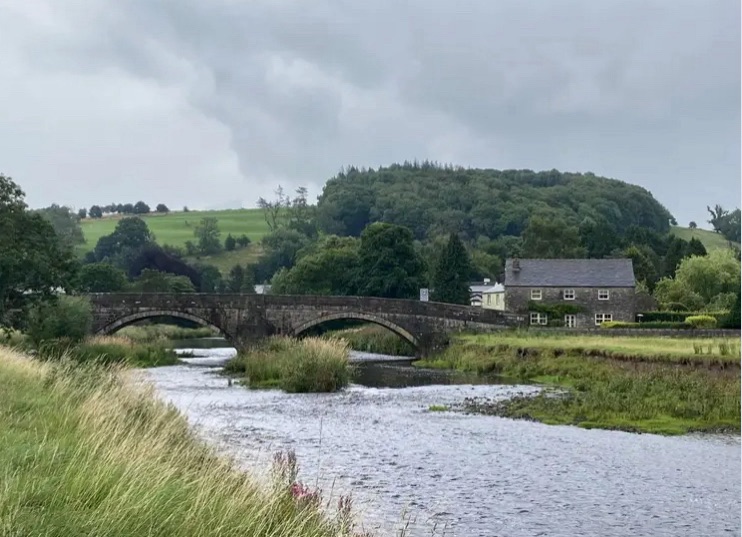
Parr, Smolts and Grilse
The salmon will head upstream over every obstacle to these favourite places to spawn every year, as they should have both the shallower, more sheltered areas which fry will inhabit once hatched, whereas ‘parr’, which is the name for salmon which are in between the fry and adult stages, can find the pools and deeper parts which are a kind of nursery for them for the next 2 years until they develop the physiological changes, called smolting, needed to move back down the rivers into the sea.
When fully developed and fattened up on a diet of insects, larvae, fish fry, molluscs, Crustaceans etc these ‘smolts’, as they are called when completing their change, follow a deep and ancient instinct to head downstream to the sea, whereupon they will unerringly find their way to the rich feeding grounds of the Norwegian Sea, where they will dine upon krill, shrimp and smaller fish.
After a winter’s season at sea they are known as ‘grilse’ and they begin an epic journey back home to spawn in the very same waters in which they were born, though only an estimated 10% will make it.
On their way they face innumerable perils , man-made and natural, including;
- Physical obstructions; dams & weirs
- Agricultural pollution; fertilisers, slurry run-off, etc
- Industrial pollution; micro-plastics, toxic chemicals etc
- Domestic pollution; micro-plastics, household cleaning products, sewage etc
- Silt and disturbance from construction projects such as housing schemes
- Predation, from Heron, Cormorant, Merganser, Otter etc
This list is not exhaustive and Salmon fishing aficionados and riverine ecologists argue a lot about which threat is the greatest, but they will agree on one thing, and that is the danger that physical obstructions pose, as they cause silt and material to smother redds and lead to Salmon becoming physically exhausted as they try to negotiate them.
With this in mind several organisations are working to remove obstructions such as defunct weirs, water gauges and other modifications from our rivers, or install fish passes or ‘ladders’ to circumvent them, the Ribble Trust is one such body, this summer they river the last of 8 barriers from the River Douglas catchment, a huge undertaking which will benefit the entire ecology of this river system enormously.

(Alexander P Kapp)
Where and when to see or catch
You have to really know your time and weather to catch a Salmon, by camera or fly, early mornings and evenings from October to December are best, a period of rain after a dry spell providing the perfect conditions for salmon to leap as does a sudden influx of fresh stormwater from hills upstream. When you’ve picked out a good time the best locations are those with small waterfalls and weirs that they will famously leap over in their drive to breed.
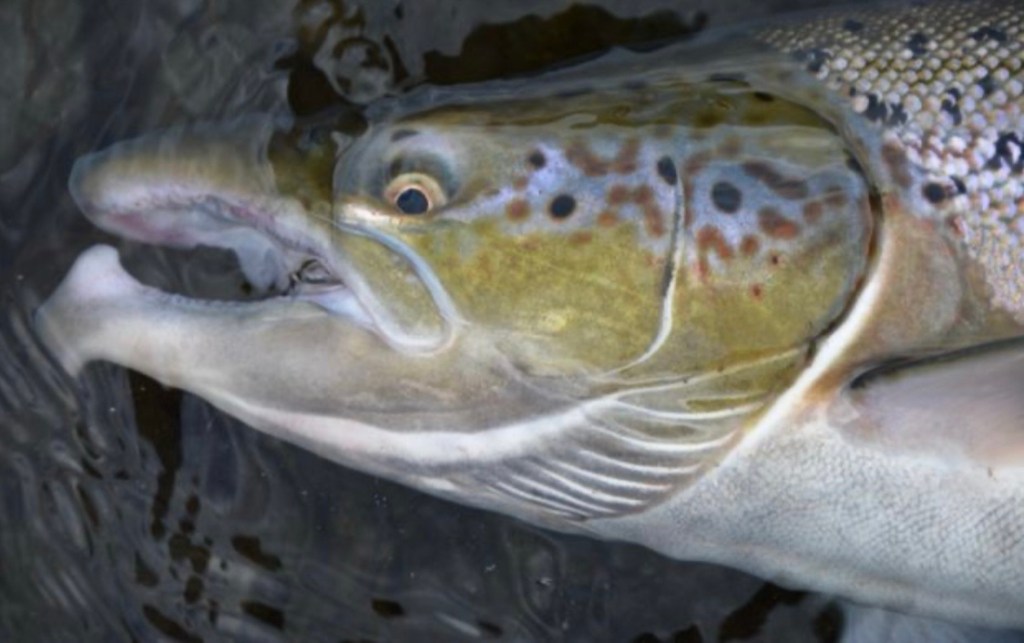
Rather peculiarly Salmon can be caught by presenting attractive-looking lures before them, called ‘flys’, hence ‘flyfishing’, this is odd and has baffled piscatologists for centuries for they do not eat when they have entered a freshwater course, so there is no reason for them to snatch up these multi-coloured bits of tinsel and feather like they do.
But they do anyway and the sport is partaken by hundreds of thousands of people in the UK who spend millions of pounds in angling shops and clubs to take part in a tradition which has existed since at least 1496 and which is ranked as the 19th most popular sport in the UK.


a traditional fly for clearer waters
Fishermen can find several good salmon fishing rivers in the northwest including the Ribble, Border Esk, Ure, Hodder, Derwent, Lune, Wyre and the Eden and many lodges to stay at too.
This site has the fishing seasons for england but different rivers have different byelaws, these are the byelaws for Wyre and this is the official site for byelaws for the north west.
If you would like to learn a bit more about Salmon fishing you can’t go wrong with watching this documentary series by keen sportsman and England football manager Jackie Charlton;
Evening Fishing on the River Ribble, by Hilary Roper
Slurp of the cows drinking,
Flick flies with their tails.
Surreptitious cast, sneaky and fast,
Line whipping the air with a rasp.
Cow-pat river, green-brown as it flows,
He’s fishing for salmon, I know.
Fat yellow, red flies with a speck of white,
Salmon might rise to his delight.
Mallards amidst marigolds,
Ancient stones and rabbit holes,
The Ribble runs like a snake you know,
Slides along whipping the land as it goes.
Summer birds trill, evening aglow,
Orb in the sky sheds a golden glow.
River in flush across rain fed ford,
Salmon is running with the Lord.
A heron pokes the water, a long beak stab,
It takes the minnow with a definite grab.
Swifts they dive high this evening,
The river is running and racing.
Cows snort, waddle and mow,
Each rivulet runs into the big flow.
Silverweed, dockweed; mounds for moles.
Mallards middling above the shoals.
Salmon are only interested in their spawning grounds,
Whilst the pools twirl in widened rounds.
Water races across sluggish pools.
Trust me; the fishermen are no fools.
He casts across the river span,
Pools spin across river fan.
Silt, slash, sodden and suck,
Rings of pools around the ducks.
Through the liquescence, mist magically rises,
Like a lacy shroud in disguises.
Her menacing fingers across the sink.
Leaping salmon are hidden in the drink.
The misty lady fingers the creeks,
Everything humid and white sneaks.
Her fingers fumbling the forest’s floor,
In the heat of the golden core.
Sauntering river stop teasing,
Pied treasures wavering.
Trout and salmon rushing fine,
But for the pull of one tight line.
A B-H
(Oct 2024)
 Northwest Nature and History
5 thoughts on “The Salmon Run”