The Silver Birch
The Silver birch, Betula pendula, the ‘Lady of the Woods’, is a graceful looking deciduous tree which grows up to about 30m tall and flowers from around April to May, they are a short-lived species and rarely live beyond 100 years.
Its scientific name, betula, comes from the ancient Gaulish word ‘betu’, meaning bitumen, or tar, as the Gauls extracted a tar-like substance from the sap of the tree which they used, and is still used to this day, for pain relief and as a stimulant.

Widespread and tolerant
It is native to and found throughout the British isles in a wide variety of dryer habitats including woodlands, fell-sides and heaths and is able to tolerate a wide range of temperatures, on the continent its range extends as far north as the high Arctic tundra and south to the further-most reaches of the Iberian peninsula.
The adaptations that the Silver Birch has evolved in order to survive such temperature extremes include having narrow, flexible branches, which shed heavy snowfall rather than break under its weight and small leaves with a tiny surface area, which help them keep hold of water in dry winds.
The light colour of a Birch’s, paper-like bark reflects light too, which stops the tree from warming up in the daytime sunlight only to cool down too rapidly after the sun has set.

Betulinic acid
Rapid warming and cooling can cause stress damage to the cambium, which is the living layer of the tree found beneath the bark and around the heartwood, and the white colouration of the cell walls which reflects light and prevents this happening is due to an organic compound called Betulinic acid.
This compound acts as a waterproofing agent, which prevents frost damage, but it has the drawback of being highly flammable, if temperatures become high enough it can even become superheated and form clouds of highly flammable gas which then explode, this does make Birchwood very useful for lighting fires and it does crackle very nicely on a log fire!
Recently scientists have been looking into the use of Betulinic acid in fighting certain types of tumours, including malignant melanoma , although native peoples have know for many years that Birch sap has many healthy properties.

Catkins
The Silver birch is a monoecious plant, meaning that it produces both male and female flowers on the same tree, both flowers are arranged as a catkin (‘little cat’), so-called because they resemble a kitten’s tail.
You can see both catkins in the image below, the male flowers are long, yellow/brown catkins which hang in groups of two to four, these appear in autumn and remain on the tree all winter, only opening around April to May, female catkins are smaller, shorter, green, stick upwards, and appear in spring along with new shoots.
Pollination happens via pollen spores being blown from the catkins by the wind, and can be responsible for allergies in susceptible people, afterwards the catkins become browner, thicken and tiny, winged seeds are produced in huge numbers that are also dispersed by the wind.

Firewood and brooms
The tree’s attractive appearance and the fact that it is tolerant of dry conditions and temperature extremes means that it is widely planted as an ornamental or garden tree, and it is very common in the wild too, accounting for over 7% of our total woodland area.
The timber of the Silver Birch is pale brown, almost white in colour, finely textured, and straight-grained, it has similar properties to, but lacks the durability of, Oak, it is also very easy to work with and turn.

This makes it commercially useful for manufacturing furniture, plywood, pulp, and it is increasingly grown purely for firewood, especially since log-burners became fashionable. Traditionally the twigs were, are still are, used to make hurdles for horse-racing and sweeping brooms or ‘besoms’.
Silver birch are also planted to improve soil quality, as its roots grow quite deeply and extract nutrients from the bedrock and lower soil layers into the leaves and branches, which are then reintroduced to the upper layers of the soil when the leaves fall and the tree dies and decays, although it doesn’t grow well in soils with low Phosphate levels.
Its tolerance to cold weather also makes it useful as a ‘nursing tree’, planted strategically in new plantations to shelter less hardy species such as Beech, Oaks and Conifers.

Importance in conservation
Upland Birch woods are now classed as a priority habitat under the U.K. Biodiversity Action Plan due to the sheer number of species they support and the uniqueness of the habitats an established Birch Wood sustains. The characteristically light canopy of a Birchwood allows woodland plants and grasses such as Wood Anenome, Bluebells, Wood Sorrel, Lesser Celandine and Violets amongst others, to flourish on the floor of a Birchwood.
The trees themselves support many species too, their sap attracts aphids which in turn attract birds such as Long-tailed Tits and Chiffchaff, the ripe seeds provide food for seed-eating birds like the Goldfinch and the leaves provide food for several moth species, including the ‘Angle-Shades’, ‘Buff-tip’ and Emperor moth, all-in-all a healthy, established Silver Birch Wood can support over 300 species of insects.
Silver Birch woods are also rich in fungi, the tree forming symbiotic relationships with species including Fly Agaric, several species of Milk cap, Birch brittlegill, Chanterelle and the Birch polypore, which is a member of an interesting group of fungi, called polypores, here is a a similar species that lives on oaks. Silver birch is susceptible to several damaging, non-symbiotic species of fungi as well, Melamsporidium betulinum, a type of ‘rust’ fungi, can badly affect a trees health, and it can be killed by ‘canker’ fungi including Discula betulina and Marssonina betulae and a type of ‘honey’ fungus; Armillaria.
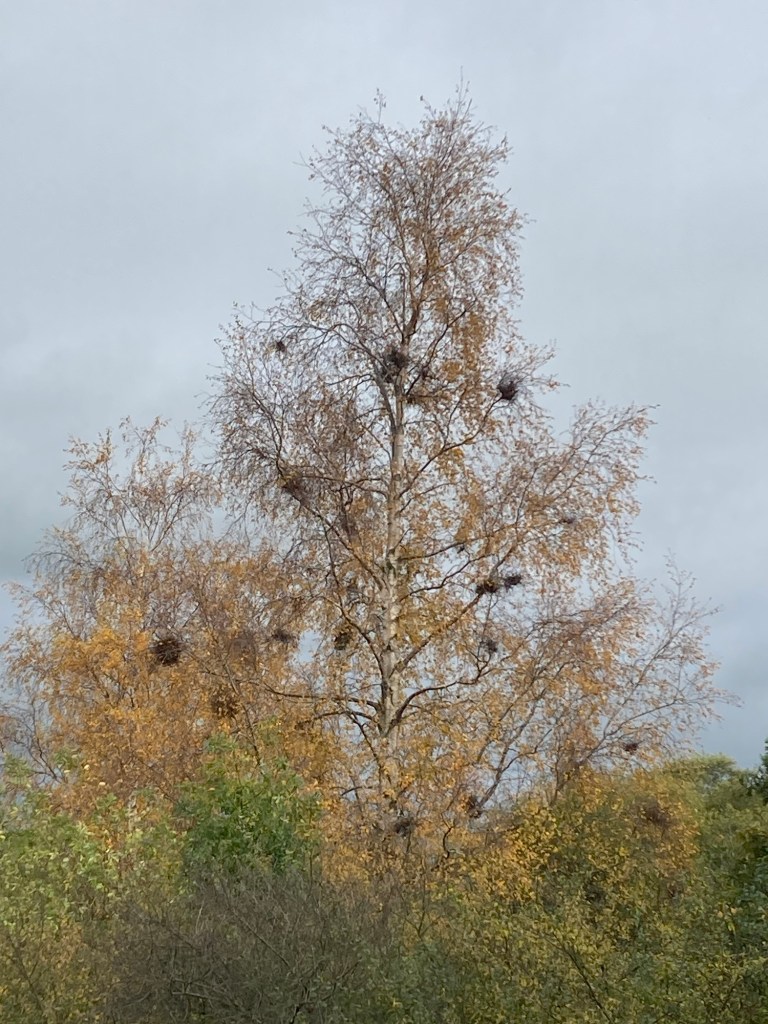
One species of fungi which infects the Silver Birch but does not kill it is a parasitic species, Taphrina betulina, called the Witch’s Broom fungus, as it caused abnormally dense growths of small twigs on the branches, which supposedly look like brooms, although they are more often mistaken for bird’s nests.

‘Walking had been easy, because his knapsack was nearly empty and he had no worries on his mind. He felt happy about the wood and the weather, and himself.
Tomorrow and yesterday were both at a distance, and just at present the sun was shining brightly between the birches, and the air was cool and soft’
(Snufkin in Tales from Moominvalley, by Tove Jansson)
A B-H
(Oct 2024)
 Northwest Nature and History
5 thoughts on “The Lady of the Woods and the Witches Brooms”