My wife is very good at choosing unique and fun presents, she has a knack for knowing what people like.
For Christmas she organised a day out for me drystone walling at Harwes farm, situated high on the hills above the town of Colne, on the Lancashire/Yorkshire border.
Harwes farm is a CIC, a Community Interest Company, focused on providing access to the countryside for educational and recreational purposes, with a strong emphasis on the natural environment, and as regular readers of this blog will know it’s exactly the kind of thing I’m into!
I enjoy my job, it’s a pleasant and very often fun place to work and the team there are almost like a second family, but if I can pick one fault, it’s that it’s situated entirely indoors and I’m not naturally an indoors kind of person, I’m happier outdoors, in the fresh air, wind, rain and in this case mud.
With this in mind and knowing my background Louise found this event on eventbrite and I booked it off work.
I woke up early on the day, 5:30am (though it’s when I normally wake up if I’ve got an early shift), and after breakfast walked across town to get the bus to Colne.
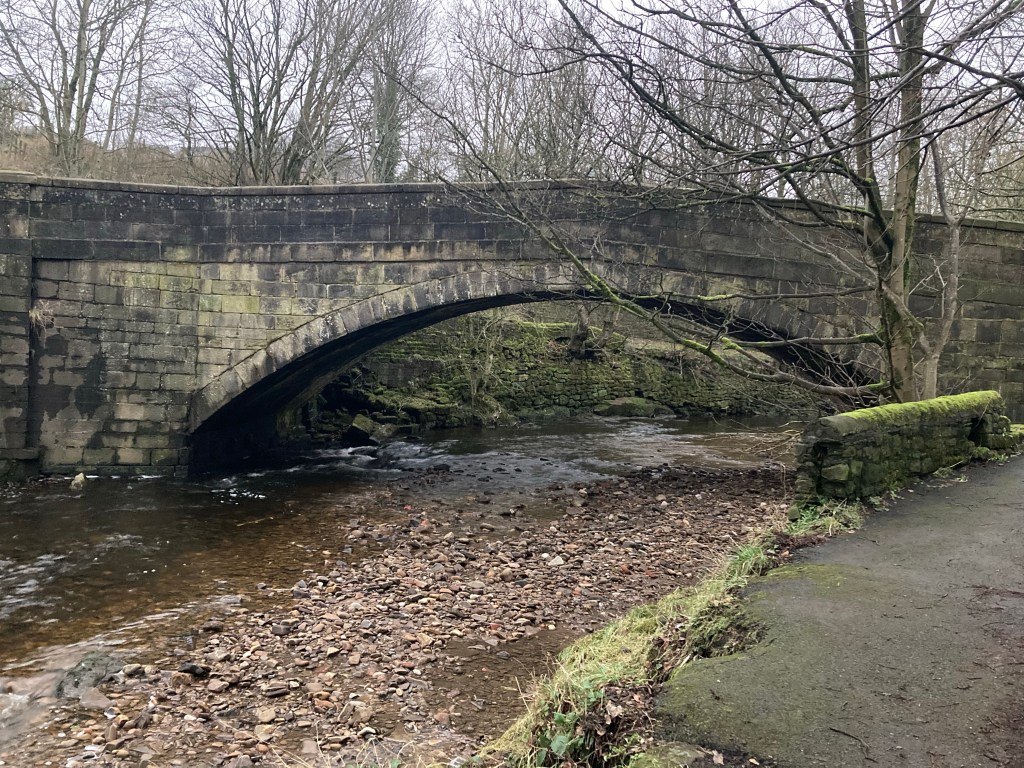
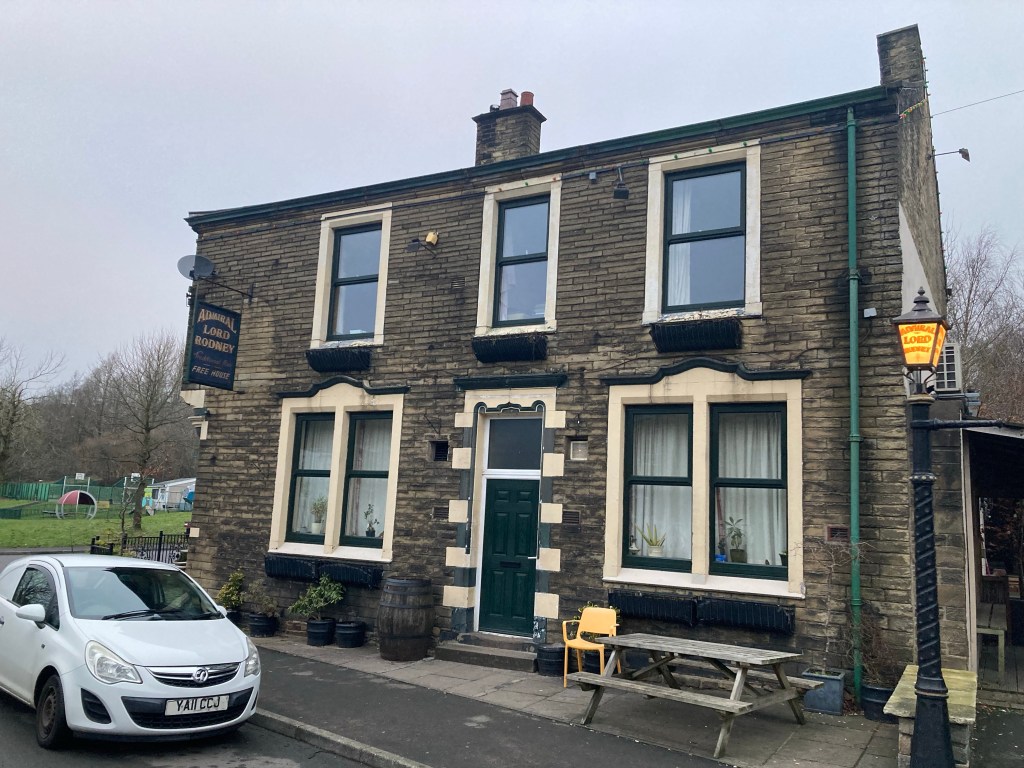
I got there early though so I went for a walk along Colne water, crossing over the Carry bridge (pictured below) over which Coal Pit Lane crosses, downstream, back over the Waterside bridge and past the famous Admiral Lord Rodney pub (which was obviously not open at 8am in the morning).
Back in the town centre I had a coffee at Wild’s café and got a taxi up Skipton Old Road to the farm.
I was a little bit trepidatious about the location of the farm, knowing it was quite high up and that some of the farms had been snowed in for over a week I wondered if the taxi would make it. These worries were unfounded though and the taxi made its way there with no problems, the only snow left was piled up melting in the lee of the walls, showing where drifts had laid several feet thick only a week or so ago.
I got the taxi driver to drop me off at Jerusalem farm, which is a bit nearer the main road and had somewhere for him to turn and walked up the rest of the track, getting there just before 9:30 where the founder and director of the CIC Gillian Taylor was waiting.
Once inside the cosy (and most importantly warm!) farmhouse kitchen Gillian kindly made me a rather tasty ‘Baabucks’ coffee and told me a bit about the farm and what they do there.

What do they do at the farm?
Their website covers the full spectrum of what the 57 acre farm offers, which Gillian told me includes workshop sessions, volunteering, corporate days, school visits, an event called YES, which is short for Youth Eco Summit and a whole lot more, but the activity I was there for was a Heritage Skills session of drystone walling.
After a short while Hugh, our course leader for the day, turned up followed by the rest of the event’s attendants and we set off across the fields to the stretch of wall which was being rebuilt.
On the way it was apparent that there had been some seriously big snowdrifts up here, as although it was a cloudy day with poor visibility you could make out distant strips of white which delineated walls on nearby hills. I commented that when the weather is clear the views must be quite beautiful and I’ll have to return to find out.
Hugh is from Donegal in Ireland, where the land, constantly swept by gales coming fresh off the Atlantic, is criss-crossed with tens of thousands of miles of drystone walls. I visited Donegal a few times when I lived over there myself and had vaguely placed his accent as from the northwest before he mentioned it, so I thought to myself beforehand that he would definitely know how to mend gaps in walls!
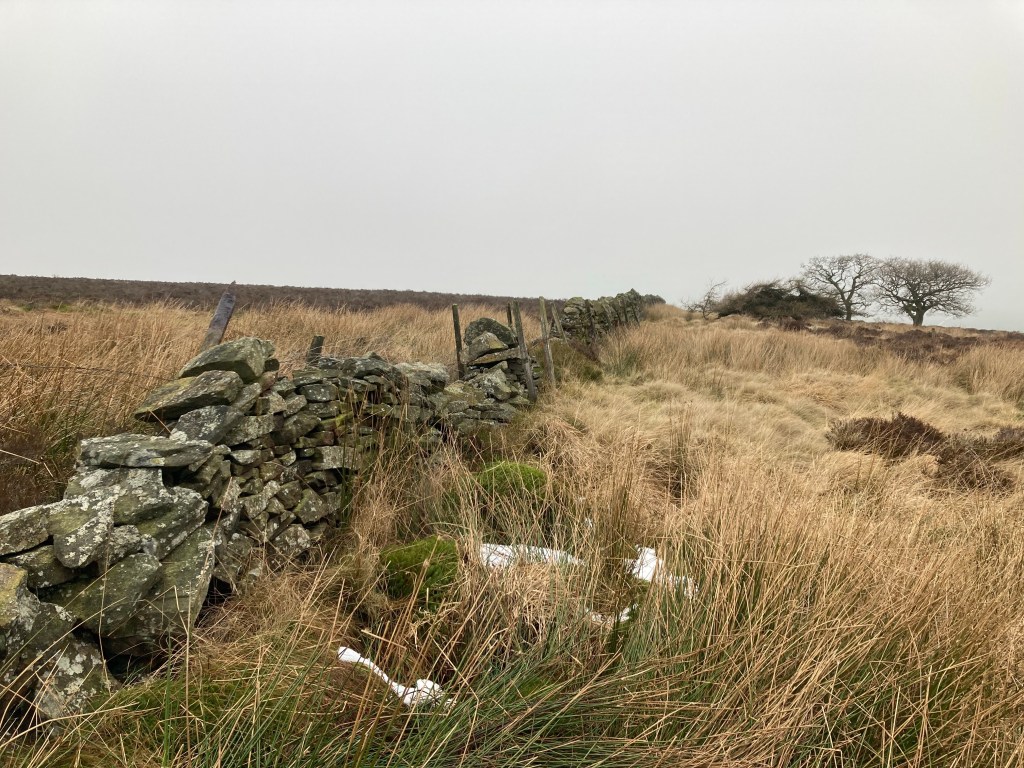
It turned out that he did and as soon as we had reached the spot, about half way up the 500 metre wall that they are restoring, which runs along the bottom edge of Kelbrook moor, we got to work.
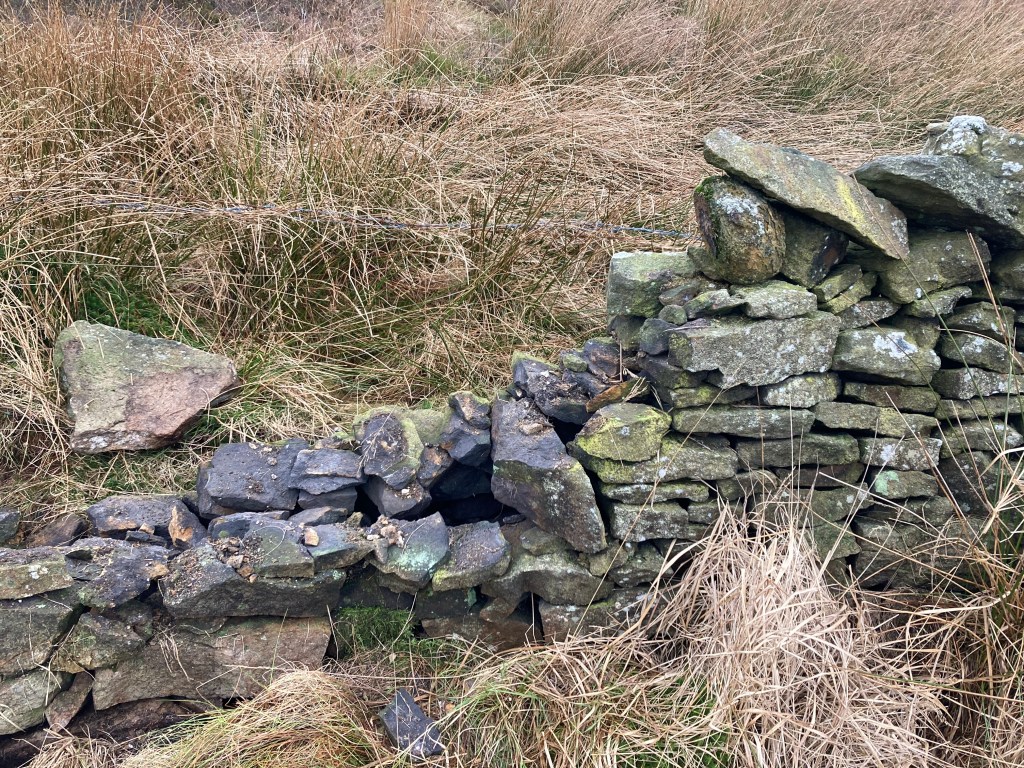
Crumbling walls
I’ve written about drystone walls before, having a bit of experience of helping farmers mend them and getting an NVQ level 1 at college, but I hadn’t done it in a while so it was good to work with an expert.
This wall, which separates an area of heather moorland from an area of Molina grass, bog rushes and scattered trees, has collapsed in many parts, its sandstone rocks weathering and crumbling. Over 200 metres had been repaired by groups like ours and we were continuing this work by tearing down the collapsed wall and rebuilding it behind us.
It appeared that the other groups had it lucky with their stretches as ours was the only bit that seemed to cross over a bog, do one of the first tasks was to remove the larger stones at the wall’s base and make a channel for the brackish, brown water to flow through.
These we placed to one side, some of the longer ones we used as ‘through’ stones, which sit across the width of the wall to tie it together, the largest ones, especially if they had suitable weather-proof surfaces, i.e: hard-not-crumbly, smooth, flat and sloped (see sketch below) we put to one side for use as ‘coping’ or ‘cap’ stones.
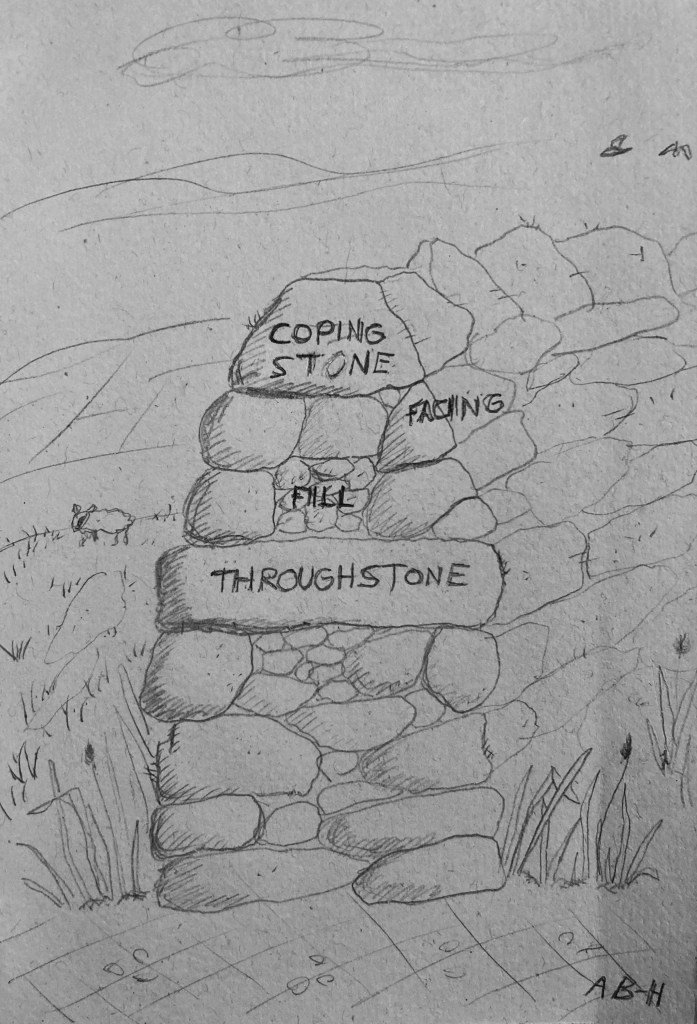
The sandstone here seemed particularly friable (easily crumbled) and those we found that were of no use as facing, (on the outside) coping, through or foundation stones were used as heart, fill or pin stones instead.
These fill-stones, which were sometimes so rotted that they would crumble to sand in your hand, supported the larger stones, providing contact points and preventing them from rocking, and filled the interior of the wall, settling in and stopping it from collapsing in on itself.
Once you have the knack you can identify and pick out the right stone for the next place instantly without having to sort through them, which would take up valuable time, then you can get a good pace going on.
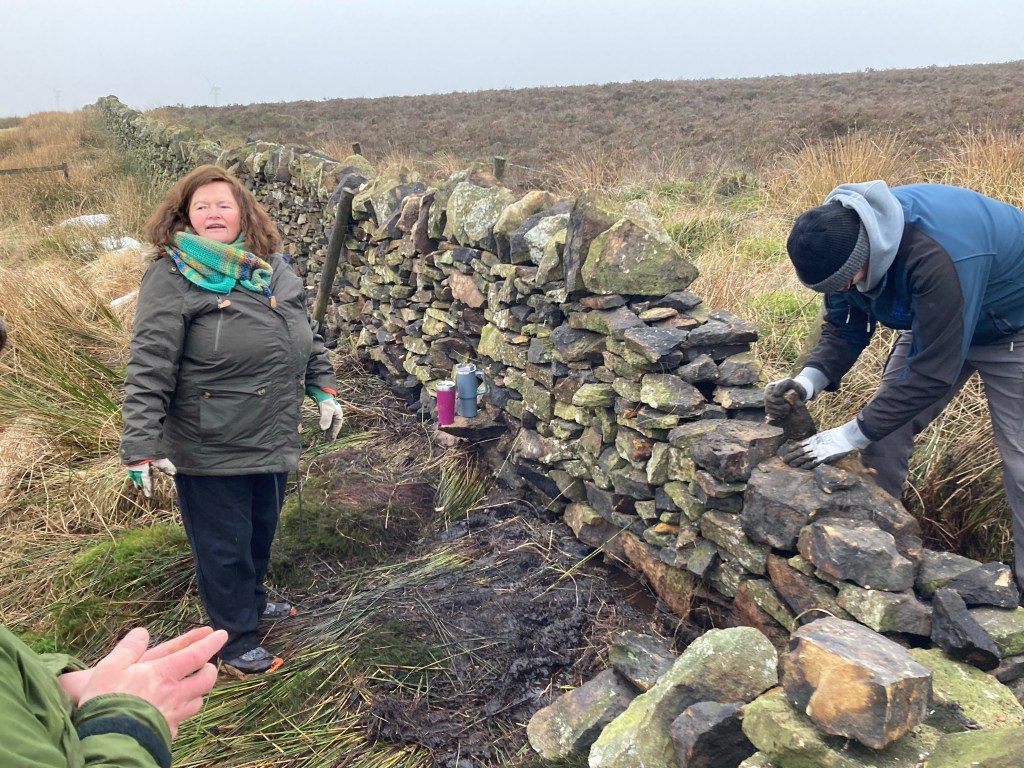
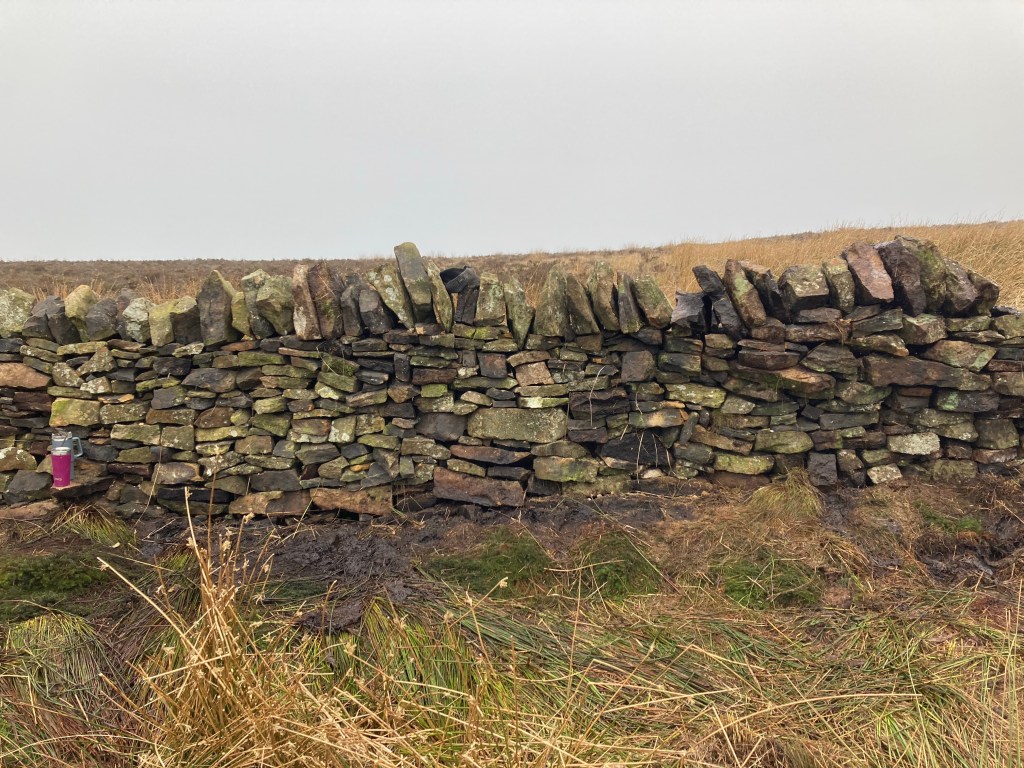
It took 4 of us about 2 hours to complete the 3 metre stretch of walk pictured below (starting where the flasks are in the photo) but a professional, left to their own devices without having to teach anyone, would have done this much or more in the same time.
We couldn’t rebuild much more of this stretch of wall because the gap between the rebuilt and collapsed stretches was becoming impracticably long and we needed larger stones to build a more solid foundation over the bog. We also needed to rebuild it to a slightly greater height so as not to not offer a chin-scratching opportunity for cattle which through doing so would knock them down.
We all learnt a lot at Harwes farm, I decided that I rather liked drystone walling but my back probably wouldn’t and I don’t really fancy developing the back problems a lot of countryside workers seem to have.
I also decided that I would try to get back up there for some of their future events, and maybe do some more volunteering elsewhere this year when work allows it.
I’ve done a bit of volunteering in the past, mainly for the National Trust and BTO and I really recommend it as a way of expanding your view of the world, learning new skills, meeting new people and getting some fresh air and exercise.
Here are some ways you can find volunteering opportunities near you, if you have any others let me know in the comments and I’ll add them here.
A B-H
(Jan 2025)
 Northwest Nature and History
Well that’s a different present – lugging great lumps of stone 😱
LikeLiked by 1 person