Part one of a series in which we look at Inheritance Tax Reform, the Land-Grab Theory and what it means for our Farms, Countryside and Food

Our Country was built by farming, our culture, our language, our villages, towns and cities, our very landscape all owe their existence to the thousands of years of blood, sweat and tears expended by those who worked the land.
We are a rich nation because of farmers and our political system owes its very being to them too, as symbolised by the Woolsack in the House of Lords.

The Woolpack
The Woolpack, or Woolsack, in the House of Lords symbolises the historical importance of the Wool Trade, hence farming, to the British economy.
Introduced by King Edward III, it reminds the lords of the wealth and prosperity derived from farming, as well as the nation’s economic reliance on its product. The Lord Speaker (formerly the Lord Chancellor) sitting on the Woolsack signifies this connection to Britain’s past economic strength through farming.
We would do well to remember that although the intricate threads holding our nation together are woven of wool from our fields it is our current crop of politicians and their insatiable greed for money and power that will unpick them.
And once unravelled that symbolic woolpack will be no more, and it will be replaced by a throne of Black Rock.
The Meeting before Budget Day
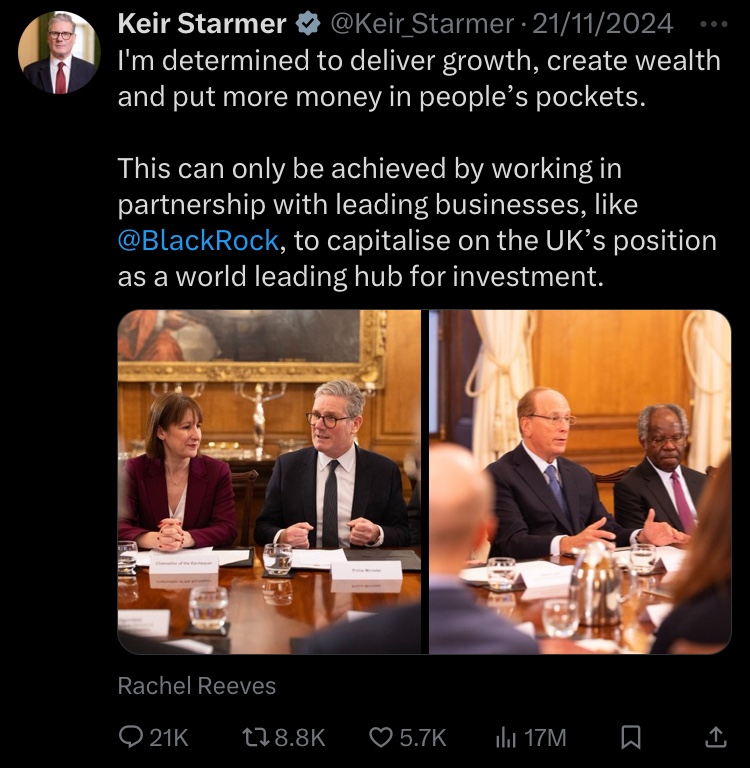
Before and after the last budget day, the first one of this the 11th term in which a Labour Prime Minister has governed the United Kingdom since the party’s foundation in 1900, our new Prime Minister, Keir Starmer, held two meetings behind the closed doors of Number 10 Downing Street.
In the first of these clandestine meetings, (for which Freedom Of Information requests have been denied*) Kier held court to the billionaire businessman Bill Gates, shortly after budget day, on November the 21st, he met with the CEO of Blackrock, Larry Finks.

*UPDATE: a response (of sorts) has finally been given to Lewis Brackpool’s request, see video below;
Blackrock and Bill Gates
Blackrock
Now Blackrock Inc are immensely powerful, founded in 1988 the global investment management corporation has a market capitalisation of approximately $161 billion and manages over $10.5 trillion of assets.
They are very heavily invested in Carbon Transition and Clean Energy, in fact they have stated; “It’s no longer a question of whether low-carbon transition will happen, it’s how”, and hold significant shares in numerous UK companies across various sectors including:
- BP plc: A major player in the oil and gas industry.
- Shell plc: Another significant energy company.
- AstraZeneca plc: A major pharmaceutical company.
- GlaxoSmithKline: Known for pharmaceuticals and consumer healthcare products.
- HSBC Holdings plc: A leading global bank headquartered in London.
- Unilever plc: A multinational consumer goods company.
- Vodafone Group plc: A major telecommunications company.
- Diageo plc: One of, if not the world’s biggest beverage manufacturer.
- National Grid plc: Involved in the transmission and distribution of electricity and gas.
- Bookers: a food wholesale company used by much of the hospitality industry and smaller shops.
- Nisbets: suppliers to hotels, restaurants, bars, cafes, schools, colleges, universities and others.
- Tesco plc: A British multinational grocery chain and one of the largest retailers in the world with over 6,800 shops across the world in countries including the UK, Ireland, China, India, Malaysia, Thailand, Czech Republic, Hungary, Slovakia, and Poland.
- Serco (see below)
- Cranswick plc: A British company known for manufacturing and supplying premium, fresh, and added-value food products.
- They primarily serve UK grocery retailers (like Tescos above), the food service sector (Nisbets, Bookers), and other food producers.
- Cranswick’s product range includes fresh pork, gourmet sausages, cooked meats, bacon, poultry, and various deli items. Cranswick is listed on the London Stock Exchange and is part of the FTSE 250 Index.
- Their East Anglian operation has recently been involved in a scandal after breaching environmental regulations 700 times in 7 years. (I’ll look closer at Cranswick in part 2)
Bill Gates
Bill Gates, the biggest owner of farmland in the US, whose best friend and business partner Warren Buffett once lost £444 million through investing in Tesco, previously met with Kier in 2022 to discuss climate change, he has investments in the following UK companies:
- Mission Zero: a start-up focused on building direct air capture machines to remove carbon from the air.
- Reactive Technologies: a company working on electricity grid stabilisation tools for renewable energy.
- Diageo
- Unilever
- Serco plc: This British multinational service provider, often referred to as the ‘biggest organised crime syndicate in the world’ specialise in defence, transport, health, welfare, justice and immigration.

Farmageddon
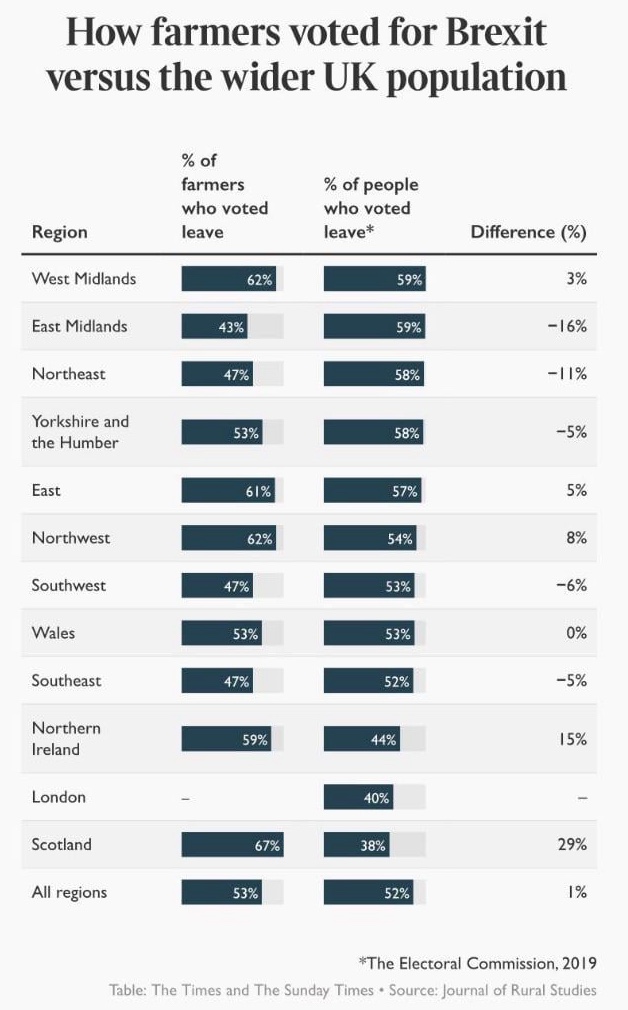
In recent years UK farmers have been under immense pressure due to a cataclysmic combination of factors including Brexit-related policy changes (see chart below for how farmers voted for brexit,) increased costs, labour shortages, and poor harvests due to bad weather.
Most recently changes made by the Labour Party to Inheritance Tax (IHT) which would impose inheritance tax on farms exceeding a £1m asset value, are forcing terminal financial strains on family farms which is leading to many being sold.
A break-down of what the IHT bill means for our farmers
The average UK farm is valued at around £2.3 million.
With the new IHT, £1.3 million of this would be taxable at 20%, resulting in £260,000 owed. (if there is a single owner.)
Spread over 10 years (if that’s the repayment option), that’s £26,000 per year.
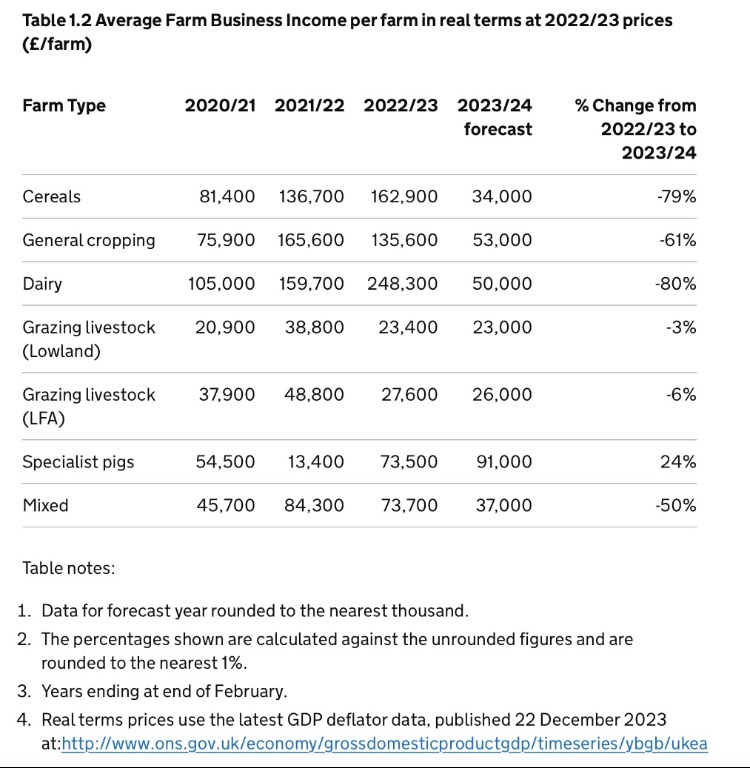
Now, let’s compare this to income: A 2022 study found that the average UK farm income was £72,000 per year.
If we take that as pure profit (of course in reality nearly all of this will be reinvested into the farm), around 36% of their profit would go to paying inheritance tax for 10 years.
This is a huge additional bill on top of standard business rates, when many farm businesses are already operating on razor-thin margins.

How do farmers pay the bill?
Farming businesses are not cash-rich, the value of a farm is tied up in the buildings, land and machinery needed to keep it running.
Other businesses may be able to pay IHT bills due to being able to sell off assets or draw funds from the business whilst keeping it operational, their accountants have well-used and oiled procedures and advise to give for this circumstance.
However most farm businesses cannot do this, this means that many families could be forced to sell their farms to cover this tax bill.
Who buys the land if they sell?
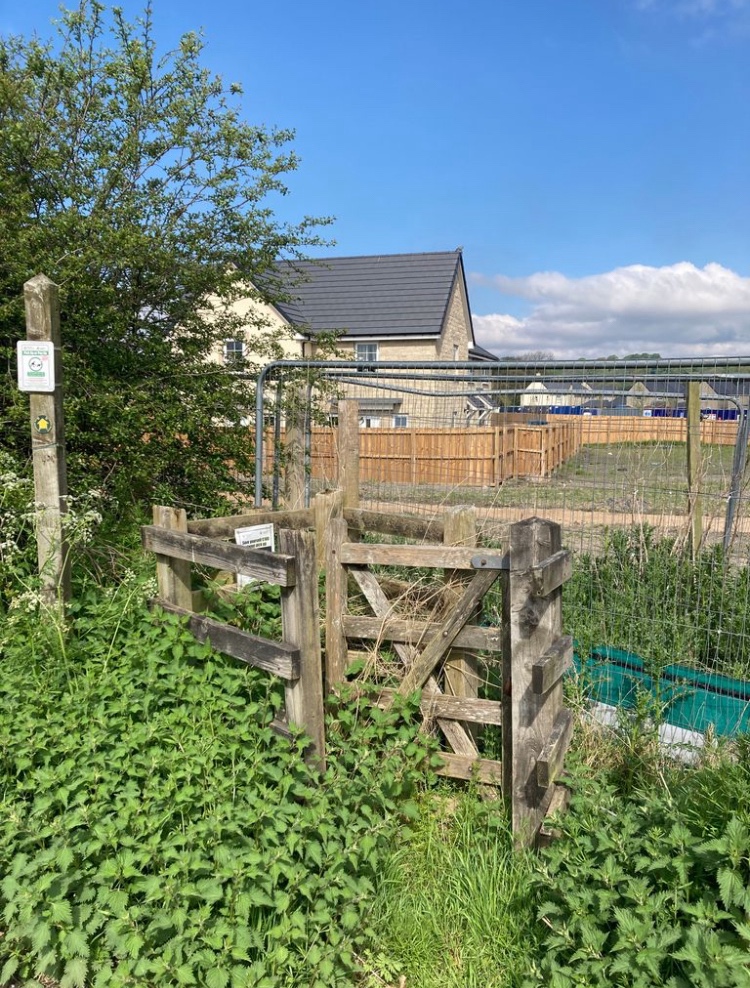
No SMEs (Small or Medium Enterprises) with any sense will be buying these small family farms, there is no immediate profit to be made, and the whole industry, including the farm-building manufacturers, the tractor and machinery dealers, the feed merchants, the contracting firms, small abattoirs, auction markets etc has been weakened .
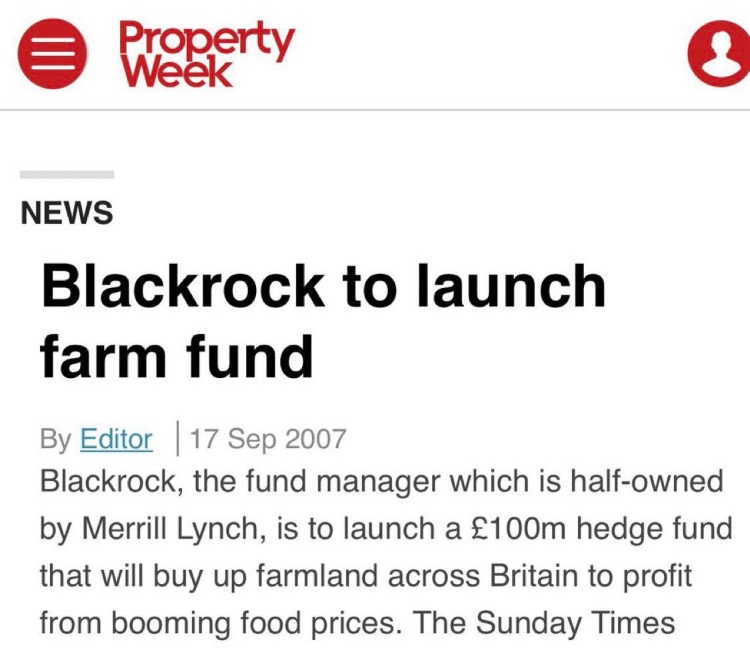
Therefore the only parties interested in buying will be large corporations or developers (such as Blackrock) with plenty of capital to utilise and the backing of major international banks inc. the Bank of England) which will either centralise food production or change it to something entirely different.
This has lead some spectators to theorise that the powers-that-be have long been planning and executing the extinction of Britain’s ancient farming way of life, destruction and rebuilding of the whole industry and wholesale expropriation of farmland to re-purpose for centralised and controlled food production and carbon-transition/clean energy, or ‘Net-Zero’.
It is without a doubt the biggest existential threat UK farming has faced since the Foot & Mouth outbreak 24 years ago (keep an eye open for news about F&M at the moment), it really does appear to be nothing but a land-grab.
Here we breakdown how this could happen into steps.
“Buy Land, they’re not making it anymore” Mark Twain (1835-1910)
The point that Mark Twain was making in the quote above is that land is a finite resource, our growing population of now nearly 70 million will require ever more food, electricity and room for housing but there is only 60 million acres to share.
This equates to 0.8 acres each but around 71% of the 60 million acres is farmland, green fields which the green eyes of messrs Starmer, Milliband, Gates, Finks, Vince et al have now set their avaricious gaze upon.

(UKCEH (UK Centre for Ecology and Hydrology)
The Land-grab theory; how will the corporations get hold of the land?
The ‘land-grab’ theory is one of the most widely accepted theories currently circulating, according to some spectators we are in Step One at the moment, let’s see how things play out.
Step One:
When farmers across the country are selling off their land as they can no longer afford to farm it Blackrock affiliates and subsidiaries, energy companies like Dale Vince’s Ecotricity (who have conveniently donated over £3 million to the labour party) and others, waiting like crows around a struggling ewe, will start buying up plots, readily paying over the normal price if they have to.
Step Two:
These third parties will then start bidding against each other to force the value of agricultural land up further.
Desperate farmers won’t believe their luck “These city folks are mad! if they want to buy an acre for £50K, who am I to say no to these fools!” is what you’ll hear down at the auction market or the pub.
These outlandish prices will set record high comparisons for agricultural land, so when a farmer dies, their farm will be valued using these new metrics.
The next generation will discover that the farm they thought was worth £3 Million is now worth £9 Million, and they don’t have anything close to the money needed to cover the tax on it.
Step Three:
At this point the crows will swoop in with ‘Agricultural Debt Finance Tax Relief’ products to lend them say 20% of the ‘value’ of their farm so they can pay these taxes.
This loan will come with conditions, or ‘covenants’ stipulating that the farm has to adopt and maintain certain prescribed practices. It will have to use fertilisers, software, machinery, finance and labour solutions supplied by Blackrock owned or affiliated companies.
These are to prepare the farm for interfacing with larger conglomerates.
Step Four:
When a farm cannot make its debt payments, which is almost inevitable, it will be sold at auction, but the crows will be instructed NOT to buy.
Instead they will have a special arrangement to buy the unsold farms at a rate that covers the unpaid debt plus outstanding fees and taxes to government, which will equate to what the farm was originally worth.
Step Five:
When the crows have taken over the farm, now fattened and finished up like a prime hogget, it will be consolidated into a larger group of farms, its future set in concrete forever and backed by Blackrock’s trillions.
Machinery set in place
The machinery to operate these conglomerates will have been set in place by this stage, like clockwork gears just waiting for the key to wind them.
Markets
Several large companies will be involved in marketing of these super-farms, for now let’s look at the biggest by far; Tesco (I’ll look at some of the others in part 2)
Seeing as Blackrock already own most of the UK’s largest supermarket chain; Tesco, there is already a well-oiled distribution, marketing and retail apparatus set up for the produce of the farms and the ‘clean’ electric from the solar and wind plants.
As I’m writing there is news that Tesco are already setting up low carbon farms, so this is one way the gears of this machine will mesh together.
Here is a list of some companies that Tesco owns along with a description of what each does:
- Tesco Bank: This arm of Tescos already offer a range of financial services including credit cards, loans, savings accounts, insurance, and mortgages, so although they don’t offer the ag loans now it would not be a stretch for them to do so.
- Bookers: This is a food wholesale business acquired by Tesco in 2018. They operate several brands including Budgens, Londis, Premier Stores, and Euro Shopper, which are franchises providing food and convenience retail services, any restaurant you have ever eaten at, no matter how many stars it has, will have bought stock from Bookers.
- Dunnhumby: A data science company providing customer data analysis for retail strategies, loyalty schemes, and marketing. They developed Tesco’s Clubcard.
- Dobbies Garden Centres: Purchased by Tesco in 2008, Dobbies operate garden centers across the UK, selling plants, horticultural and gardening supplies.
In Part Two I’ll delve deeper into the roles of the companies and names mentioned above and how they will mesh together in the greater machinery of things, look at the ongoing battle between farmers and the government vis-a-vis IHT and proposed changes to it, and I’ll also uncover some of the other parties that are involved in this take-over of Britain’s farms and countryside.
A B-H
(Feb 2025)
 Northwest Nature and History
Hi Alex
Interesting blog! I just have one correction though: BlackRock was founded in 1988. My ex was head of their UK equities operation for many years…
By the way , if you could find a way to give our wind farm campaign’s petition to parliament a push we would be really grateful. We had good numbers for the first three weeks, but things are dropping off now. We’re trying to emphasise that it’s a national campaign to ban wind farms on protected peatland. Here’s the link:
https://petition.parliament.uk/petitions/701290 https://petition.parliament.uk/petitions/701290
All best – and looking forward to Part Two
Lydia
LikeLike
Hi Lydia, thanks for the correction (i have to confess i rushed this a little bit to publish it this weekend), i will share the petitions on my social media accounts, i hope that helps and if there’s any other way you think i can help please let me know,
All the best,
Alex
LikeLike