
(Louise B-H)
The Flowers of Gorse, Bright and Bold, Paint the Landscape with Strokes of Gold
Also known as ‘furze’ or ‘Whin’, Gorse, Ulex europaeus, is an exceedingly spiny evergreen shrub with an abundance of aromatic yellow flowers and a familiar sight across the Northwest of England, from the windswept mountainsides of the Lake District to the coastal dunes of the Fylde coast and Formby.
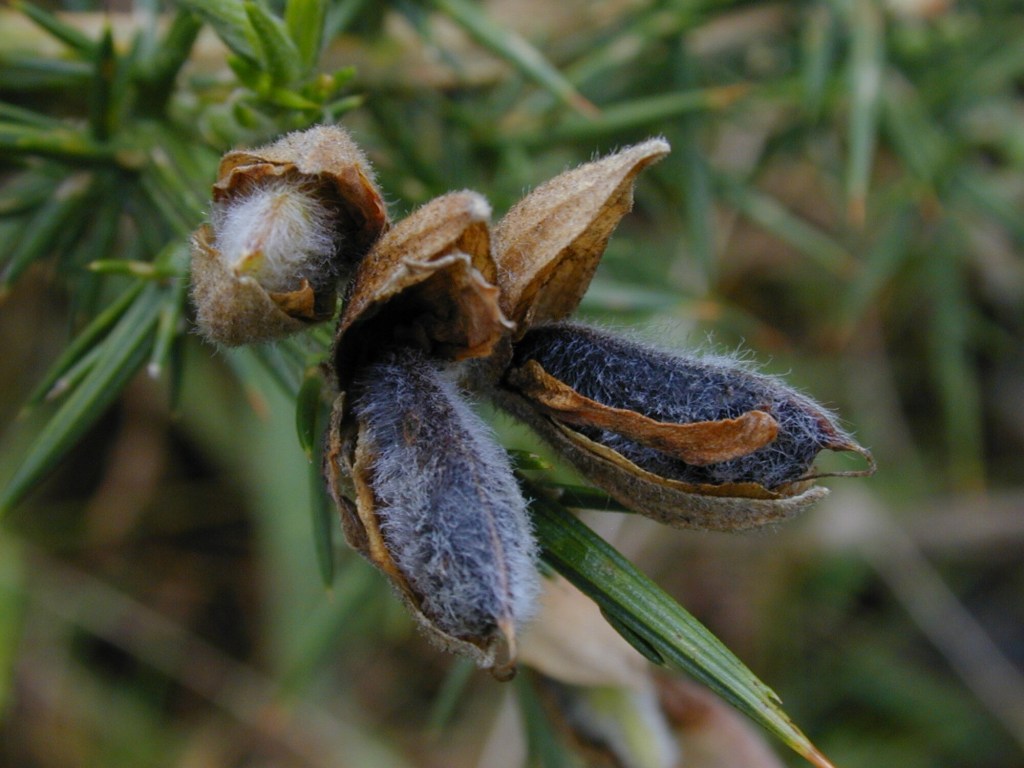
It is, believe it or not, a member of the pea family, you can tell this by looking at its dark purple/brown seed cases, which burst open in the summer to release seeds, and there are two other species found in the British isles; Western Gorse Ulex galii and Dwarf Gorse Ulex minor.
Successional Species
A master of survival Gorse is perfectly suited to the Northwest’s often harsh climate. Its prickly, needle-like leaves deterring grazing animals and reducing water loss, allowing it to flourish in exposed, nutrient-poor soils where other plants might struggle.
The plant’s ability to fix nitrogen through its roots also enriches the soil, making it a pioneer species that paves the way for other vegetation in barren areas like heathlands and coastal cliffs.
Plant species that fill this role are called ‘successional’, as they appear during ecological succession, the process where plant communities change over time following a disturbance or the creation of new land. These plants are typically adapted to specific stages of succession; early successional plants (like grasses or weeds) colonise bare or disturbed areas quickly, while late successional plants (like trees) establish later as conditions stabilise.
Gorse fits somewhere in the middle of this process and is a perfect example for the key role it plays in rebuilding ecosystems by altering soil, light, and habitat for other species.

“When gorse is out of bloom, kissing’s out of fashion”
The golden blooms of Gorse will brighten the landscape throughout the whole of the year if the winter is mild, a phenomenon that inspired the old saying, “When gorse is out of bloom, kissing’s out of fashion.”
This near-constant flowering adds a splash of color to the region’s often grey and overcast climate and provides a very welcome source of food to early emerging pollinators like Bumblebees, which can sense its glorious, almost tropical, coconut scent from a wide radius.
They are immensely useful for us too and have been used to treat a wide variety of ailments including colds, sore throats, tuberculosis, asthma, heartburn, hiccups, jaundice, heart problems, dermatitis and ringworm.
Because of this Gorse is one of the 38 plants included on the Bach Flower Remedies list, as a remedy for ‘hopelessness and despair’, which seems appropriate considering that its blooms can brighten up the gloomiest of days.
The flowers are also used to make a wine and for dying textiles, in particular Tartan (I’ll publish a recipe for Gorse wine soon).
Historically, the whole of the plant was useful, as its dense, thorny growth made it a natural livestock barrier, and its woody stems were harvested for fuel, particularly in rural areas where timber was scarce.

Ecologically, as well as providing a food source for wildlife its spiny, almost impenetrable, foliage provides shelter, especially for nesting birds like the Grasshopper warbler, which you may hear churring away in the depths of a Gorse bush from the end of April in quieter parts of the countryside. (the banks of Stocks reservoir are a good site to hear this species)
This tenacious, entangled, spiny nature might make Gorse windproof and prevent grazing by all but the hungriest of animals, but it causes it to pose somewhat of a challenge for land managers, especially as it has become invasive in many areas, spreading rapidly and outcompeting native plants.
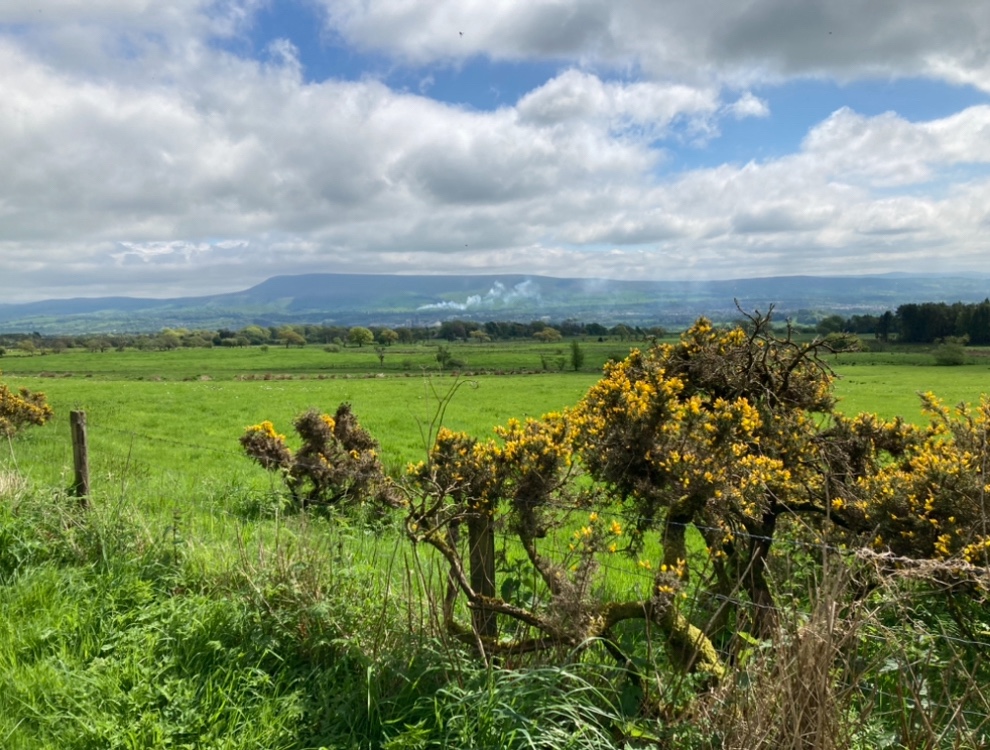
(Ribble valley, author)
Flammable Foliage
The flammability of its oily foliage means that Gorse can pose a high fire risk, particularly during dry summers, a concern that has grown with changing climate patterns.
Land managers often work hard to control its spread, but as it resists grazing this has to be done by burning or cutting it back. Controlled burning is a highly contentious practice which many cannot countenance, due to concerns about Carbon emissions and public perception, so it is almost universally managed by cutting now.
Yet the option of cutting is not entirely without its cons; those petrol-powered chainsaws, brush-cutters, mowers and the vehicles needed to transport them, are not entirely ‘green’ themselves, so it can be quite difficult for land managers to balance the ecological benefits of Gorse with the need to protect biodiversity.
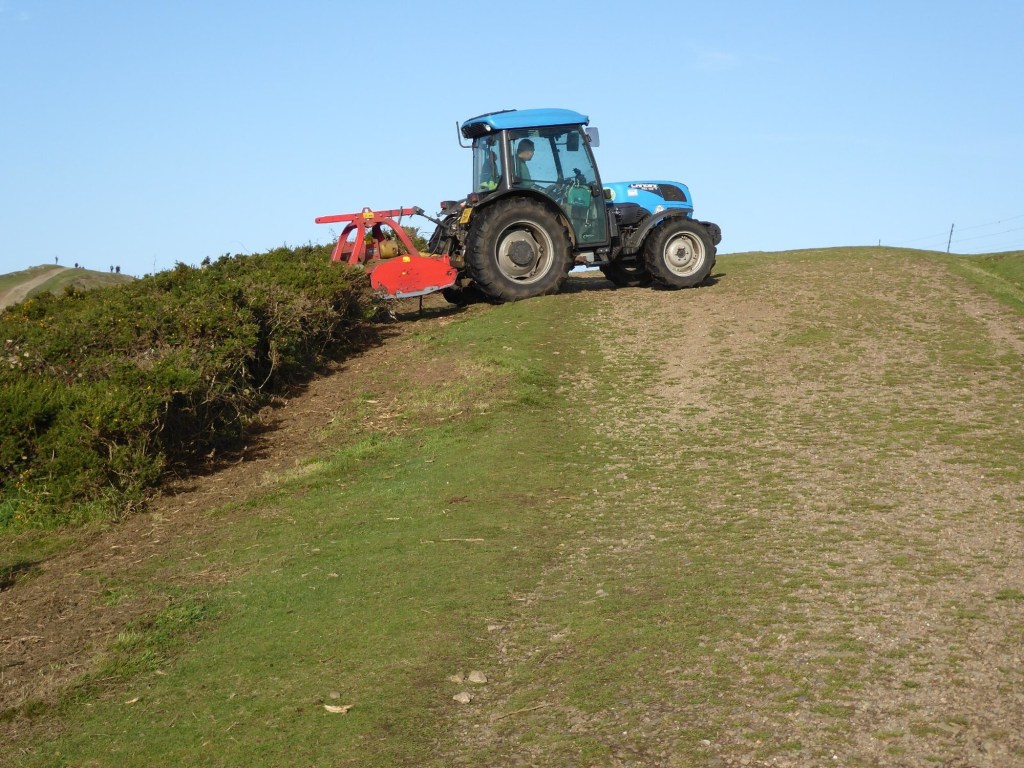
(Phillip Halling)
This is something I know of all too well having spent many hours cutting it back on the sand dunes of Murlough and the cliffs of Bloody Bridge in Co Down, where it encroaches on rarer habitats and footpaths. On one memorable and (for my colleagues at least) hilarious occasion I fell off the back of a National Trust pickup and ended up in a predicament very much like the stuffed character at the end of this article. (this is a story I’ll recount in my Up in Down series)
The tradition there and in the rest of Ireland is to burn it back over winter, and despite this being frowned upon many farmers still practice this today, applying for licences so they can control its encroachment and reclaim lost grazing land.
This is thought to have been the cause of the Mourne conflagration in April 2021 when Gorse on the fringes of the mountainsides was set alight, as it is every year, and the flames spread onto heather that had been allowed to grow thick and rank on the flanks of Slieve Donard by its new landlords the National Trust.

(James Allen)
Fingers crossed lessons have been learnt, there and on this side of the Irish sea, about the risks of Gorse fires in dry weather, and that land has to be managed, even in the case of rewilding, to prevent habitat destruction by fire.
“An Ambush,” said Owl, “is a sort of Surprise.”
“So is a gorse-bush sometimes,” said Pooh.
“An Ambush, as I was about to explain to Pooh,” said Piglet, “is a sort of Surprise.”
“If people jump out at you suddenly, that’s an Ambush,” said Owl.
“It’s an Ambush, Pooh, when people jump at you suddenly,” explained Piglet.
Pooh, who now knew what an Ambush was, said that a gorse bush had sprung at him suddenly one day when he fell off a tree, and he had taken six days to get all the prickles out of himself.
“We are not talking about gorse-bushes,” said Owl a little crossly.
“I am,” said Pooh.
Winnie the Pooh – A.A.Milne

A & L B-H
(March 2025)


Love the Pooh reference! We live in Down these days, know Murlough and can see the Mournes from our road.
LikeLiked by 1 person
Thanks, my wife found that though, I told her the story about falling off the back of the pickup when we were working on Murlough and she immediately thought of that!
I used to live in Dundrum and then Newcastle on the promenade so I know the area very well, my cousins come from Dundrum and my aunt was the first warden on Murlough, she’s probably the main reason I’ve always been interested in nature as I spent nearly every summer holiday there with her poking about the dunes. It’s an absolutely gorgeous part of the world.
LikeLike
We’re in the countryside closer to Banbridge, living with offspring. Our first visit to NI we stayed in Dundrum. Love it over here
LikeLiked by 1 person
Hi! Trying to grow my blog. Follow for follow back? I just followed yours. Sincerely, Mikayla Scotlynd Littrell (MetsMadness the blog)😄
LikeLiked by 1 person