
Deep in the heart of Lancashire’s Ribble Valley, under the shadow of Longridge Fell, sits stately Stonyhurst College, a 400-year-old Jesuit institution. It is home to many artworks and treasures, including one of the most revered relics in the Christian world; a thorn believed to be from the Crown of Thorns placed on Jesus Christ’s head during the Crucifixion.
Known as the Holy Thorn, this sacred artifact carries a remarkable history that intertwines royal lineage, religious devotion, and centuries of Catholic resilience in the face of persecution.
Here we explore the origins, journey, and spiritual significance of the Holy Thorn, as well as its place within the rich heritage of the college.
Origins and Provenance
The Holy Thorn’s story begins in the early Christian era, with the Crown of Thorns venerated as a supreme relic of the Passion of Christ.
According to tradition, the Crown was preserved in Jerusalem before being transferred to Constantinople in the 4th century.
During the Fourth Crusade (1204), relics from Constantinople were dispersed, and a thorn is said to have been acquired by Louis IX of France, the saintly king who built the Sainte-Chapelle in Paris to house such treasures.
In 1558, a thorn from this collection was gifted to Mary Queen of Scots upon her marriage to the French Dauphin, François.
Mary, a devout Catholic, brought the relic with her to Scotland, where it accompanied her through the turbulent years of her reign.
Following her imprisonment in England and execution in 1587, the thorn was entrusted to Thomas Percy, Earl of Northumberland, a loyal supporter.
Percy passed it to his daughter, Elizabeth Woodruff, who, in 1600, gave it to her confessor, a Jesuit priest named John Gerard.
This marked the beginning of the thorn’s association with the Society of Jesus, which would eventually bring it to Stonyhurst.

St Peter’s Church, the parish church and chapel for the college is on the right
(Peter Moore)
The Journey to Stonyhurst
The Holy Thorn’s path to Stonyhurst College reflects the broader history of the Jesuit order and English Catholicism during a time of intense persecution.
Stonyhurst’s origins trace back to 1593, when Father Robert Persons founded the English Jesuit College at St Omer in the Spanish Netherlands to educate English Catholic boys barred from receiving a Catholic education under Elizabethan penal laws. (read more about the history of the college here)
The college moved to Bruges in 1762, then Liège in 1773, before finally settling at Stonyhurst Hall in Lancashire in 1794, thanks to the generosity of alumnus Thomas Weld.
In 1660 the thorn arrived at Stonyhurst, likely brought by Jesuits fleeing persecution on the Continent. Encased in an exquisite reliquary commissioned by Elizabeth Percy around 1595, it is adorned with pearls said to have belonged to Mary Queen of Scots, thus enhancing its historical and spiritual allure.
Since then the relic has been preserved in the college’s collections, safeguarded alongside other treasures such as the Wintour vestments, a cope made for Henry VII, and manuscripts by St. Edmund Campion.

Spiritual and Cultural Significance
For centuries, the Holy Thorn has been a focal point for meditation and prayer at Stonyhurst.
Each year during Holy Week, it is displayed in the college’s chapel, inviting students, staff, and visitors to reflect on Christ’s sacrifice. The thorn, described as a stark reminder of the Crucifixion’s brutality, is shorn of its ornate reliquary during these moments to emphasize its raw spiritual power.
As Catriona Graffius, a former Stonyhurst student and now the Senior External Affairs Manager for the Tate, noted in a 2011 British Museum Podcast, the relic’s connection to Mary Queen of Scots and its annual veneration during Holy Week make it a living part of the college’s spiritual life.

The thorn’s significance extends beyond Stonyhurst, in 2011, it was loaned to the British Museum for the Treasures of Heaven exhibition, which showcased sacred relics of the medieval period.
Displayed alongside Vatican treasures and rare loans, the Holy Thorn stood out as one of only 15 extant relics believed to be from the Crown of Thorns, with another housed at Stanbrook Abbey in Worcestershire. The exhibition highlighted the relic’s historical journey and its role in medieval devotion, when relics were venerated as tangible links to the divine.
More recently, in 2022, the thorn featured prominently in Stonyhurst’s Hot, Holy Ladies exhibition, which celebrated the contributions of 16th and 17th century Catholic women who preserved the faith during England’s religious upheavals.
The exhibition underscored the thorn’s connection to Mary Queen of Scots and other women like Elizabeth Percy, who ensured its survival.

(pjposullivan)
The Holy Thorn Today
Today, the Holy Thorn remains a cornerstone of Stonyhurst’s identity as a leading Catholic institution.
The college, which educates approximately 450 students aged 13 to 18 and operates a preparatory school, St Mary’s Hall, for younger pupils, is renowned for its Jesuit ethos of intellectual rigor and spiritual formation. The thorn is housed in the college’s museum, which claims to be the oldest in the English-speaking world, with artifacts dating back to 1609.
In 2021 the relic also gained royal attention, when HM King Charles the Third contributed to Stonyhurst’s Easter Meditation by reciting gods grandeur by Jesuit poet Gerard Manley Hopkins. The meditation featured the Holy Thorn, emphasising its enduring relevance as a symbol of renewal and faith.

(Marathon)
A Relic of Resilience
The Holy Thorn of Stonyhurst College is more than a historical artefact, it is a testament to the endurance of Catholic faith through centuries of adversity.
From its origins in Jerusalem to its journey through royal hands and Jesuit stewardship, the thorn embodies a narrative of devotion, sacrifice, and preservation. At Stonyhurst, it continues to inspire students and visitors alike, serving as a bridge between the past and present, the sacred and the scholarly.
As Dr. Jan Graffius, curator of Stonyhurst’s collections, has said, the thorn invites us to “imagine the moment when a crown of cruel thorns was pressed onto the brow of an innocent man” in Jerusalem two millennia ago.
In doing so, it remains a powerful symbol of faith, history, and the long and enduring legacy of Stonyhurst College.

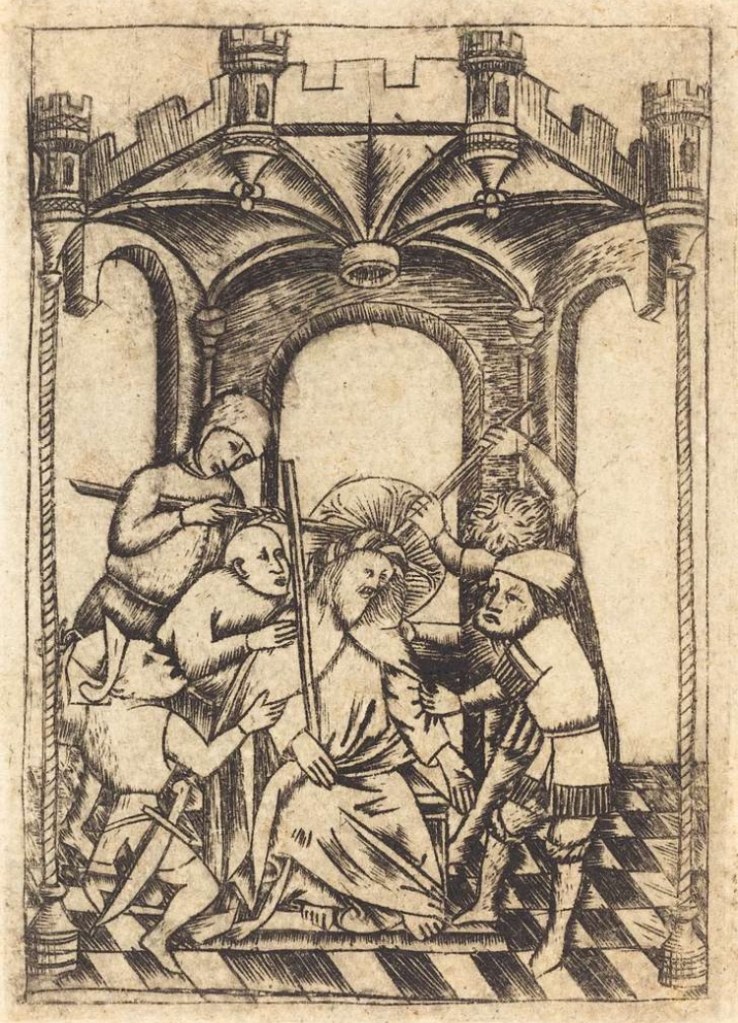
So Pilate then took Jesus and had Him flogged. And the soldiers twisted together a crown of thorns and placed it on His head, and put a purple cloak on Him; and they repeatedly came up to Him and said, “Hail, King of the Jews!” and slapped Him in the face again and again.
And then Pilate came out again and said to them, “See, I am bringing Him out to you so that you will know that I find no grounds at all for charges in His case.” Jesus then came out, wearing the crown of thorns and the purple robe.
And Pilate said to them, “Behold, the Man!” So when the chief priests and the officers saw Him, they shouted, saying, “Crucify, crucify!” Pilate said to them, “Take Him yourselves and crucify Him; for I find no grounds for charges in His case!” The Jews answered him, “We have a law, and by that law He ought to die, because He made Himself out to be the Son of God!”
John 19, The Crown of Thorns
A B-H
(April 2025)
 Northwest Nature and History